Ilona Marx
Editorial work / Concepts / Texts
Healing waters
Art & Culture
Painter Anna Kuen’s abstract canvases are heavily influenced by the landscape. Now based in Berlin, she escapes to Lake Liepnitzsee to swim whenever she can –and finds that it puts life back into perspective.
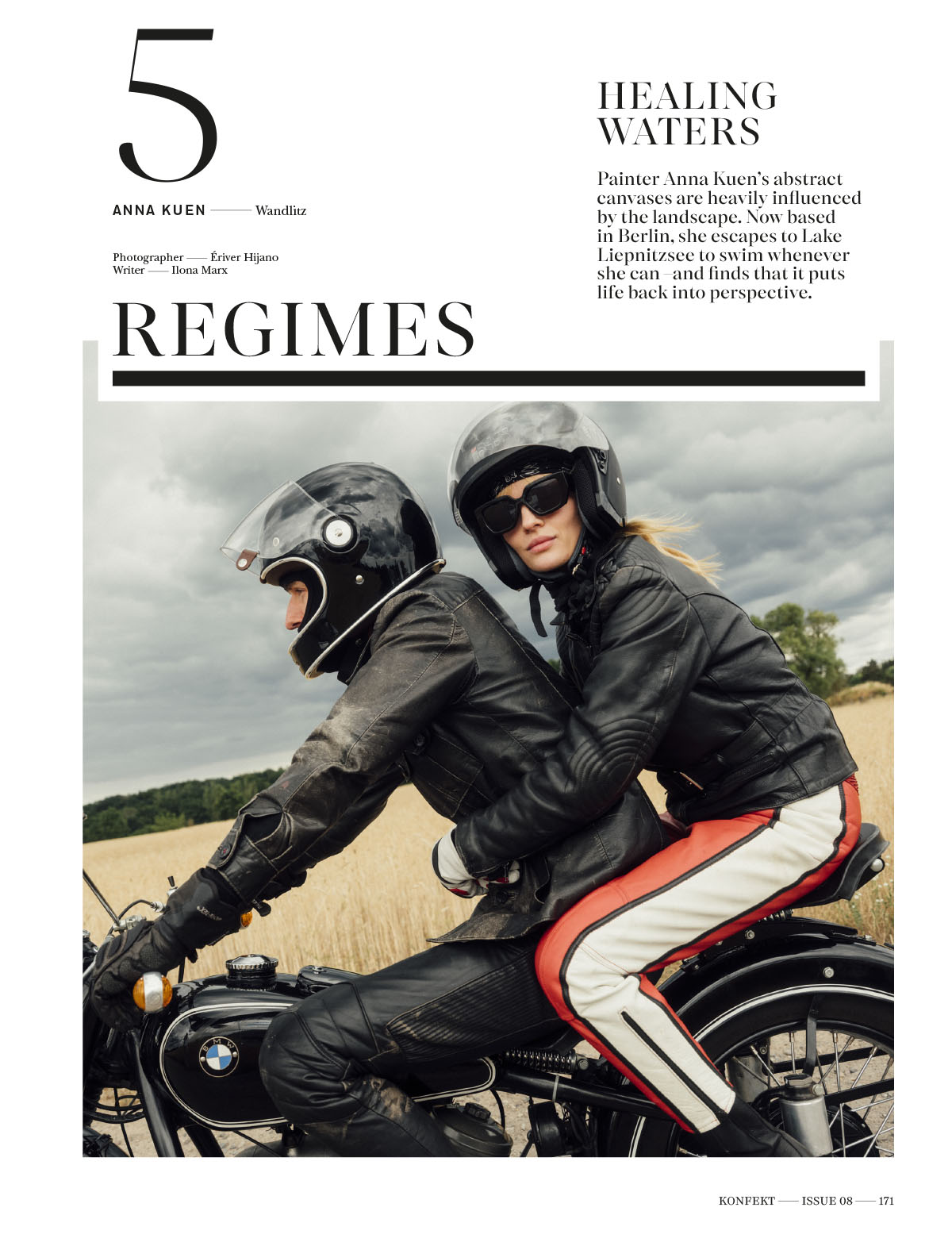
Its engine purring like a jazz singer at the end of a long set, the 1953 black bmw motorbike, with its elegantly curved tank and gleaming silver spokes, turns into a deserted carpark at Lake Liepnitzsee. Artist Anna Kuen climbs off the pillion seat, takes off her matte black helmet and large sunglasses, and shakes her layered blonde hair. She drove the 50 minutes from Berlin-Wedding this morning with her boyfriend, actor Johannes Schüchner, to go swimming and to show Konfekt the place where she loves to refuel. “It’s only 10 minutes through the forest now, then we’ll be there,” she says cheerfully, unzipping her black vintage leather jacket.
The morning is still cool. It promises to be a lonely swim. “We discovered the lake in the winter of 2019, shortly after we moved to Berlin,” says Kuen as we turn into the forest path. “Since then, we’ve come here in summer and winter for swimming and long walks.” We walk through tall beech trees as the morning sun fights its way through the clouds and foliage from time to time, dotting points of light on the sandy ground.
Lake Liepnitzsee belongs to the Wandlitz lake district and lies 9km north of the Berlin city limits in the Bernau district, surrounded by beautiful woods. It is it is fed by an underground spring and therefore considered to be one of the cleanest lakes in Brandenburg, which is rich in such bathing spots. The watershed between the North sea and the Baltic sea runs very close by; the water from Lake Liepnitzsee flows via Obersee and Hellsee, through the Finow and Oder rivers and into the Baltic, while the water of the nearby Lake Wandlitz runs via the Briese, Havel and Elbe rivers into the North sea.
After a few hundred metres, it’s a couple of steps down the embankment and along the shore on a wooden footbridge. The water shimmers green-blue through the reeds on our right. Then the forest thins out to reveal a sandy spot where there is a wooden table with two benches. “This is it,” says Kuen, lowering her backpack at the foot of an old oak tree. She slips out of her ankle boots, peels off her red-and-white leather motorbike trousers, revealing a white, classically cut swimming costume made from crinkled fabric.
Lakes and mountains define Anna Kuen’s biography. She grew up in the idyllic town of Burghausen in the district of Altötting in Bavaria, a place known for the longest castle complex in the world and its fantastic view of the Alps. “There, the nature is so beautiful and powerful that it takes your breath away,” she says enthusiastically. “I understand why faith is so firmly rooted there. Some natural phenomena in the mountains are so overwhelming that purely scientific explanations seem to fall short.” Kuen spreads her towel in the sand. “And in the middle of Burghausen is the Wöhrsee. From April to November we regularly went swimming there after school.” So when she moved to Berlin after studying art at the Academy of Fine Arts in Vienna, she was soon on the lookout for a place to swim. “But the lakes in the urban area of Berlin are too crowded for me. We’d rather take the drive and come here.”
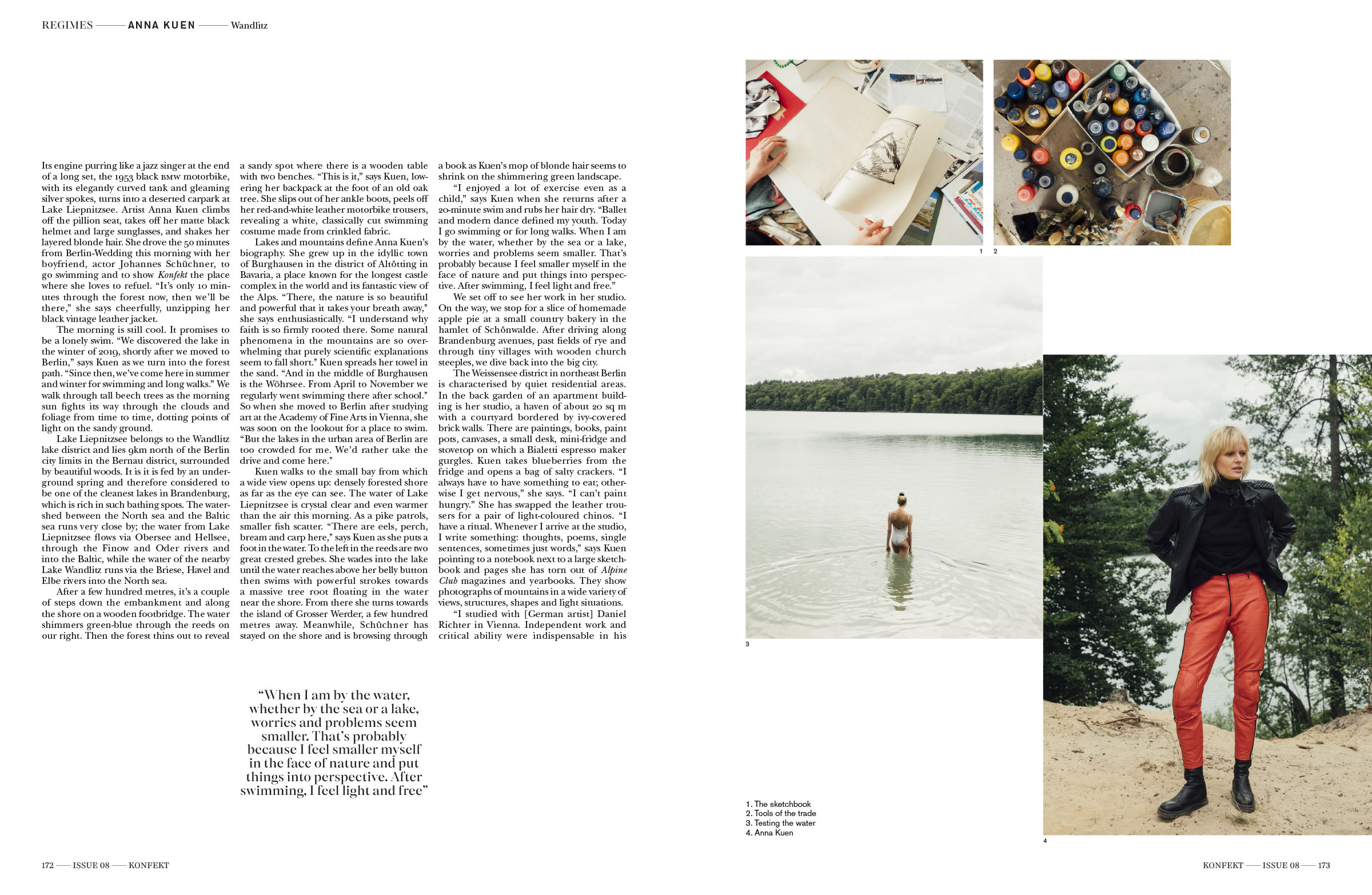
Kuen walks to the small bay from which a wide view opens up: densely forested shore as far as the eye can see. The water of Lake Liepnitzsee is crystal clear and even warmer than the air this morning. As a pike patrols, smaller fish scatter. “There are eels, perch, bream and carp here,” says Kuen as she puts a foot in the water. To the left in the reeds are two great crested grebes. She wades into the lake until the water reaches above her belly button then swims with powerful strokes towards a massive tree root floating in the water near the shore. From there she turns towards the island of Grosser Werder, a few hundred metres away. Meanwhile, Schüchner has stayed on the shore and is browsing through a book as Kuen’s mop of blonde hair seems to shrink on the shimmering green landscape.
“I enjoyed a lot of exercise even as a child,” says Kuen when she returns after a 20-minute swim and rubs her hair dry. “Ballet and modern dance defined my youth. Today I go swimming or for long walks. When I am by the water, whether by the sea or a lake, worries and problems seem smaller. That’s probably because I feel smaller myself in the face of nature and put things into perspective. After swimming, I feel light and free.”
We set off to see her work in her studio. On the way, we stop for a slice of homemade apple pie at a small country bakery in the hamlet of Schönwalde. After driving along Brandenburg avenues, past fields of rye and through tiny villages with wooden church steeples, we dive back into the big city.
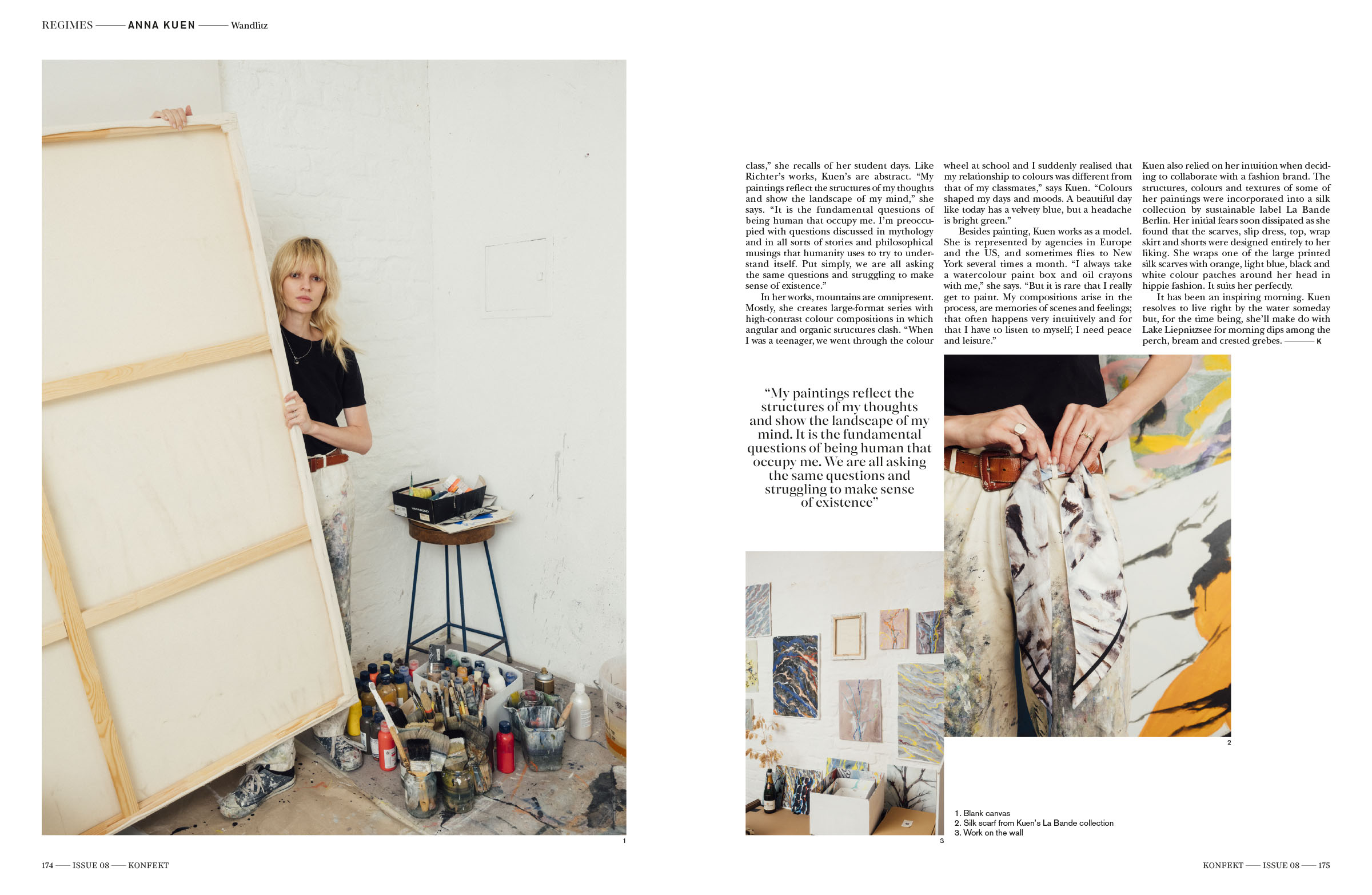
The Weissensee district in northeast Berlin is characterised by quiet residential areas. In the back garden of an apartment build-ing is her studio, a haven of about 20 sq m with a courtyard bordered by ivy-covered brick walls. There are paintings, books, paint pots, canvases, a small desk, mini-fridge and stovetop on which a Bialetti espresso maker gurgles. Kuen takes blueberries from the fridge and opens a bag of salty crackers. “I always have to have something to eat; otherwise I get nervous,” she says. “I can’t paint hungry.” She has swapped the leather trousers for a pair of light-coloured chinos. “I have a ritual. Whenever I arrive at the studio, I write something: thoughts, poems, single sentences, sometimes just words,” says Kuen pointing to a notebook next to a large sketchbook and pages she has torn out of Alpine Club magazines and yearbooks. They show photographs of mountains in a wide variety of views, structures, shapes and light situations.
“I studied with [German artist] Daniel Richter in Vienna. Independent work and critical ability were indispensable in his class,” she recalls of her student days. Like Richter’s works, Kuen’s are abstract. “My paintings reflect the structures of my thoughts and show the landscape of my mind,” she says. “It is the fundamental questions of being human that occupy me. I’m preoccu-pied with questions discussed in mythology and in all sorts of stories and philosophical musings that humanity uses to try to under-stand itself. Put simply, we are all asking the same questions and struggling to make sense of existence.”
In her works, mountains are omnipresent. Mostly, she creates large-format series with high contrast colour compositions in which angular and organic structures clash. “When I was a teenager, we went through the colour wheel at school and I suddenly realised that my relationship to colours was different from that of my classmates,” says Kuen. “Colours shaped my days and moods. A beautiful day like today has a velvety blue, but a headache is bright green.”
Besides painting, Kuen works as a model. She is represented by agencies in Europe and the US, and sometimes flies to New York several times a month. “I always take a watercolour paint box and oil crayons with me,” she says. “But it is rare that I really get to paint. My compositions arise in the process, are memories of scenes and feelings; that often happens very intuitively and for that I have to listen to myself; I need peace and leisure.”
Kuen also relied on her intuition when deciding to collaborate with a fashion brand. The structures, colours and textures of some of her paintings were incorporated into a silk collection by sustainable label La Bande Berlin. Her initial fears soon dissipated as she found that the scarves, slip dress, top, wrap skirt and shorts were designed entirely to her liking. She wraps one of the large printed silk scarves with orange, light blue, black and white colour patches around her head in hippie fashion. It suits her perfectly. It has been an inspiring morning. Kuen resolves to live right by the water someday but, for the time being, she’ll make do with Lake Liepnitzsee for morning dips among the perch, bream and crested grebes.
Konfekt,
Autmun 2022