Ilona Marx
Editorial work / Concepts / Texts
In vanitas veritas
Art & Culture / Retail
The botanical couturiers behind Anatomie Fleur find contrast and complement in their budding business.
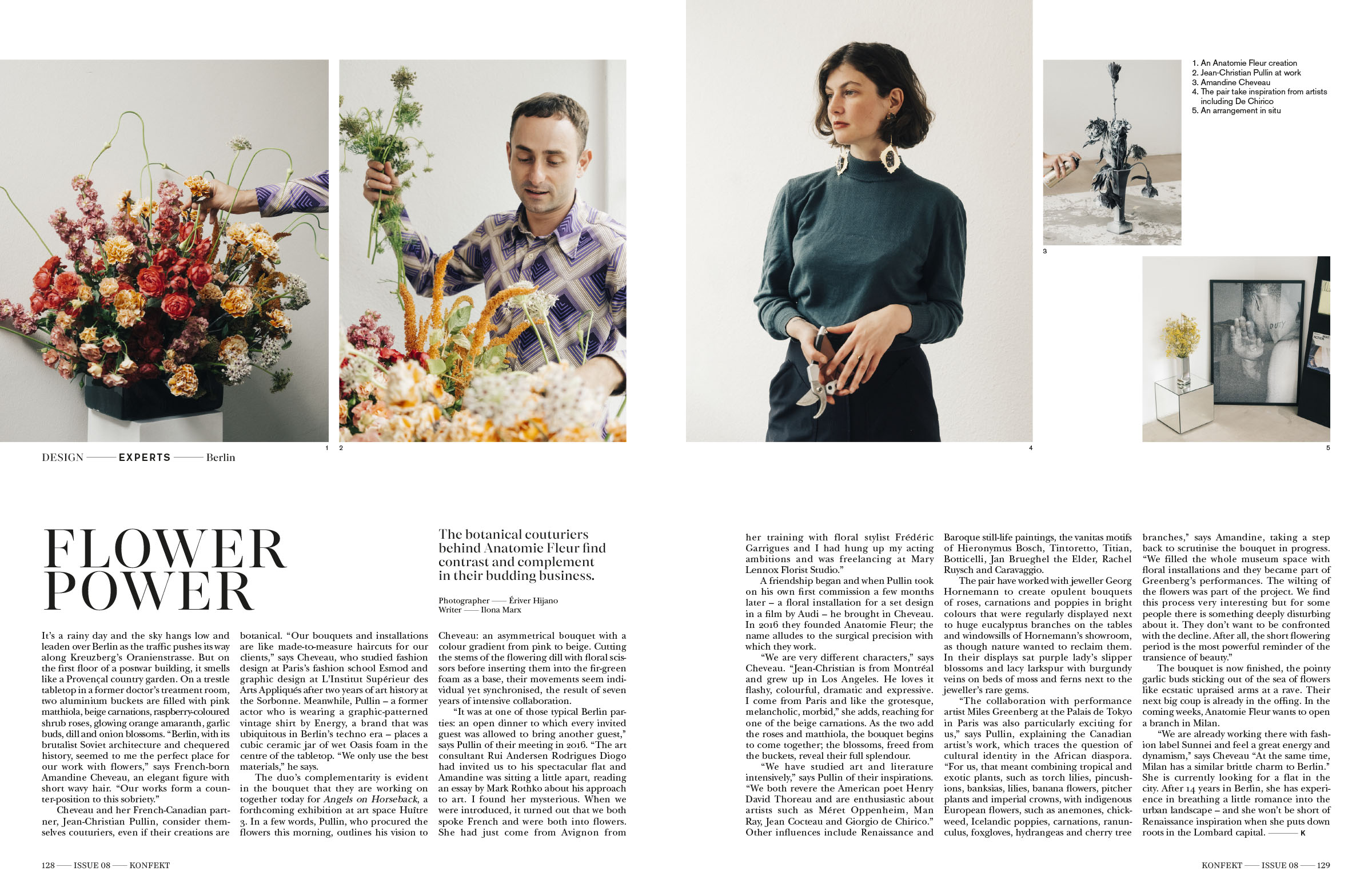
It’s a rainy day and the sky hangs low and leaden over Berlin as the traffic pushes its way along Kreuzberg’s Oranienstrasse. But on the first floor of a postwar building, it smells like a Provençal country garden. On a trestle tabletop in a former doctor’s treatment room, two aluminium buckets are filled with pink matthiola, beige carnations, raspberry-coloured shrub roses, glowing orange amaranth, garlic buds, dill and onion blossoms. “Berlin, with its brutalist Soviet architecture and chequered history, seemed to me the perfect place for our work with flowers,” says French-born Amandine Cheveau, an elegant figure with short wavy hair. “Our works form a coun-ter-position to this sobriety.”
Cheveau and her French-Canadian partner, Jean-Christian Pullin, consider themselves couturiers, even if their creations are botanical. “Our bouquets and installations are like made-to-measure haircuts for our clients,” says Cheveau, who studied fashion design at Paris’s fashion school Esmod and graphic design at L’Institut Supérieur des Arts Appliqués after two years of art history at the Sorbonne. Meanwhile, Pullin – a former actor who is wearing a graphic-patterned vintage shirt by Energy, a brand that was ubiquitous in Berlin’s techno era – places a cubic ceramic jar of wet Oasis foam in the centre of the tabletop. “We only use the best materials,” he says.
The duo’s complementarity is evident in the bouquet that they are working on together today for Angels on Horseback, a forthcoming exhibition at art space Huître 3. In a few words, Pullin, who procured the flowers this morning, outlines his vision to Cheveau: an asymmetrical bouquet with a colour gradient from pink to beige. Cutting the stems of the flowering dill with floral scissors before inserting them into the fir-green foam as a base, their movements seem individual yet synchronised, the result of seven years of intensive collaboration.
“It was at one of those typical Berlin parties: an open dinner to which every invited guest was allowed to bring another guest,” says Pullin of their meeting in 2016. “The art consultant Rui Andersen Rodrigues Diogo had invited us to his spectacular flat and Amandine was sitting a little apart, reading an essay by Mark Rothko about his approach to art. I found her mysterious. When we were introduced, it turned out that we both spoke French and were both into flowers. She had just come from Avignon from her training with floral stylist Frédéric Garrigues and I had hung up my acting ambitions and was freelancing at Mary Lennox Florist Studio.”
A friendship began and when Pullin took on his own first commission a few months later – a floral installation for a set design in a film by Audi – he brought in Cheveau. In 2016 they founded Anatomie Fleur; the name alludes to the surgical precision with which they work. “We are very different characters,” says Cheveau. “Jean-Christian is from Montréal and grew up in Los Angeles. He loves it flashy, colourful, dramatic and expressive. I come from Paris and like the grotesque, melancholic, morbid,” she adds, reaching for one of the beige carnations. As the two add the roses and matthiola, the bouquet begins to come together; the blossoms, freed from the buckets, reveal their full splendour.
“We have studied art and literature intensively,” says Pullin of their inspirations. “We both revere the American poet Henry David Thoreau and are enthusiastic about artists such as Méret Oppenheim, Man Ray, Jean Cocteau and Giorgio de Chirico.” Other influences include Renaissance and Baroque still-life paintings, the vanitas motifs of Hieronymus Bosch, Tintoretto, Titian, Botticelli, Jan Brueghel the Elder, Rachel Ruysch and Caravaggio.
The pair have worked with jeweller Georg Hornemann to create opulent bouquets of roses, carnations and poppies in bright colours that were regularly displayed next to huge eucalyptus branches on the tables and windowsills of Hornemann’s showroom, as though nature wanted to reclaim them. In their displays sat purple lady’s slipper blossoms and lacy larkspur with burgundy veins on beds of moss and ferns next to the jeweller’s rare gems.
“The collaboration with performance artist Miles Greenberg at the Palais de Tokyo in Paris was also particularly exciting for us,” says Pullin, explaining the Canadian artist’s work, which traces the question of cultural identity in the African diaspora. “For us, that meant combining tropical and exotic plants, such as torch lilies, pincush-ions, banksias, lilies, banana flowers, pitcher plants and imperial crowns, with indigenous European flowers, such as anemones, chick-weed, Icelandic poppies, carnations, ranunculus, foxgloves, hydrangeas and cherry tree branches,” says Amandine, taking a step back to scrutinise the bouquet in progress. “We filled the whole museum space with floral installations and they became part of Greenberg’s performances. The wilting of the flowers was part of the project. We find this process very interesting but for some people there is something deeply disturbing about it. They don’t want to be confronted with the decline. After all, the short flowering period is the most powerful reminder of the transience of beauty.”
The bouquet is now finished, the pointy garlic buds sticking out of the sea of flowers like ecstatic upraised arms at a rave. Their next big coup is already in the offing. In the coming weeks, Anatomie Fleur wants to open a branch in Milan.
“We are already working there with fashion label Sunnei and feel a great energy and dynamism,” says Cheveau “At the same time, Milan has a similar brittle charm to Berlin.” She is currently looking for a flat in the city. After 14 years in Berlin, she has experience in breathing a little romance into the urban landscape – and she won’t be short of Renaissance inspiration when she puts down roots in the Lombard capital.
Konfekt,
Autumn 2022