Ilona Marx
Editorial work / Concepts / Texts
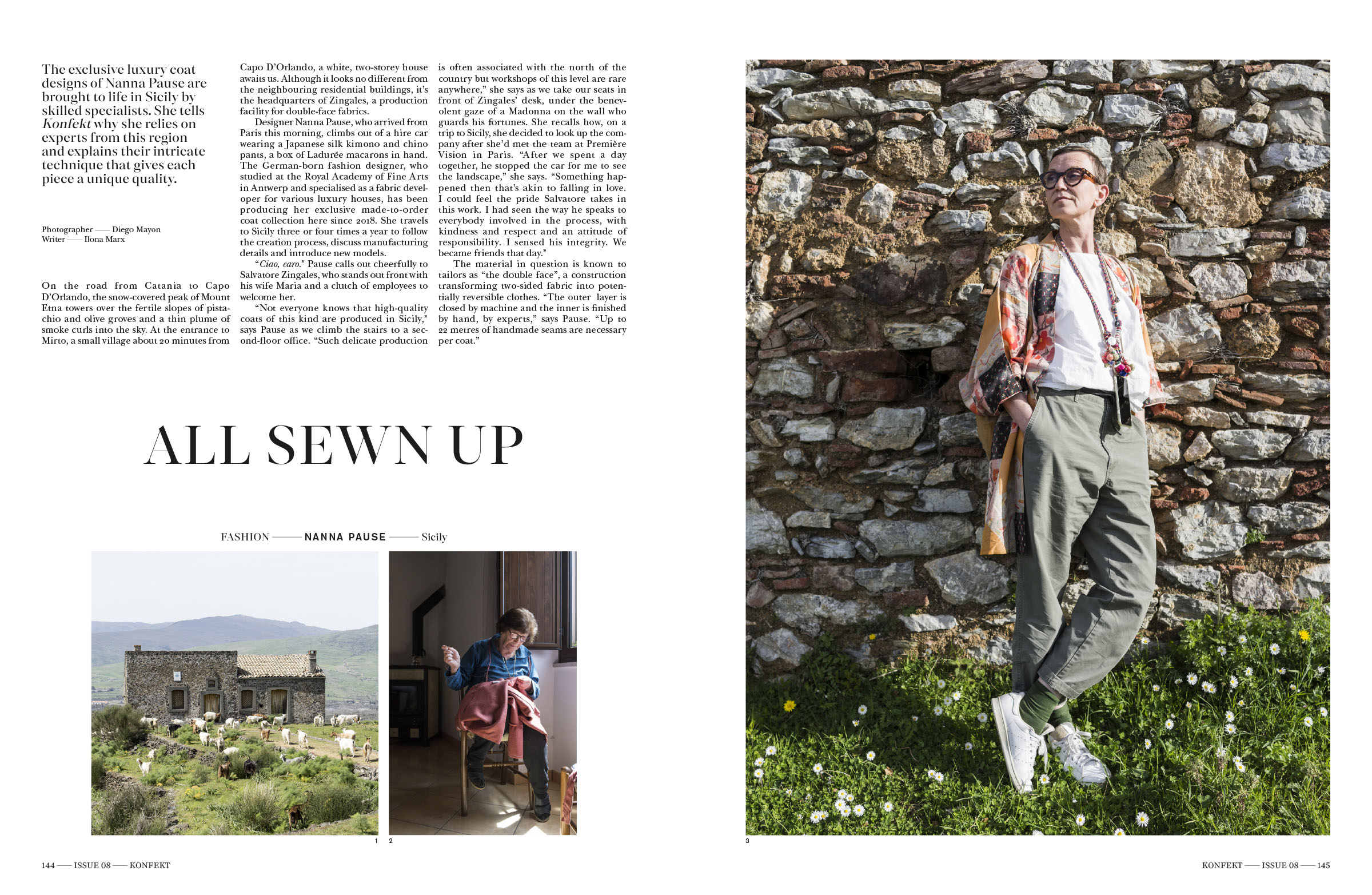
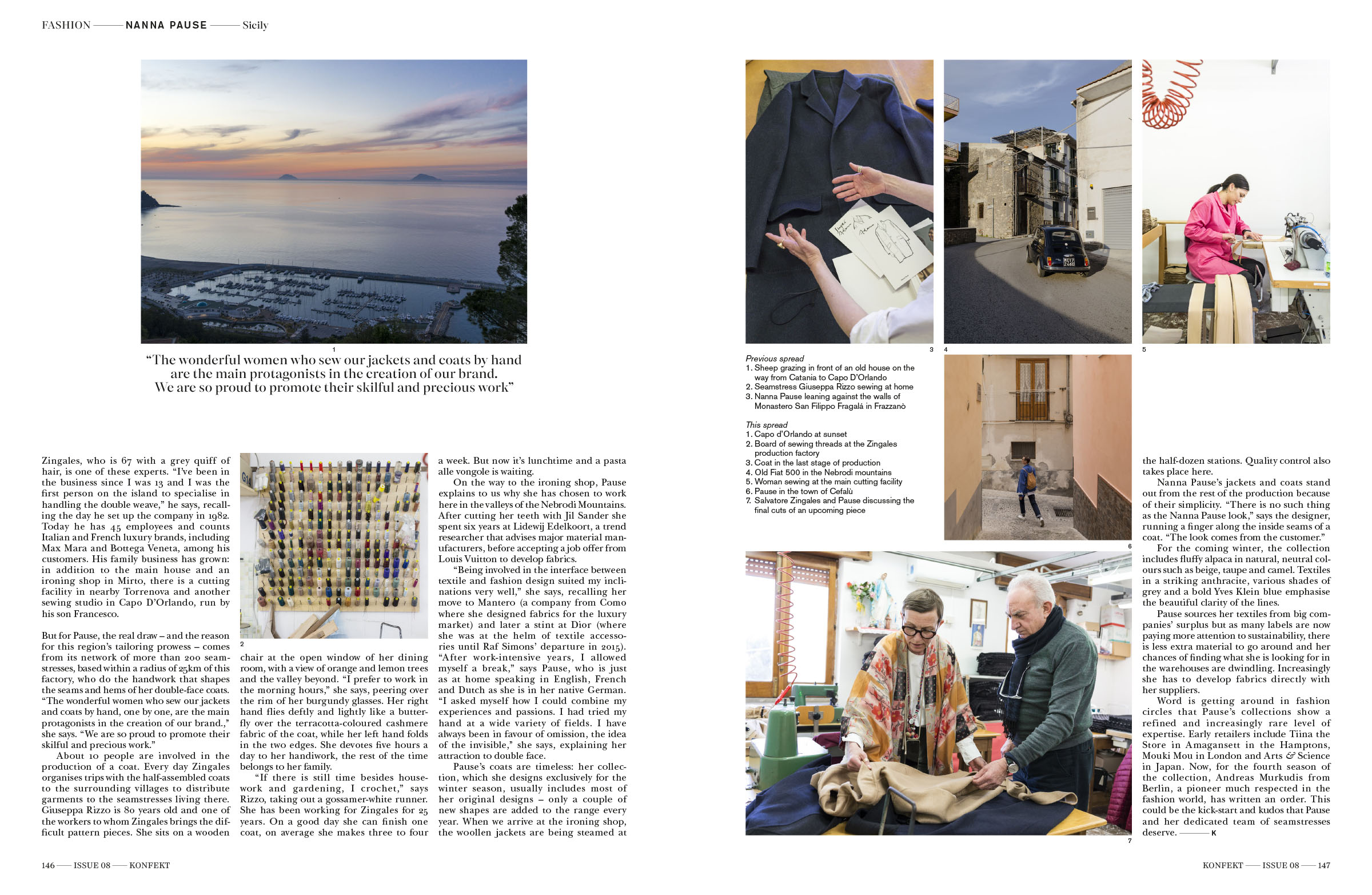
All sewn up
Art & Culture / Fashion
The exclusive luxury coat designs of Nanna Pause are brought to life in Sicily by skilled specialists. She tells Konfekt why she relies on experts from this region and explains their intricate technique that gives each piece a unique quality.
On the road from Catania to Capo D’Orlando, the snow-covered peak of Mount Etna towers over the fertile slopes of pista-chio and olive groves and a thin plume of smoke curls into the sky. At the entrance to Mirto, a small village about 20 minutes from Capo D’Orlando, a white, two-storey house awaits us. Although it looks no different from the neighbouring residential buildings, it’s the headquarters of Zingales, a production facility for double-face fabrics.
Designer Nanna Pause, who arrived from Paris this morning, climbs out of a hire car wearing a Japanese silk kimono and chino pants, a box of Ladurée macarons in hand. The German-born fashion designer, who studied at the Royal Academy of Fine Arts in Antwerp and specialised as a fabric developer for various luxury houses, has been producing her exclusive made-to-order coat collection here since 2018. She travels to Sicily three or four times a year to follow the creation process, discuss manufacturing details and introduce new models.
“Ciao, caro.” Pause calls out cheerfully to Salvatore Zingales, who stands out front with his wife Maria and a clutch of employees to welcome her.
“Not everyone knows that high-quality coats of this kind are produced in Sicily,” says Pause as we climb the stairs to a second-floor office. “Such delicate production is often associated with the north of the country but workshops of this level are rare anywhere,” she says as we take our seats in front of Zingales’ desk, under the benevolent gaze of a Madonna on the wall who guards his fortunes. She recalls how, on a trip to Sicily, she decided to look up the company after she’d met the team at Première Vision in Paris. “After we spent a day together, he stopped the car for me to see the landscape,” she says. “Something happened then that’s akin to falling in love. I could feel the pride Salvatore takes in this work. I had seen the way he speaks to everybody involved in the process, with kindness and respect and an attitude of responsibility. I sensed his integrity. We became friends that day.”
The material in question is known to tailors as “the double face”, a construction transforming two-sided fabric into poten-tially reversible clothes. “The outer layer is closed by machine and the inner is finished by hand, by experts,” says Pause. “Up to 22 metres of handmade seams are necessary per coat.”
Zingales, who is 67 with a grey quiff of hair, is one of these experts. “I’ve been in the business since I was 13 and I was the first person on the island to specialise in handling the double weave,” he says, recalling the day he set up the company in 1982. Today he has 45 employees and counts Italian and French luxury brands, including Max Mara and Bottega Veneta, among his customers. His family business has grown: in addition to the main house and an ironing shop in Mirto, there is a cutting facility in nearby Torrenova and another sewing studio in Capo D’Orlando, run by his son Francesco.
But for Pause, the real draw – and the reason for this region’s tailoring prowess – comes from its network of more than 200 seamstresses, based within a radius of 25km of this factory, who do the handwork that shapes the seams and hems of her double-face coats. “The wonderful women who sew our jackets and coats by hand, one by one, are the main protagonists in the creation of our brand.,” she says. “We are so proud to promote their skilful and precious work.”
About 10 people are involved in the production of a coat. Every day Zingales organises trips with the half-assembled coats to the surrounding villages to distribute garments to the seamstresses living there. Giuseppa Rizzo is 80 years old and one of the workers to whom Zingales brings the difficult pattern pieces. She sits on a wooden chair at the open window of her dining room, with a view of orange and lemon trees and the valley beyond. “I prefer to work in the morning hours,” she says, peering over the rim of her burgundy glasses. Her right hand flies deftly and lightly like a butterfly over the terracotta-coloured cashmere fabric of the coat, while her left hand folds in the two edges. She devotes five hours a day to her handiwork, the rest of the time belongs to her family. “If there is still time besides housework and gardening, I crochet,” says Rizzo, taking out a gossamer-white runner. She has been working for Zingales for 25 years. On a good day she can finish one coat, on average she makes three to four a week. But now it’s lunchtime and a pasta alle vongole is waiting.
On the way to the ironing shop, Pause explains to us why she has chosen to work here in the valleys of the Nebrodi Mountains. After cutting her teeth with Jil Sander she spent six years at Lidewij Edelkoort, a trend researcher that advises major material manufacturers, before accepting a job offer from Louis Vuitton to develop fabrics.
“Being involved in the interface between textile and fashion design suited my inclinations very well,” she says, recalling her move to Mantero (a company from Como where she designed fabrics for the luxury market) and later a stint at Dior (where she was at the helm of textile accessories until Raf Simons’ departure in 2015). “After work-intensive years, I allowed myself a break,” says Pause, who is just as at home speaking in English, French and Dutch as she is in her native German. “I asked myself how I could combine my experiences and passions. I had tried my hand at a wide variety of fields. I have always been in favour of omission, the idea of the invisible,” she says, explaining her attraction to double face.
Pause’s coats are timeless: her collection, which she designs exclusively for the winter season, usually includes most of her original designs – only a couple of new shapes are added to the range every year. When we arrive at the ironing shop, the woollen jackets are being steamed at 5 the half-dozen stations. Quality control also takes place here.
Nanna Pause’s jackets and coats stand out from the rest of the production because of their simplicity. “There is no such thing as the Nanna Pause look,” says the designer, running a finger along the inside seams of a coat. “The look comes from the customer.”
For the coming winter, the collection includes fluffy alpaca in natural, neutral colours such as beige, taupe and camel. Textiles in a striking anthracite, various shades of grey and a bold Yves Klein blue emphasise the beautiful clarity of the lines.
Pause sources her textiles from big companies’ surplus but as many labels are now paying more attention to sustainability, there is less extra material to go around and her chances of finding what she is looking for in the warehouses are dwindling. Increasingly she has to develop fabrics directly with her suppliers.
Word is getting around in fashion circles that Pause’s collections show a refined and increasingly rare level of expertise. Early retailers include Tiina the Store in Amagansett in the Hamptons, Mouki Mou in London and Arts & Science in Japan. Now, for the fourth season of the collection, Andreas Murkudis from Berlin, a pioneer much respected in the fashion world, has written an order. This could be the kick-start and kudos that Pause and her dedicated team of seamstresses deserve.
Konfekt,
Autumn 2022