Ilona Marx
Editorial work / Concepts / Texts
Home rules
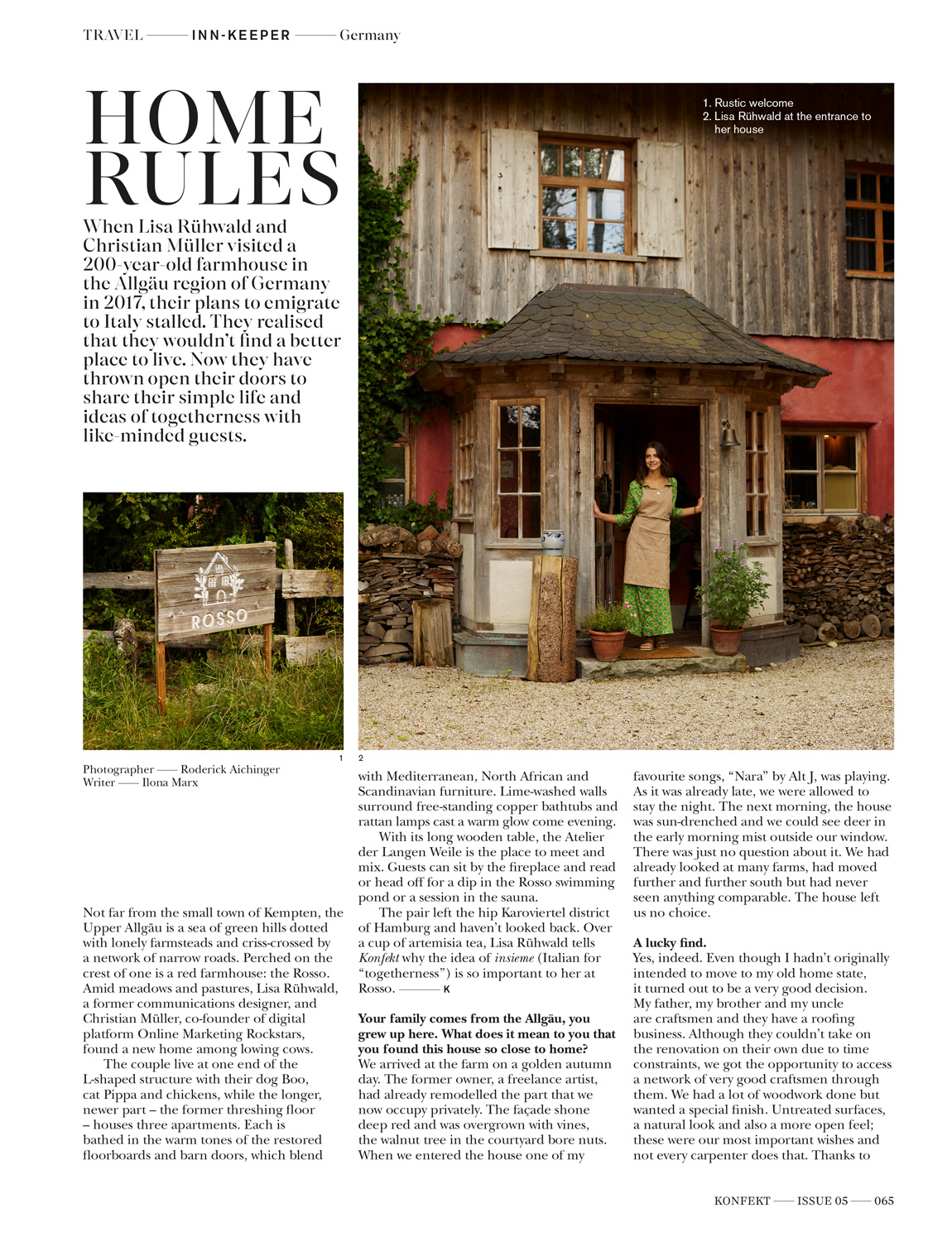
When Lisa Rühwald and Christian Müller visited a 200-year-old farmhouse in the Allgäu region of Germany in 2017, their plans to emigrate to Italy stalled. They realised that they wouldn’t find a better place to live. Now they have thrown open their doors to share their simple life and ideas of togetherness with like-minded guests.
Not far from the small town of Kempten, the Upper Allgäu is a sea of green hills dotted with lonely farmsteads and criss-crossed by a network of narrow roads. Perched on the crest of one is a red farmhouse: the Rosso. Amid meadows and pastures, Lisa Rühwald, a former communications designer, and Christian Müller, co-founder of digital platform Online Marketing Rockstars, found a new home among lowing cows.
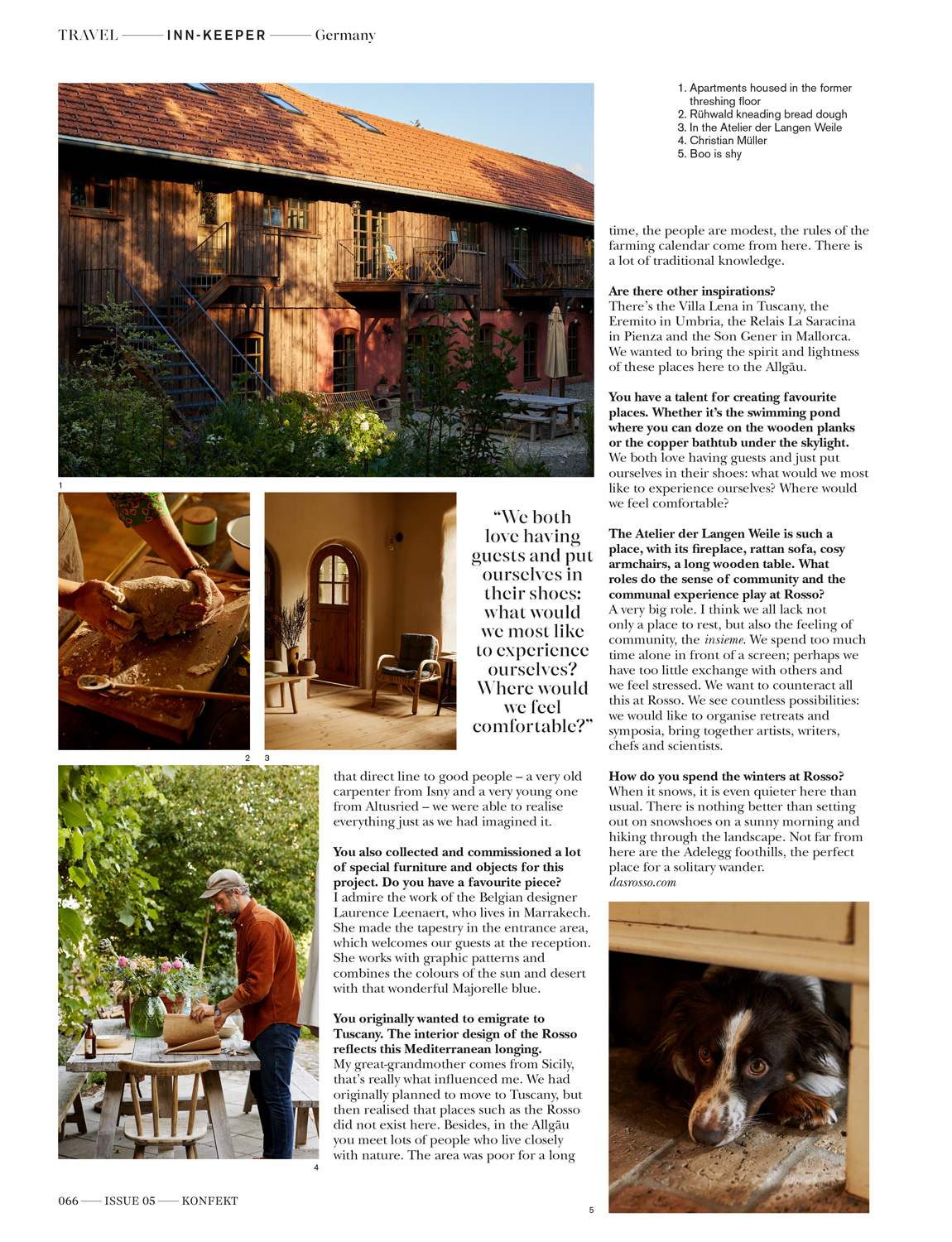
The couple live at one end of the L-shaped structure with their dog Boo, cat Pippa and chickens, while the longer, newer part – the former threshing floor – houses three apartments. Each is bathed in the warm tones of the restored floorboards and barn doors, which blend with Mediterranean, North African and Scandinavian furniture. Lime-washed walls surround free-standing copper bathtubs and rattan lamps cast a warm glow come evening.
With its long wooden table, the Atelier der Langen Weile is the place to meet and mix. Guests can sit by the fireplace and read or head off for a dip in the Rosso swimming pond or a session in the sauna.
The pair left the hip Karoviertel district of Hamburg and haven’t looked back. Over a cup of artemisia tea, Lisa Rühwald tells Konfekt why the idea of insieme (Italian for “togetherness”) is so important to her at Rosso.
Your family comes from the Allgäu, you grew up here. What does it mean to you that you found this house so close to home?
We arrived at the farm on a golden autumn day. The former owner, a freelance artist, had already remodelled the part that we now occupy privately. The façade shone deep red and was overgrown with vines, the walnut tree in the courtyard bore nuts. When we entered the house one of my favourite songs, “Nara” by Alt J, was playing. As it was already late, we were allowed to stay the night. The next morning, the house was sun-drenched and we could see deer in the early morning mist outside our window. There was just no question about it. We had already looked at many farms, had moved further and further south but had never seen anything comparable. The house left us no choice.
A lucky find.
Yes, indeed. Even though I hadn’t originally intended to move to my old home state, it turned out to be a very good decision. My father, my brother and my uncle are craftsmen and they have a roofing business. Although they couldn’t take on the renovation on their own due to time constraints, we got the opportunity to access a network of very good craftsmen through them. We had a lot of woodwork done but wanted a special finish. Untreated surfaces, a natural look and also a more open feel; these were our most important wishes and not every carpenter does that. Thanks to that direct line to good people – a very old carpenter from Isny and a very young one from Altusried – we were able to realise everything just as we had imagined it.
You also collected and commissioned a lot of special furniture and objects for this project. Do you have a favourite piece?
I admire the work of the Belgian designer Laurence Leenaert, who lives in Marrakech. She made the tapestry in the entrance area, which welcomes our guests at the reception. She works with graphic patterns and combines the colours of the sun and desert with that wonderful Majorelle blue.
You originally wanted to emigrate to Tuscany. The interior design of the Rosso reflects this Mediterranean longing.
My great-grandmother comes from Sicily, that’s really what influenced me. We had originally planned to move to Tuscany, but then realised that places such as the Rosso did not exist here. Besides, in the Allgäu you meet lots of people who live closely with nature. The area was poor for a long time, the people are modest, the rules of the farming calendar come from here. There is a lot of traditional knowledge.
Are there other inspirations?
There’s the Villa Lena in Tuscany, the Eremito in Umbria, the Relais La Saracina in Pienza and the Son Gener in Mallorca. We wanted to bring the spirit and lightness of these places here to the Allgäu.
You have a talent for creating favourite places. Whether it’s the swimming pond where you can doze on the wooden planks or the copper bathtub under the skylight.
We both love having guests and just put ourselves in their shoes: what would we most like to experience ourselves? Where would we feel comfortable?
The Atelier der Langen Weile is such a place, with its fireplace, rattan sofa, cosy armchairs, a long wooden table. What roles do the sense of community and the communal experience play at Rosso?
A very big role. I think we all lack not only a place to rest, but also the feeling of community, the insieme. We spend too much time alone in front of a screen; perhaps we have too little exchange with others and we feel stressed. We want to counteract all this at Rosso. We see countless possibilities: we would like to organise retreats and symposia, bring together artists, writers, chefs and scientists.
How do you spend the winters at Rosso?
When it snows, it is even quieter here than usual. There is nothing better than setting out on snowshoes on a sunny morning and hiking through the landscape. Not far from here are the Adelegg foothills, the perfect place for a solitary wander.
Konfekt,
May 2022