Ilona Marx
Editorial work / Concepts / Texts
The white way
Travel
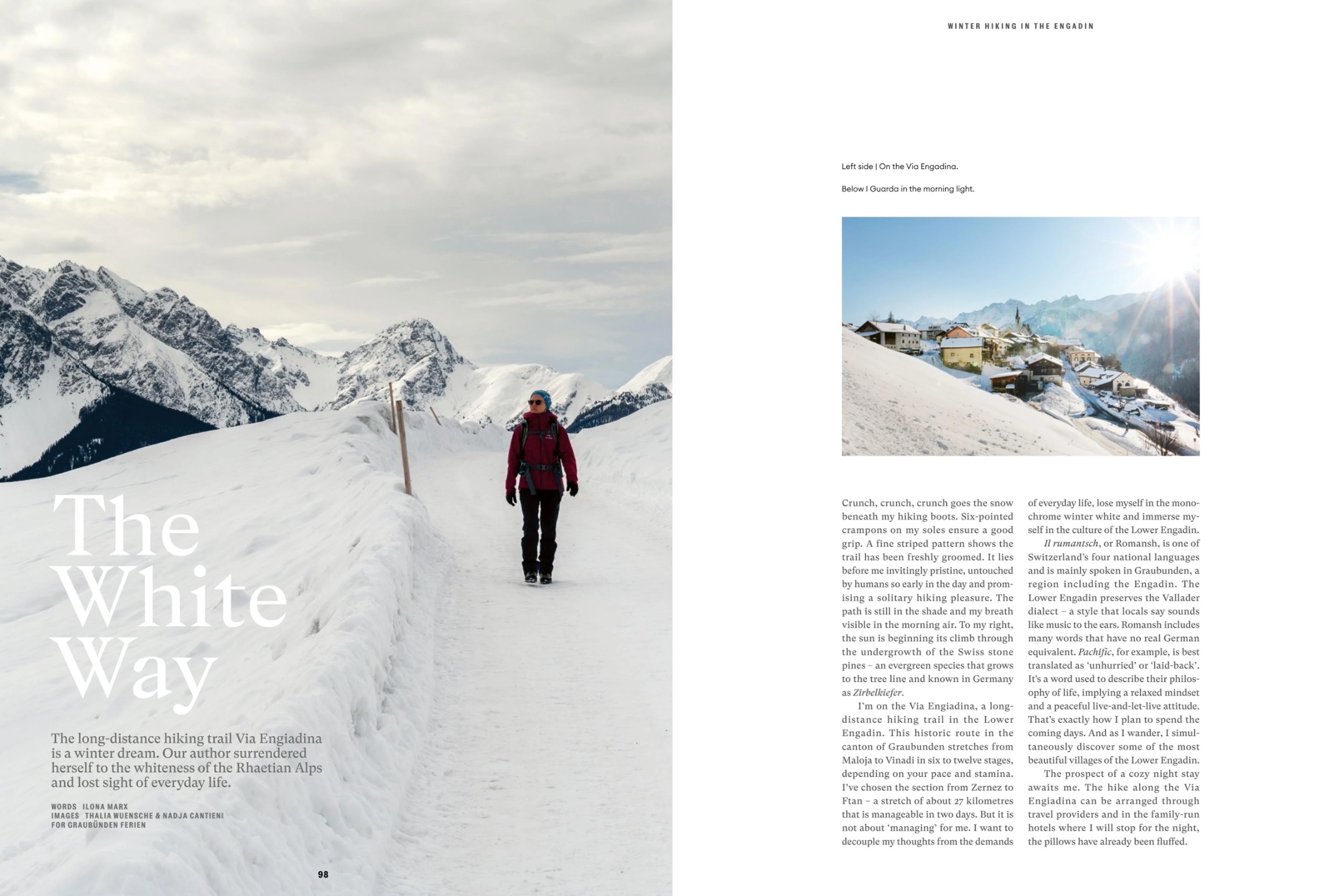
The longdistance hiking trail Via Engiadina is a winter dream. Our author surrendered herself to the whiteness of the Rhaetian Alps and lost sight of everyday life.
Crunch, crunch, crunch goes the snow beneath my hiking boots. Six-pointed crampons on my soles ensure a good grip. A fine striped pattern shows the trail has been freshly groomed. It lies before me invitingly pristine, untouched by humans so early in the day and promising a solitary hiking pleasure. The path is still in the shade and my breath visible in the morning air. To my right, the sun is beginning its climb through the undergrowth of the Swiss stone pines – an evergreen species that grows to the tree line and known in Germany as Zirbelkiefer.
I’m on the Via Engiadina, a long distance hiking trail in the Lower Engadin. This historic route in the canton of Graubunden stretches from Maloja to Vinadi in six to twelve stages, depending on your pace and stamina. I’ve chosen the section from Zernez to Ftan – a stretch of about 27 kilometres that is manageable in two days. But it is not about ‘managing’ for me. I want to decouple my thoughts from the demands of everyday life, lose myself in the mono chrome winter white and immerse my self in the culture of the Lower Engadin.
Il rumantsch, or Romansh, is one of Switzerland’s four national languages and is mainly spoken in Graubunden, a region including the Engadin. The Lower Engadin preserves the Vallader dialect – a style that locals say sounds like music to the ears. Romansh includes many words that have no real German equivalent. Pachific, for example, is best translated as ‘unhurried’ or ‘laidback’. It’s a word used to describe their philosophy of life, implying a relaxed mindset and a peaceful live-and-let-live attitude. That’s exactly how I plan to spend the coming days. And as I wander, I simultaneously discover some of the most beautiful villages of the Lower Engadin.
The prospect of a cozy night stay awaits me. The hike along the Via Engiadina can be arranged through travel providers and in the familyrun hotels where I will stop for the night, the pillows have already been fluffed.
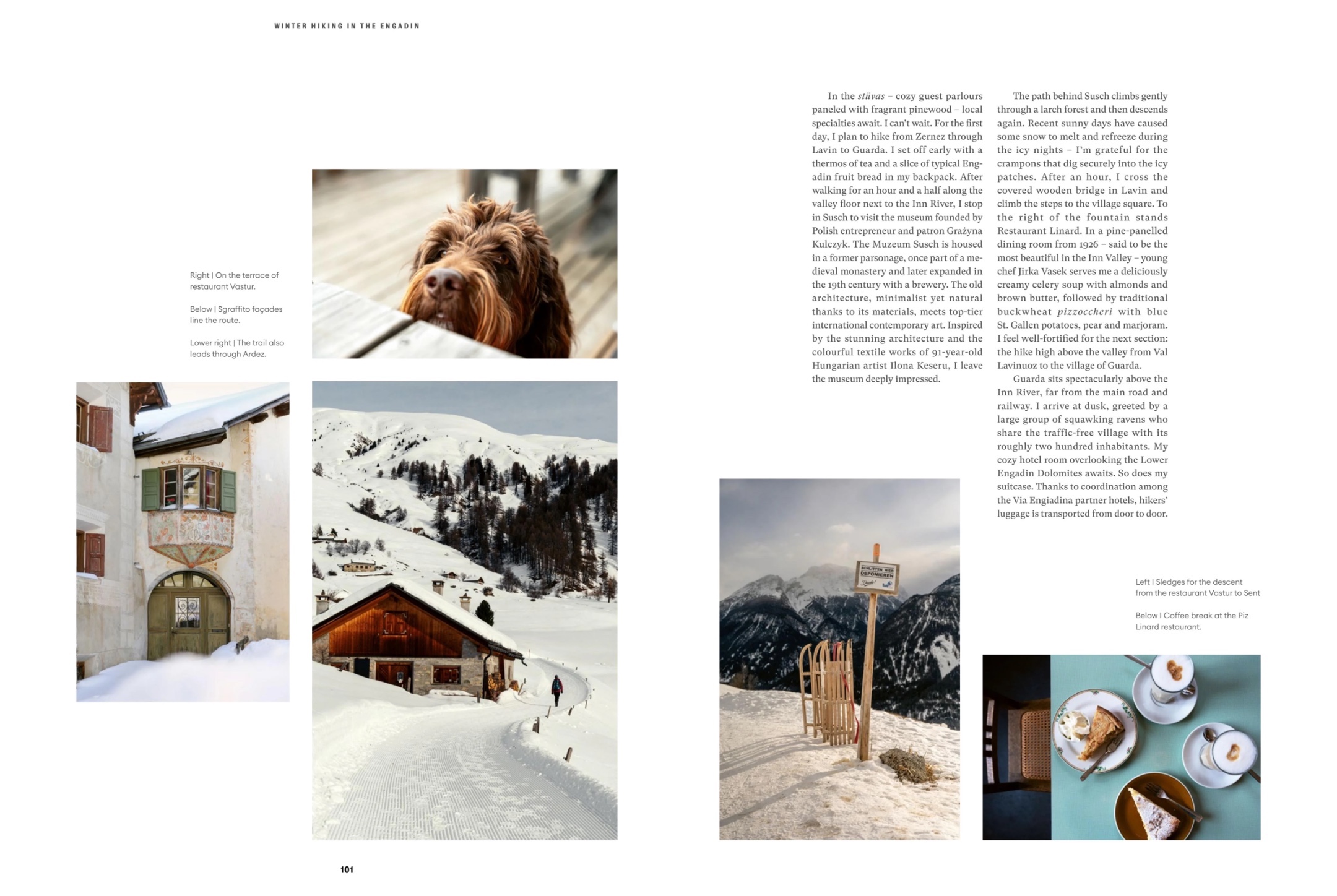
In the stüvas – cozy guest parlours paneled with fragrant pinewood – local specialties await. I can’t wait. For the first day, I plan to hike from Zernez through Lavin to Guarda. I set off early with a thermos of tea and a slice of typical Engadin fruit bread in my backpack. After walking for an hour and a half along the valley floor next to the Inn River, I stop in Susch to visit the museum founded by Polish entrepreneur and patron Grażyna Kulczyk. The Muzeum Susch is housed in a former parsonage, once part of a me dieval monastery and later expanded in the 19th century with a brewery. The old architecture, minimalist yet natural thanks to its materials, meets toptier international contemporary art. Inspired by the stunning architecture and the colourful textile works of 91-year-old Hungarian artist Ilona Keseru, I leave the museum deeply impressed.
The path behind Susch climbs gently through a larch forest and then descends again. Recent sunny days have caused some snow to melt and refreeze during the icy nights – I’m grateful for the crampons that dig securely into the icy patches. After an hour, I cross the covered wooden bridge in Lavin and climb the steps to the village square. To the right of the fountain stands Restaurant Linard. In a pine-panelled dining room from 1926 – said to be the most beautiful in the Inn Valley – young chef Jirka Vasek serves me a deliciously creamy celery soup with almonds and brown butter, followed by traditional buckwheat pizzoccheri with blue St. Gallen potatoes, pear and marjoram. I feel well-fortified for the next section: the hike high above the valley from Val Lavinuoz to the village of Guarda.
Guarda sits spectacularly above the Inn River, far from the main road and railway. I arrive at dusk, greeted by a large group of squawking ravens who share the traffic-free village with its roughly two hundred inhabitants. My cozy hotel room overlooking the Lower Engadin Dolomites awaits. So does my suitcase. Thanks to coordination among the Via Engiadina partner hotels, hikers’ luggage is transported from door to door.
The next stage gently climbs and descends on the sunny side of the Inn Valley to Ardez. There, I meet local guide Walter Schmid. He shows me the most beautiful sgraffito facades, an artistic style specific to these areas. He tells stories about village life; the ski lift that’s free for kids and the evening lottery that brings the whole village together – where he is hoping for a small win himself. A notable resident of Ardez is artist, sculptor and architect Not Vital. His foundation, Fundaziun Not Vital, aims to bring prints from the 17th and 18th centuries back to their place of origin. The Romansh library housing this collection is located in the Planta House of Wildenberg, an imposing white corner house dating back to 1642.
At Tarasp Castle, built in 1040 and located halfway to Scuol, the foundation showcases a collection of antique, modern and contemporary art alongside rotating exhibitions. It sounds exciting, but I decide to save it for another visit and instead hike past the ski lift and up the slope. After passing snow-covered ruins, crossing a road and hiking past a cross-country ski trail, I reach Ftan – a village known not only for skiing but also for its sports boarding school, the talent hub of the High Alpine Institute.
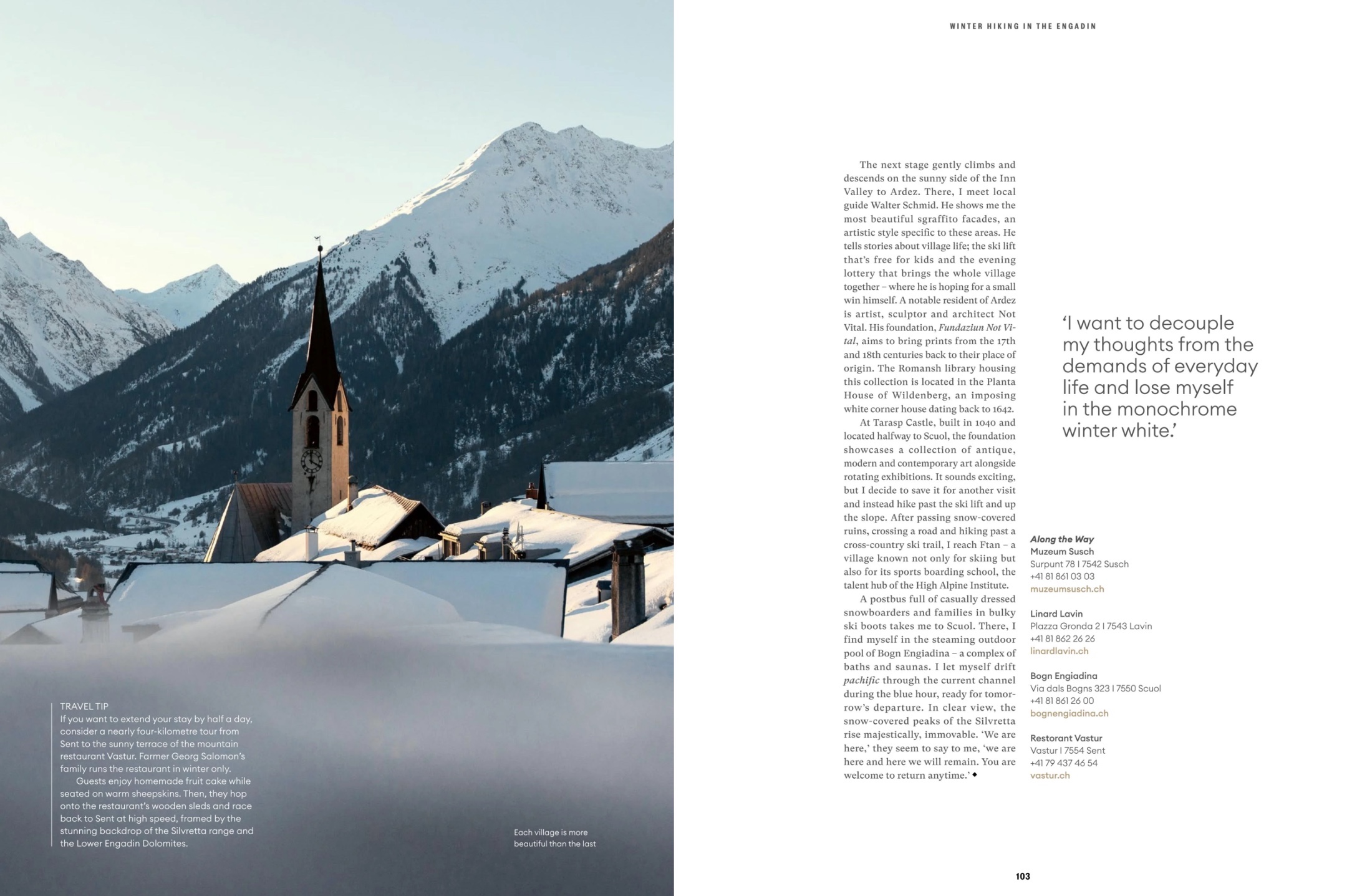
A postbus full of casually dressed snowboarders and families in bulky ski boots takes me to Scuol. There, I find myself in the steaming outdoor pool of Bogn Engiadina – a complex of baths and saunas. I let myself drift pachific through the current channel during the blue hour, ready for tomorrow’s departure. In clear view, the snow-covered peaks of the Silvretta rise majestically, immovable. ‘We are here,’ they seem to say to me, ‘we are here and here we will remain. You are welcome to return anytime.’
Along the Way
Muzeum Susch
Surpunt 78 I 7542 Susch
+41 81 861 03 03 muzeumsusch.ch
Linard Lavin
Plazza Gronda 2 I 7543 Lavin
+41 81 862 26 26 linardlavin.ch
Bogn Engiadina
Via dals Bogns 323 I 7550 Scuol
+41 81 861 26 00 bognengiadina.ch
Restorant Vastur
Vastur I 7554 Sent
+41 79 437 46 54 vastur.ch
Contributors
Special thx to:
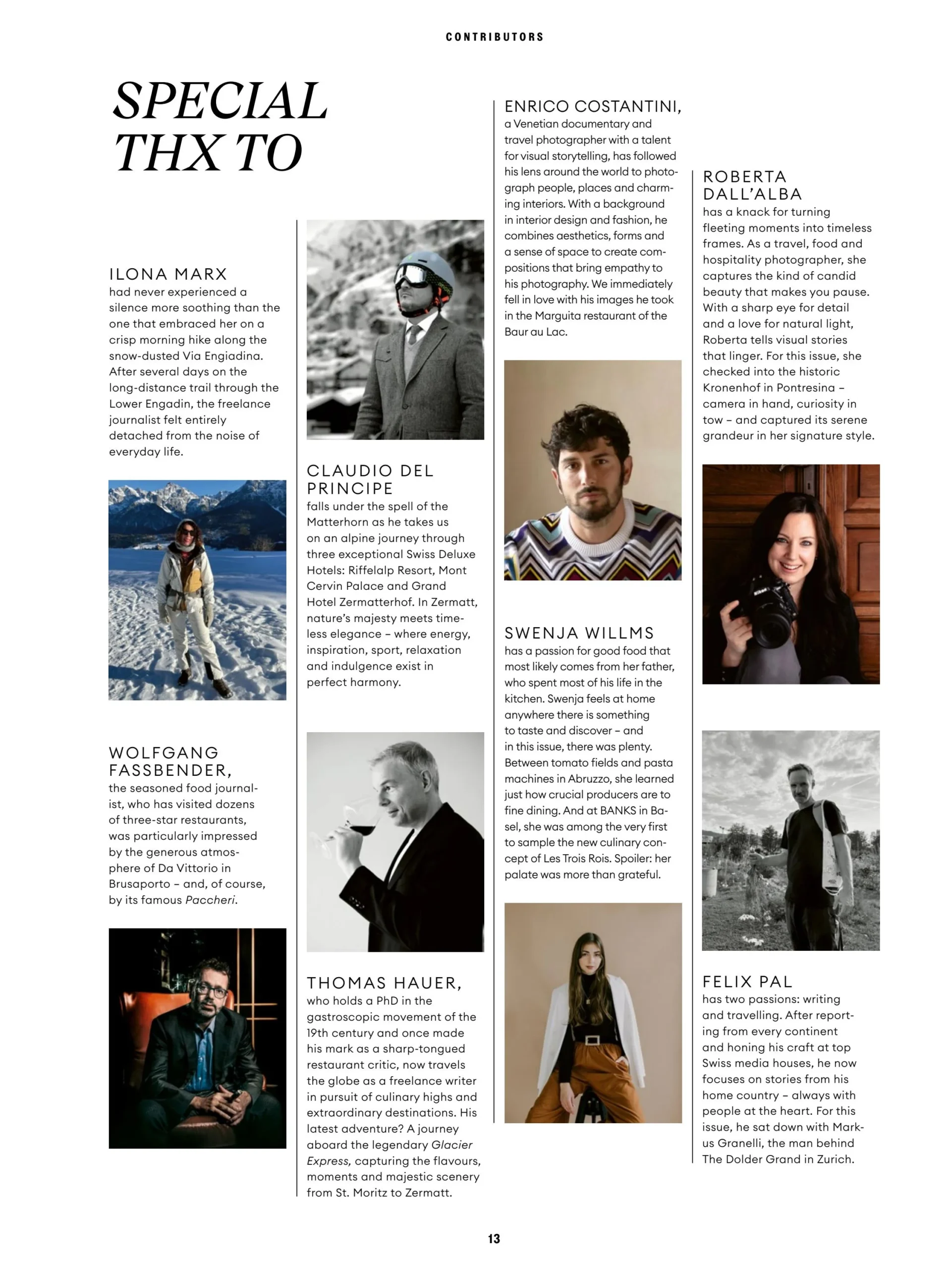
ILONA MARX had never experienced a silence more soothing than the one that embraced her on a crisp morning hike along the snow-dusted Via Engiadina. After several days on the long-distance trail through the Lower Engadin, the freelance journalist felt entirely detached from the noise of everyday life.
WOLFGANG FASSBENDER,the seasoned food journal- ist, who has visited dozens of three-star restaurants, was particularly impressed by the generous atmosphere of Da Vittorio in Brusaporto – and, of course, by its famous Paccheri.
CLAUDIO DEL PRINCIPE falls under the spell of the Matterhorn as he takes us on an alpine journey through three exceptional Swiss Deluxe Hotels: Riffelalp Resort, Mont Cervin Palace and Grand Hotel Zermatterhof. In Zermatt, nature’s majesty meets timeless elegance – where energy, inspiration, sport, relaxation and indulgence exist in perfect harmony.
THOMAS HAUER, who holds a PhD in the gastroscopic movement of the 19th century and once made his mark as a sharp-tongued restaurant critic, now travels the globe as a freelance writer in pursuit of culinary highs and extraordinary destinations. His latest adventure? A journey aboard the legendary Glacier Express, capturing the flavours, moments and majestic scenery from St. Moritz to Zermatt.
ENRICO COSTANTINI, a Venetian documentary and travel photographer with a talent for visual storytelling, has followed his lens around the world to photograph people, places and charm- ing interiors. With a background in interior design and fashion, he combines aesthetics, forms and a sense of space to create compositions that bring empathy to his photography. We immediately fell in love with his images he took in the Marguita restaurant of the Baur au Lac.
SWENJA WILLMS has a passion for good food that most likely comes from her father, who spent most of his life in the kitchen. Swenja feels at home anywhere there is something to taste and discover – and in this issue, there was plenty. Between tomato fields and pasta machines in Abruzzo, she learned just how crucial producers are to fine dining. And at BANKS in Basel, she was among the very first to sample the new culinary concept of Les Trois Rois. Spoiler: her palate was more than grateful.
ROBERTA DALL’ALBA has a knack for turning fleeting moments into timeless frames. As a travel, food and hospitality photographer, she captures the kind of candid beauty that makes you pause. With a sharp eye for detail and a love for natural light, Roberta tells visual stories that linger. For this issue, she checked into the historic Kronenhof in Pontresina – camera in hand, curiosity in tow – and captured its serene grandeur in her signature style.
FELIX PAL has two passions: writing and travelling. After reporting from every continent and honing his craft at top Swiss media houses, he now focuses on stories from his home country – always with people at the heart. For this issue, he sat down with Markus Granelli, the man behind The Dolder Grand in Zurich.
H Magazine,
Winter 25/26