Ilona Marx
Editorial work / Concepts / Texts
Metropolis of feasibility
Art & Culture / Food / Interior Design / Travel
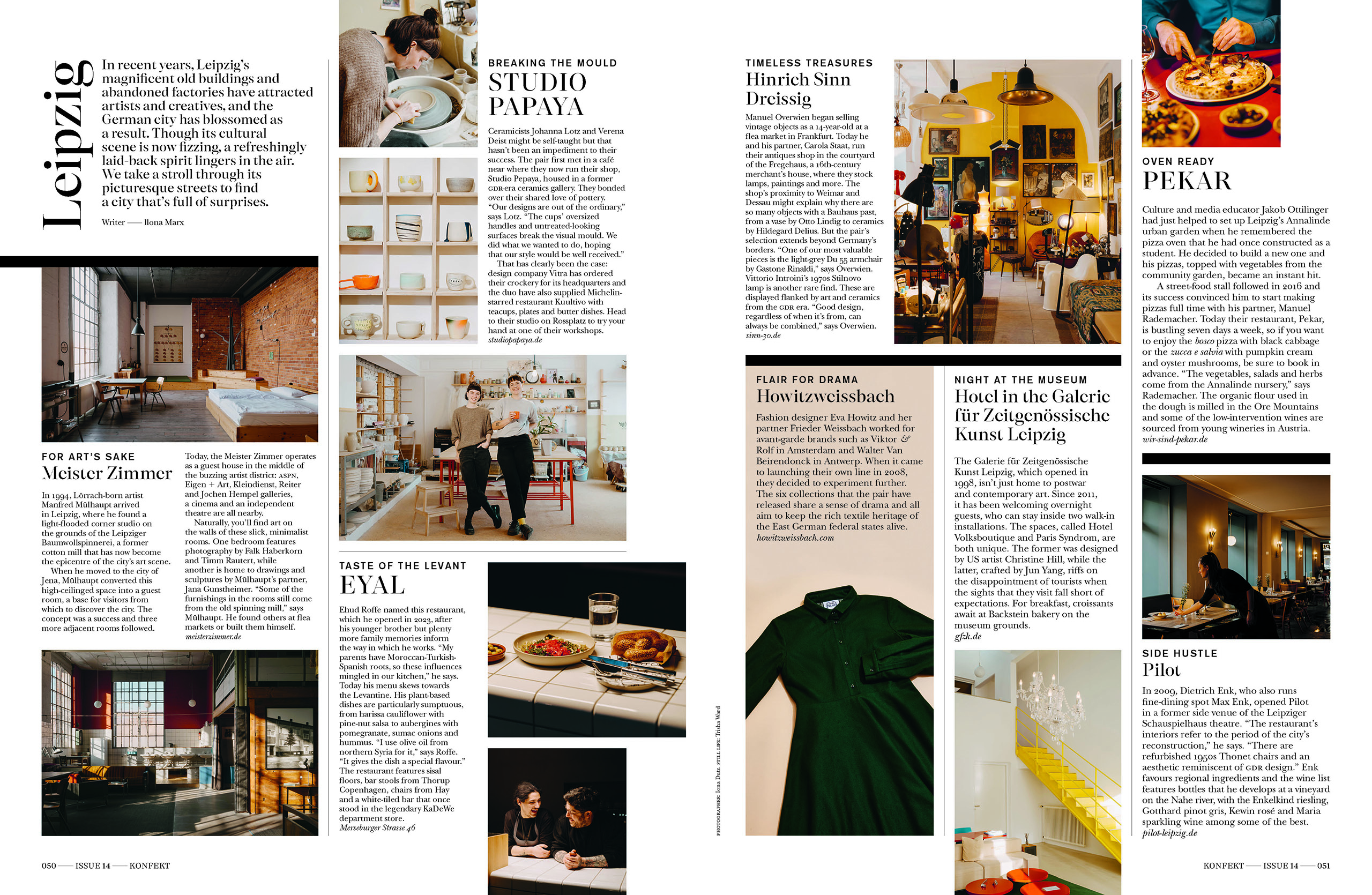
In recent years, Leipzig’s magnificent old buildings and abandoned factories have attracted artists and creatives, and the German city has blossomed as a result. Though its cultural scene is now fizzing, a refreshingly laid-back spirit lingers in the air. We take a stroll through its picturesque streets to find a city that’s full of surprises.
Meister Zimmer
For art’s sake
In 1994, Lörrach-born artist Manfred Mülhaupt arrived in Leipzig, where he found a light-flooded corner studio on the grounds of the Leipziger Baumwollspinnerei, a former cotton mill that has now become the epicentre of the city’s art scene.
When he moved to the city of Jena, Mülhaupt converted this high-ceilinged space into a guest room, a base for visitors from which to discover the city. The concept was a success and three more adjacent rooms followed. Today, the Meister Zimmer operates as a guest house in the middle of the buzzing artist district: ASPN, Eigen 1 Art, Kleindienst, Reiter and Jochen Hempel galleries, a cinema and an independent theatre are all nearby.
Naturally, you’ll find art on the walls of these slick, minimalist rooms. One bedroom features photography by Falk Haberkorn and Timm Rautert, while another is home to drawings and sculptures by Mülhaupt’s partner, Jana Gunstheimer. “Some of the furnishings in the rooms still come from the old spinning mill,” says Mülhaupt. He found others at flea markets or built them himself.
Pekar
Oven ready
Culture and media educator Jakob Ottilinger had just helped to set up Leipzig’s Annalinde urban garden when he remembered the pizza oven that he had once constructed as a student. He decided to build a new one and his pizzas, topped with vegetables from the community garden, became an instant hit.
A street-food stall followed in 2016 and its success convinced him to start making pizzas full time with his partner, Manuel Rademacher. Today their restaurant, Pekar, is bustling seven days a week, so if you want to enjoy the bosco pizza with black cabbage or the zucca e salvia with pumpkin cream and oyster mushrooms, be sure to book in advance. “The vegetables, salads and herbs come from the Annalinde nursery,” says Rademacher. The organic flour used in the dough is milled in the Ore Mountains and some of the low-intervention wines are sourced from young wineries in Austria.
Eyal
Taste of the Levant
Ehud Roffe named this restaurant, which he opened in 2023, after his younger brother but plenty more family memories inform the way in which he works. “My parents have Moroccan-Turkish-Spanish roots, so these influences mingled in our kitchen,” he says. Today his menu skews towards the Levantine. His plant-based dishes are particularly sumptuous, from harissa cauliflower with pine-nut salsa to aubergines with pomegranate, sumac onions and hummus. “I use olive oil from northern Syria for it,” says Roffe. “It gives the dish a special flavour.” The restaurant features sisal floors, bar stools from Thorup Copenhagen, chairs from Hay and a white-tiled bar that once stood in the legendary KaDeWe department store.
Hotel in the Galerie für Zeitgenössische Kunst Leipzig
Night at the Museum
The Galerie für Zeitgenössische Kunst Leipzig, which opened in 1998, isn’t just home to postwar and contemporary art. Since 2011, it has been welcoming overnight guests, who can stay inside two walk-in installations. The spaces, called Hotel Volksboutique and Paris Syndrom, are both unique. The former was designed by US artist Christine Hill, while the latter, crafted by Jun Yang, riffs on the disappointment of tourists when the sights that they visit fall short of expectations. For breakfast, croissants await at Backstein bakery on the museum grounds.
Studio Papaya
Breaking the Mould
Ceramicists Johanna Lotz and Verena Deist might be self-taught but that hasn’t been an impediment to their success. The pair first met in a café near where they now run their shop, Studio Pepaya, housed in a former GDR-era ceramics gallery. They bonded over their shared love of pottery. “Our designs are out of the ordinary,” says Lotz. “The cups’ oversized handles and untreated-looking surfaces break the visual mould. We did what we wanted to do, hoping that our style would be well received.”
That has clearly been the case: design company Vitra has ordered their crockery for its headquarters and the duo have also supplied Michelin-starred restaurant Kuultivo with teacups, plates and butter dishes. Head to their studio on Rossplatz to try your hand at one of their workshops.
Howitzweissbach
Flair for Drama
Fashion designer Eva Howitz and her partner Frieder Weissbach worked for avant-garde brands such as Viktor & Rolf in Amsterdam and Walter Van Beirendonck in Antwerp. When it came to launching their own line in 2008, they decided to experiment further. The six collections that the pair have released share a sense of drama and all aim to keep the rich textile heritage of the East German federal states alive.
Hinrich Sinn Dreissig
Timeless treasures
Manuel Overwien began selling vintage objects as a 14-year-old at a flea market in Frankfurt. Today he and his partner, Carola Staat, run their antiques shop in the courtyard of the Fregehaus, a 16th-century merchant’s house, where they stock lamps, paintings and more. The shop’s proximity to Weimar and Dessau might explain why there are so many objects with a Bauhaus past, from a vase by Otto Lindig to ceramics by Hildegard Delius. But the pair’s selection extends beyond Germany’s borders. “One of our most valuable pieces is the light-grey Du 55 armchair by Gastone Rinaldi,” says Overwien. Vittorio Introini’s 1970s Stilnovo lamp is another rare find. These are displayed flanked by art and ceramics from the GDR era. “Good design, regardless of when it’s from, can always be combined,” says Overwien.
Pilot
Side hustle
In 2009, Dietrich Enk, who also runs fine-dining spot Max Enk, opened Pilot in a former side venue of the Leipziger Schauspielhaus theatre. “The restaurant’s interiors refer to the period of the city’s reconstruction,” he says. “There are refurbished 1950s Thonet chairs and an aesthetic reminiscent of GDR design.” Enk favours regional ingredients and the wine list features bottles that he develops at a vineyard on the Nahe river, with the Enkelkind riesling, Gotthard pinot gris, Kewin rosé and Maria sparkling wine among some of the best.
Konfekt,
Spring 2024