Ilona Marx
Editorial work / Concepts / Texts
Hussein Chalayan - The scents and flavours of Cyprus are deeply engraved in me
Art & Culture / Fashion / Travel
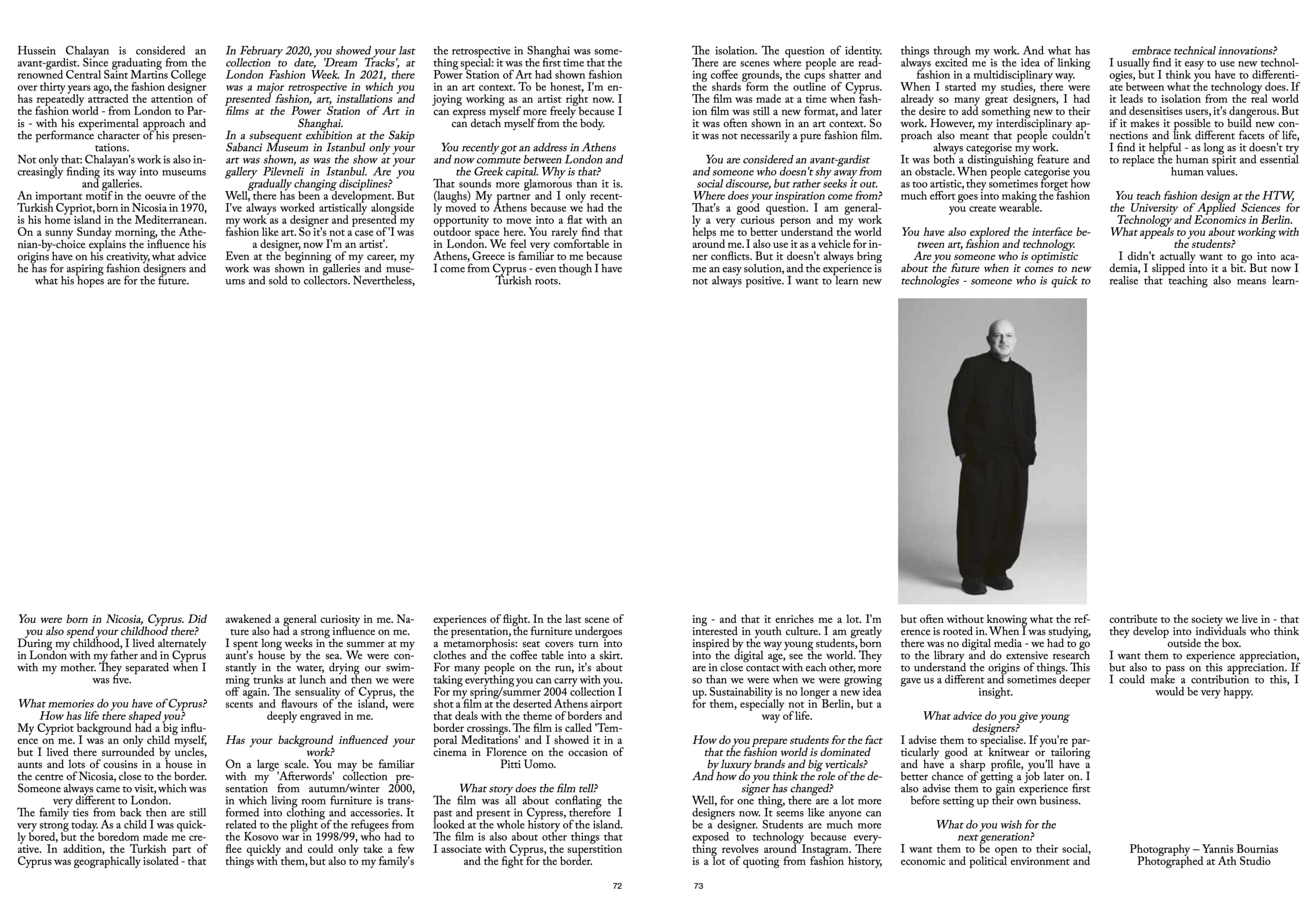
Hussein Chalayan is considered an avant-gardist. Since graduating from the renowned Central Saint Martins College over thirty years ago, the fashion designer has repeatedly attracted the attention of the fashion world – from London to Paris – with his experimental approach and the performance character of his presentations.
Not only that: Chalayan’s work is also increasingly finding its way into museums and galleries.
An important motif in the oeuvre of the Turkish Cypriot, born in Nicosia in 1970, is his home island in the Mediterrancan. On a sunny Sunday morning, the Athenian-by-choice explains the influence his origins have on his creativity, what advice he has for aspiring fashion designers and what his hopes are for the future.
In February 2020, you showed your last collection to date. ‚Dream Tracks‘, at London Fashion Weck. In 2021, there was a major retrospective in which you presented fashion, art, installations and films at the Power Station of Art in Shanghai.
In a subsequent exhibition at the Sakip Sabanci Museum in Istanbul only your art was shown, as was the show at your gallery Pilevneli in Istanbul. Are you gradually changing disciplines?
Well, there has been a development. But I’ve always worked artistically alongside my work as a designer and presented my fashion like art. So it’s not a case of „I was a designer, now I’m an artist“ Even at the beginning of my career, my work was shown in galleries and museums and sold to collectors. Nevertheless, the retrospective in Shanghai was something special: it was the first time that the Power Station of Art had shown fashion in an art context. ‚To be honest, I’m enjoying working as an artist right now. I can express myself more freely because I can detach myself from the body.
You recently got an address in Athens and now commute between London and the Greek capital. Why is that?
That sounds more glamorous than it is. (laughs) My partner and I only recently moved to Athens because we had the opportunity to move into a fat with an outdoor space here. You rarely find that in London. We feel very comfortable in Athens, Greece is familiar to me because I come from Cyprus – even though I have Turkish roots.
You were born in Nicosia, Cyprus. Did you also spend your childhood there?
During my childhood, I lived alternately in London with my father and in Cyprus with my mother. ‚They separated when I was five.
What memories do you have of Cyprus? How has life there shaped you?
My Cypriot background had a big influence on me. I was an only child myself, but I lived there surrounded by uncles, aunts and lots of cousins in a house in the centre of Nicosia, close to the border. Someone always came to visit, which was very different to London.
The family ties from back then are still very strong today. As a child I was quickly bored, but the boredom made me creative. In addition, the Turkish part of Cyprus was geographically isolated – that awakened a general curiosity in me. Nature also had a strong influence on me. I spent long weeks in the summer at my aunt’s house by the sea. We were constantly in the water, drying our swimming trunks at lunch and then we were off again. The sensuality of Cyprus, the scents and flavours of the island, were deeply engraved in me.
Has your background influenced your work?
On a large scale. You may be familiar with my ‚Afterwords‘ collection presentation from autumn/winter 2000, in which living room furniture is transformed into clothing and accessories. It related to the plight of the refugees of the Kosovo war in 1998/99, who had to flee quickly and could only take a few things with them, but also to my family’s experiences of flight. In the last scene of the presentation, the furniture undergoes a metamorphosis: seat covers turn into clothes and the coffee table into a skirt. For many people on the run, it’s about taking everything you can carry with you. For my spring/summer 2004 collection I shot a film at the deserted Athens airport that deals with the theme of borders and border crossings. The film is called „Temporal Meditations‘ and I showed it in a cinema in Florence on the occasion of Pitti Uomo.
What story does the film tell?
The film was all about conflating the past and present in Cypress, therefore I looked at the whole history of the island. The film is also about other things that I associate with Cyprus, the superstition and the fight for the border.
The isolation. The question of identity. There are scenes where people are reading coffee grounds, the cups shatter and the shards form the outline of Cyprus. The film was made at a time when fashion film was still a new format, and later it was often shown in an art context. So it was not necessarily a pure fashion film.
You are considered an avant-gardist and someone who doesn’t shy away from social discourse, but rather seeks it out. Where does your inspiration come from?
That’s a good question. I am generally a very curious person and my work helps me to better understand the world around me. I also use it as a vehicle for inner conflicts. But it doesn’t always bring me an easy solution, and the experience is not always positive. I want to learn new things through my work. And what has always excited me is the idea of linking fashion in a multidisciplinary way.
When I started my studies, there were already so many great designers, I had the desire to add something new to their work. However, my interdisciplinary approach also meant that people couldn’t always categorise my work.
It was both a distinguishing feature and an obstacle. When people categorize you as too artistic, they sometimes forget how much effort goes into making the fashion you create wearable.
You have also explored the interface between art, fashion and technology. Are you someone who is optimistic about the future when it comes to new technologies – someone who is quick to embrace technical innovations?
I usually find it easy to use new technologies, but I think you have to differentiate between what the technology does. If it leads to isolation from the real world and desensitises users, it’s dangerous. But if it makes it possible to build new connections and link different facets of life, I find it helpful – as long as it doesn’t try to replace the human spirit and essential human values.
You teach fashion design at the HTW, the University of Applied Sciences for Technology and Economics in Berlin. What appeals to you about working with the students?
I didn’t actually want to go into academia, I slipped into it a bit. But now I realise that teaching also means learning – and that it enriches me a lot. I’m interested in youth culture. I am greatly inspired by the way young students, born into the digital age, see the world. They are in close contact with each other, more so than we were when we were growing up. Sustainability is no longer a new idea for them, especially not in Berlin, but a way of life.
How do you prepare students for the fact that the fashion world is dominated by luxury brands and big verticals? And how do you think the role of the designer has changed?
Well, for one thing, there are a lot more designers now. It seems like anyone can be a designer. Students are much more exposed to technology because everything revolves around Instagram. There is a lot of quoting from fashion history, but often without knowing what the reference is rooted in. When I was studying, there was no digital media – we had to go to the library and do extensive research to understand the origins of things. This gave us a different and sometimes deeper insight.
What advice do you give young designers?
I advise them to specialise. If you’re particularly good at knitwear or tailoring and have a sharp profile, you’ll have a better chance of getting a job later on. I also advise them to gain experience first before setting up their own business.
What do you wish for the next generation?
I want them to be open to their social, economic and political environment and contribute to the society we live in – that they develop into individuals who think outside the box. I want them to experience appreciation, but also to pass on this appreciation. If I could make a contribution to this, I would be very happy.
Nomas – Cyprus,
2025