Ilona Marx
Editorial work / Concepts / Texts
Spatial verve
Art & Culture / Interior Design / Travel
In their Florentine home, gallerist couple Alessandra Tabacchi and Franco Mariotti prize patina over perfection, filling their interiors with expressive texture and detail.
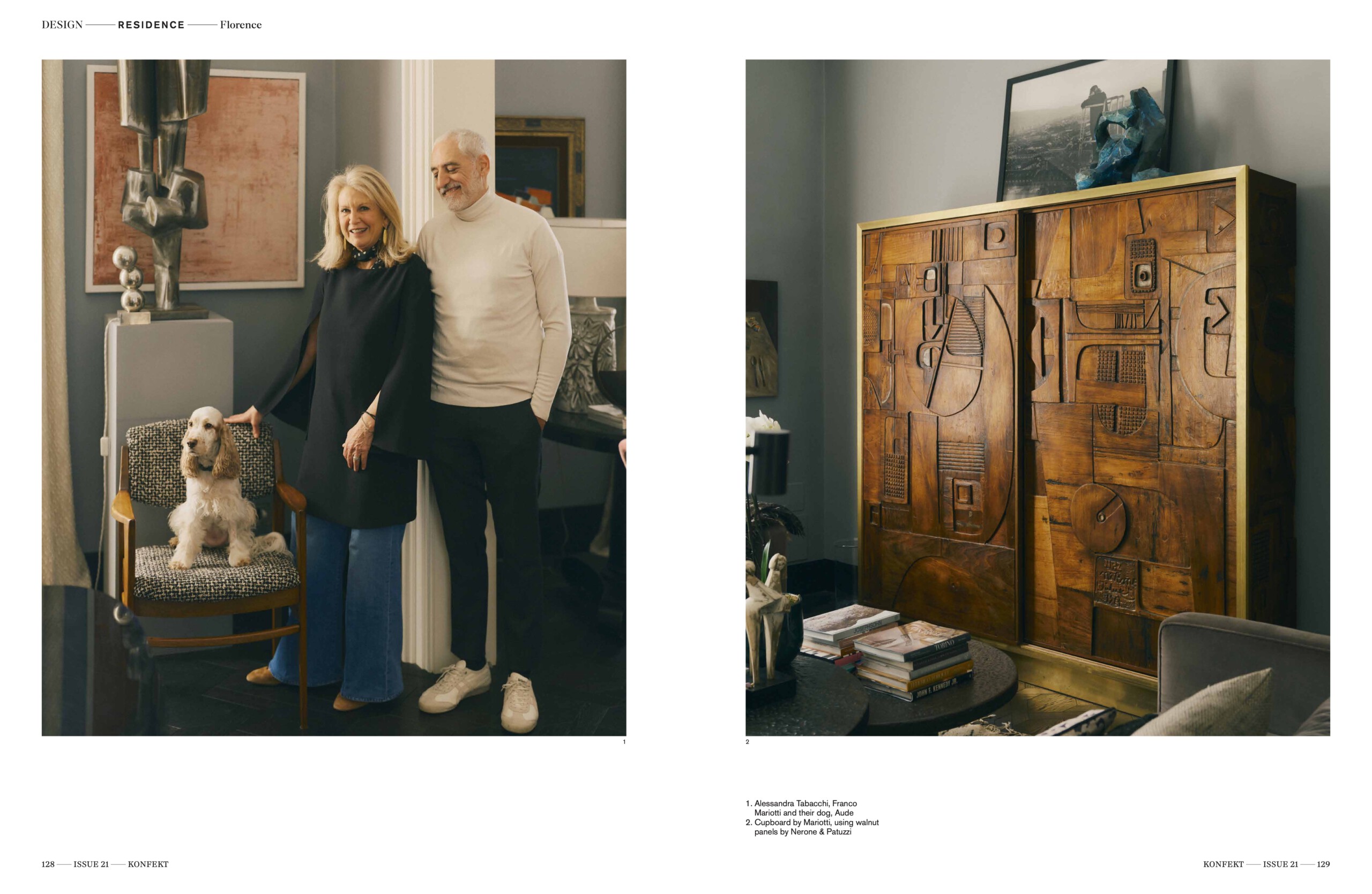
It’s early morning in Florence and gallerists Alessandra Tabacchi and Franco Mariotti have just finished a pot of strong coffee in their home, a few steps behind the US consulate on Corso Italia. „Finding this flat was a stroke of luck,“ says Tabacchi, who is dressed in a vintage Gucci knee-length top and flared jeans, as she and her husband greet Konfekt on the third floor of the apartment block. „This building was designed by Giuseppe Poggi, one of the city’s great architects, and built in 186; when Florence served as the capital,“ adds the gallerist as the couple’s cocker spaniel, Aude, follows us and wags its tail. „It was originally a ministerial residence.“
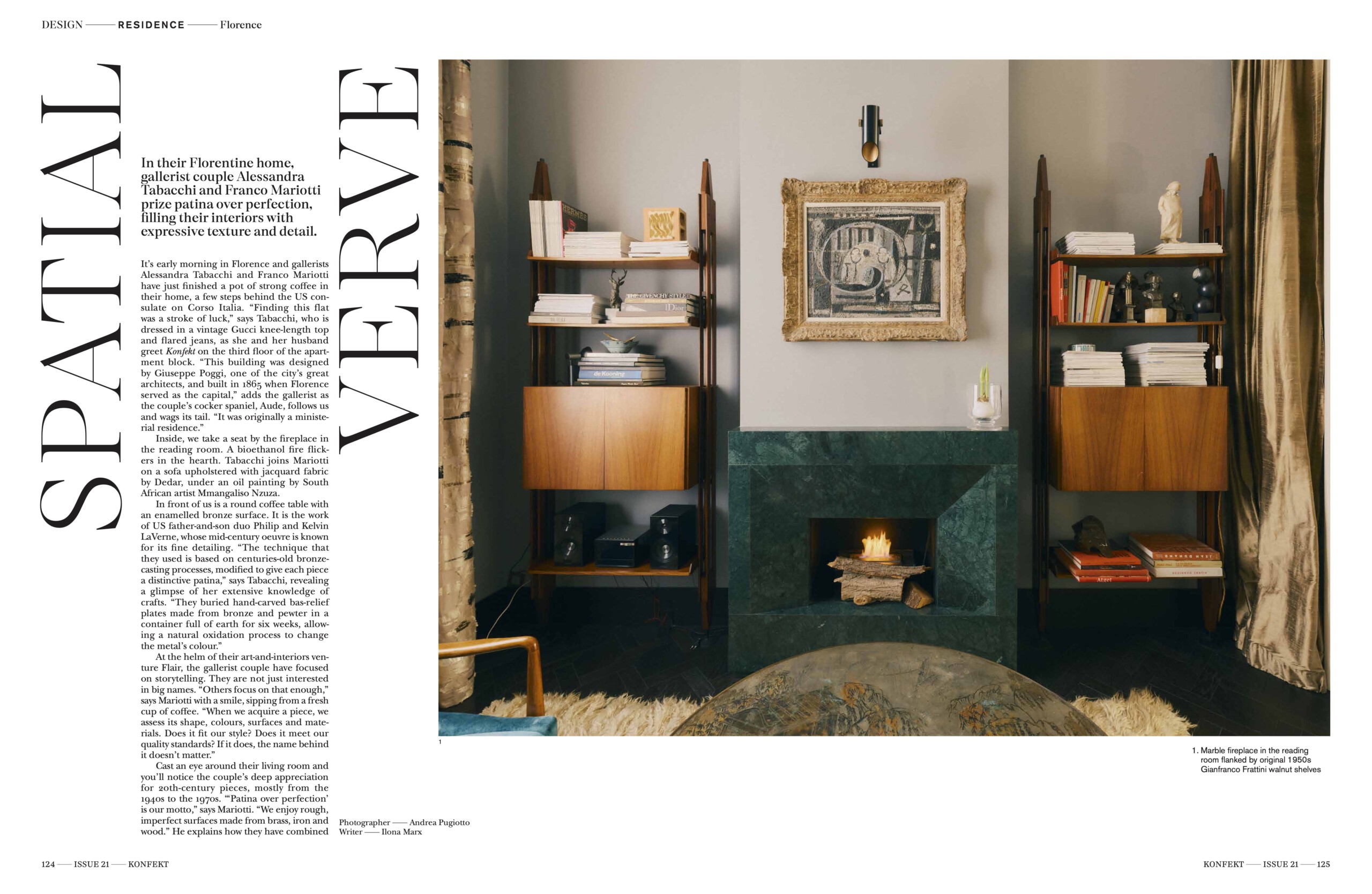
Inside, we take a seat by the fireplace in the reading room. A bioethanol fire flickers in the hearth. Tabacchi joins Mariotti on a sofa upholstered with jacquard fabric by Dedar, under an oil painting by South African artist Mmangaliso Nzuza.
In front of us is a round coffee table with an enamelled bronze surface. It is the work of US father-and-son duo Philip and Kelvin LaVerne, whose mid-century oeuvre is known for its fine detailing. „The technique that they used is based on centuries-old bronze-casting processes, modified to give ach piece a distinctive patina,“ says Tabacchi, revealing a glimpse of her extensive knowledge of crafts. „They buried hand-carved bas-relief plates made from bronze and pewter in a container full of earth for six weeks, allow- ing a natural oxidation process to change the metal’s colour.“
At the helm of their art-and-interiors venture Flair, the gallerist couple have focused on storytelling. They are not just interested in big names. „Others focus on that enough,“ says Mariotti with a smile, sipping from a fresh cup of coffee. „When we acquire a piece, we assess its shape, colours, surfaces and materials. Does it fit our style? Does it meet our quality standards? If it does, the name behind it doesn’t matter.“
Cast an eye around their living room and you’ll notice the couple’s deep appreciation for 20th-century pieces, mostly from the 1940s to the 1970s. „Patina over perfection is our motto,“ says Mariotti. „We enjoy rough, imperfect surfaces made from brass, iron and wood.“ He explains how they have combined these textures with woollen bouclés, velvet and silk for pieces that they have designed themselves, fusing brutalist influences with a love for soft surfaces.
The couple’s fondness for sumptuous textures stems from their roots in Milan’s fashion industry. Tabacchi worked in showrooms for Gianfranco Ferré and Romeo Gigli, while Mariotti has a background in visual merchandising for Gucci and Ralph Lauren. After several decades, they returned to Mariotti’s hometown of Florence to pursue their passion for antiques and opened Flair gallery in Piazza de’ Frescobaldi in 1998.
“We named it after a trendsetting magazine that American writer Fleur Cowles founded back in 1950,” says Tabacchi as she picks up a thick volume about Flair magazines from one of the walnut shelves by Gianfranco Frattini that flank the fireplace in the reading room. “It was celebrated for its blend of fashion, literature, art and travel. The content and imagery were progressive and the production was highly elaborate – it made publishing history. Though it was discontinued after just a year because of cost issues, it was far ahead of its time.”
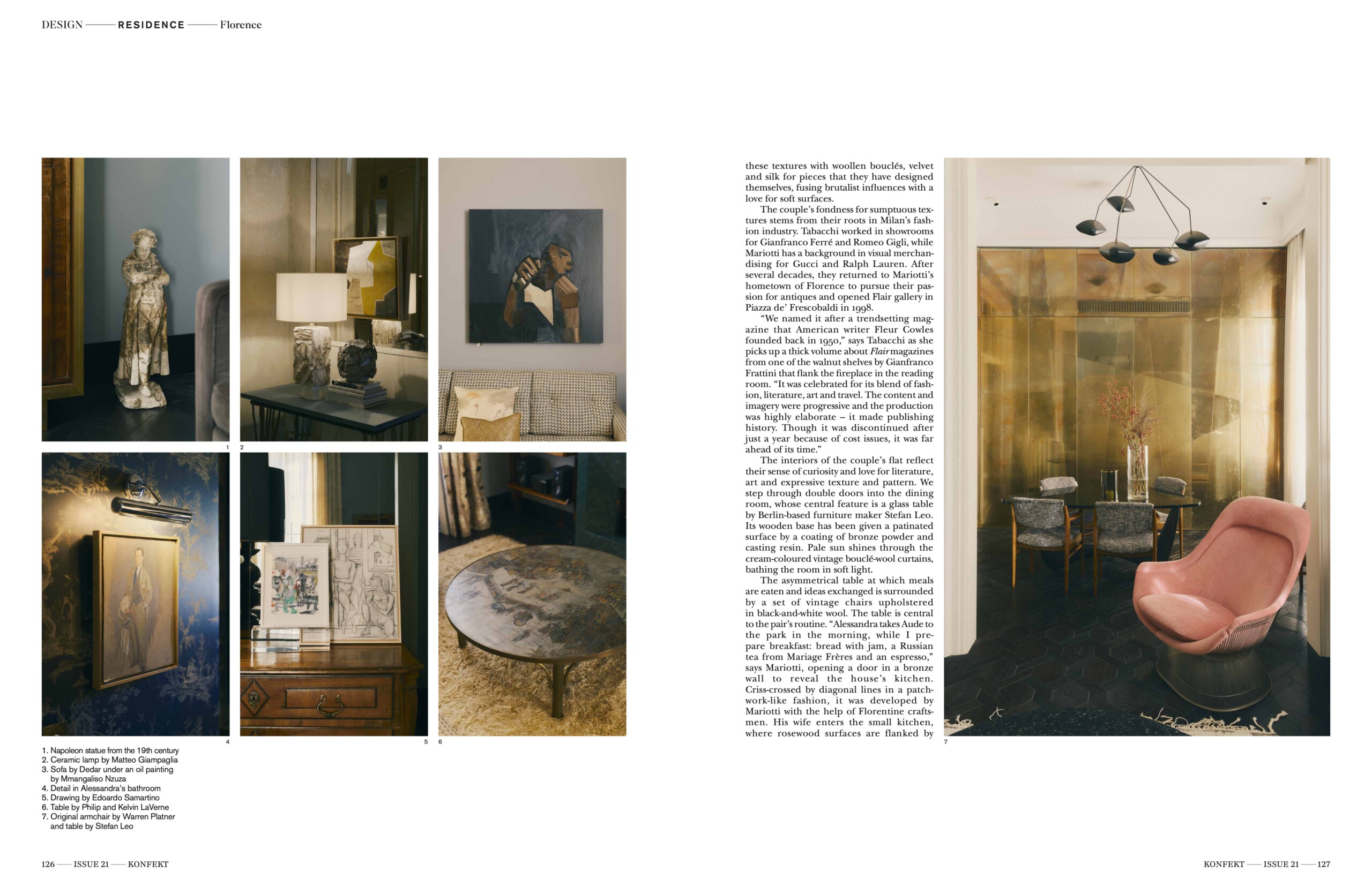
The interiors of the couple’s flat reflect their sense of curiosity and love for literature, art and expressive texture and pattern. We step through double doors into the dining room, whose central feature is a glass table by Berlin-based furniture maker Stefan Leo. Its wooden base has been given a patinated surface by a coating of bronze powder and casting resin. Pale sun shines through the cream-coloured vintage bouclé-wool curtains, bathing the room in soft light.
The asymmetrical table at which meals are eaten and ideas exchanged is surrounded by a set of vintage chairs upholstered in black-and-white wool. The table is central to the pair’s routine. “Alessandra takes Aude to the park in the morning, while I prepare breakfast: bread with jam, a Russian tea from Mariage Frères and an espresso,” says Mariotti, opening a door in a bronze wall to reveal the house’s kitchen. Criss-crossed by diagonal lines in a patchwork-like fashion, it was developed by Mariotti with the help of Florentine craftsmen. His wife enters the small kitchen, where rosewood surfaces are flanked by brown marble interspersed with yellow lines. Tabacchi takes a seat on the mustard-yellow velvet cushion in the seating niche in front of the small window. “We take turns cooking,” she says. “We usually prepare pasta and vegetable dishes. The one who is not at the stove keeps the other company with a glass of wine or a gin and tonic.”
Though they like to do things together and share in life’s experiences, Tabacchi and Mariotti decided to keep things separate in one area. “We have our own bathrooms, which are decorated very differently,” says Mariotti. “Alessandra’s has vintage chinoiserie wallpaper and black Marquina marble, while the marble in mine is grey and textured. She has decorated her bathroom with a collection of East Asian scenes and 19th-century portraits of men, while I have a collection of abstract paintings and prints from the 1960s and 1970s in black and white.”
Beyond the bathrooms, down the hallway, is the bedroom, which is wallpapered in grey silk. The bed itself has a yellow silk headboard, which also displays a chinoiserie. On either side of the bed are cabinets that are covered in cream-coloured parchment and have brass feet and handles. These were also designed by Mariotti.
Tabacchi disappears into a vast walk-in wardrobe. It’s time to open the gallery so she swaps her caramel-coloured suede pumps by Carel for white trainers with yellow soles by Sofie D’Hoore and we set off on the 15-minute walk along the Arno to the Lungarno Corsini, with Aude in tow.
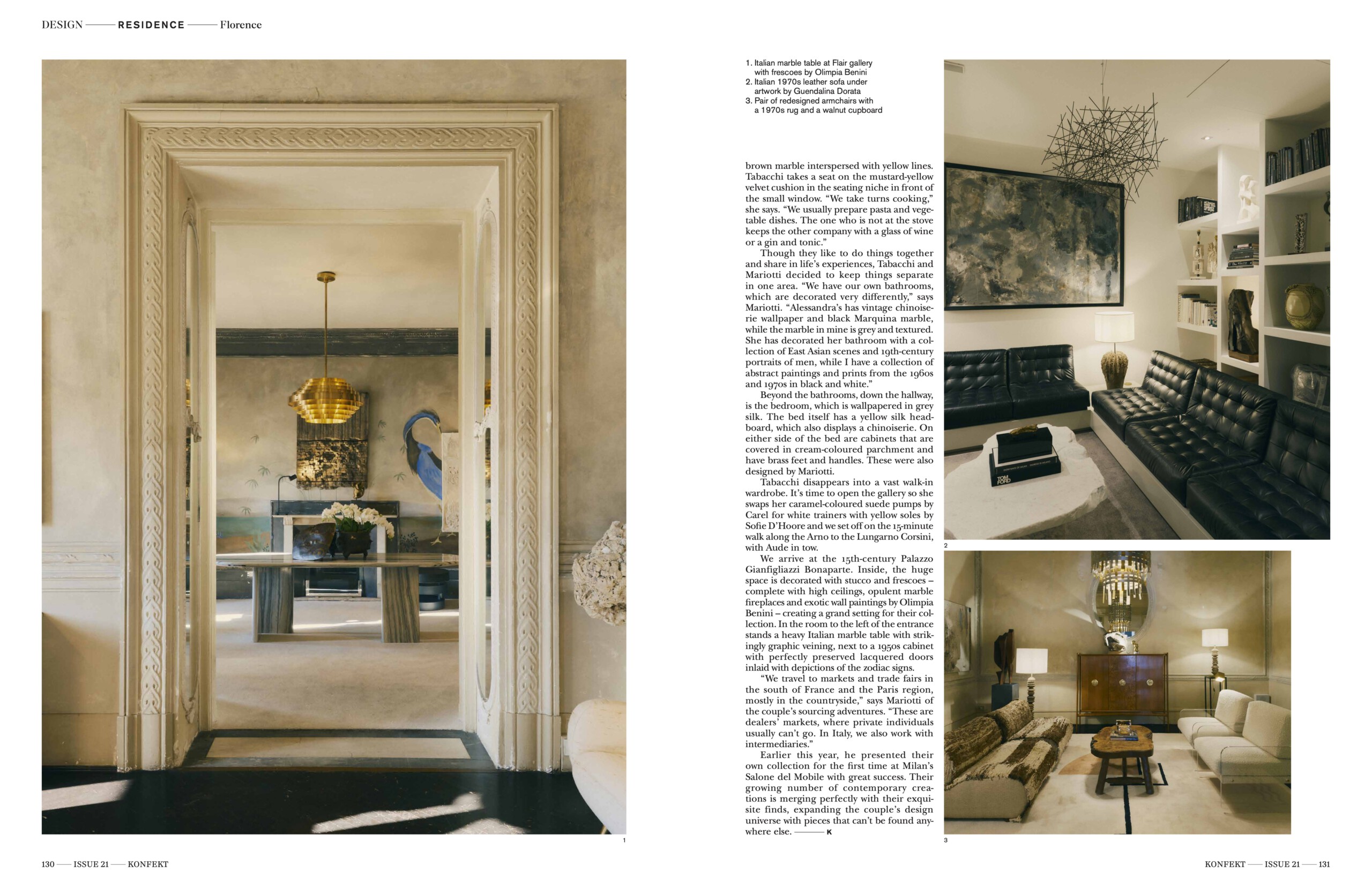
We arrive at the 15th-century Palazzo Gianfigliazzi Bonaparte. Inside, the huge space is decorated with stucco and frescoes – complete with high ceilings, opulent marble fireplaces and exotic wall paintings by Olimpia Benini – creating a grand setting for their collection. In the room to the left of the entrance stands a heavy Italian marble table with strikingly graphic veining, next to a 1950s cabinet with perfectly preserved lacquered doors inlaid with depictions of the zodiac signs.
“We travel to markets and trade fairs in the south of France and the Paris region, mostly in the countryside,” says Mariotti of the couple’s sourcing adventures. “These are dealers’ markets, where private individuals usually can’t go. In Italy, we also work with intermediaries.”
Earlier this year, he presented their own collection for the first time at Milan’s Salone del Mobile with great success. Their growing number of contemporary creations is merging perfectly with their exquisite finds, expanding the couple’s design universe with pieces that can’t be found anywhere else.
Konfekt,
Winter 2025