Ilona Marx
Editorial work / Concepts / Texts
Change of art
Art & Culture / Interior Design / Travel
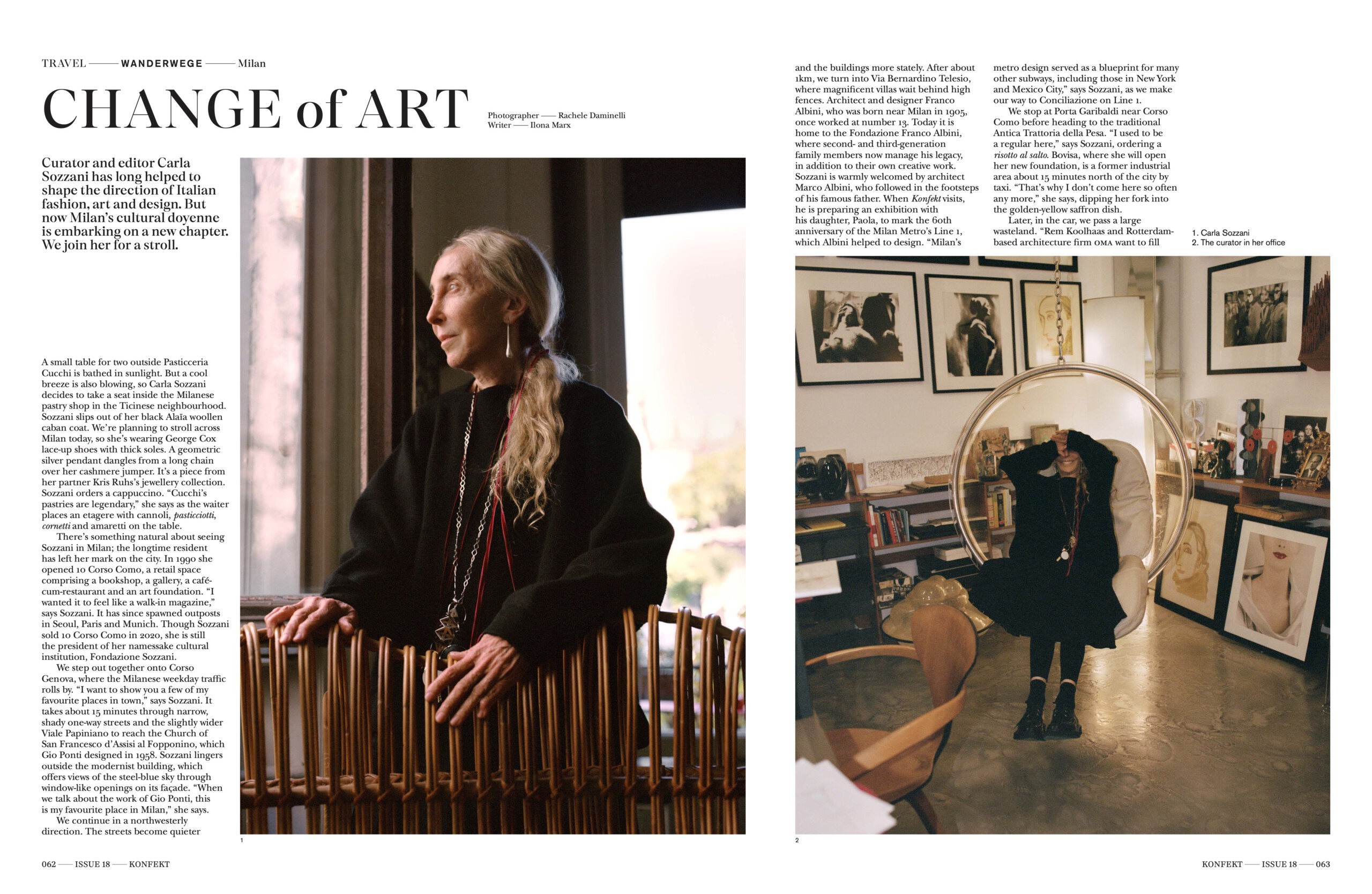
Curator and editor Carla Sozzani has long helped to shape the direction of Italian fashion, art and design. But now Milan’s cultural doyenne is embarking on a new chapter. We join her for a stroll.
A small table for two outside Pasticceria Cucchi is bathed in sunlight. But a cool breeze is also blowing, so Carla Sozzani decides to take a seat inside the Milanese pastry shop in the Ticinese neighbourhood. Sozzani slips out of her black Alaïa woollen caban coat. We’re planning to stroll across Milan today, so she’s wearing George Cox lace-up shoes with thick soles. A geometric silver pendant dangles from a long chain over her cashmere jumper. It’s a piece from her partner Kris Ruhs’s jewellery collection. Sozzani orders a cappuccino. “Cucchi’s pastries are legendary,” she says as the waiter places an etagere with cannoli, pasticciotti, cornetti and amaretti on the table.
There’s something natural about seeing Sozzani in Milan; the longtime resident has left her mark on the city. In 1990 she opened 10 Corso Como, a retail space comprising a bookshop, a gallery, a café- cum-restaurant and an art foundation. “I wanted it to feel like a walk-in magazine,” says Sozzani. It has since spawned outposts in Seoul, Paris and Munich. Though Sozzani sold 10 Corso Como in 2020, she is still the president of her namessake cultural institution, Fondazione Sozzani.
We step out together onto Corso Genova, where the Milanese weekday traffic rolls by. “I want to show you a few of my favourite places in town,” says Sozzani. It takes about 15 minutes through narrow, shady one-way streets and the slightly wider Viale Papiniano to reach the Church of San Francesco d’Assisi al Fopponino, which Gio Ponti designed in 1958. Sozzani lingers outside the modernist building, which offers views of the steel-blue sky through window-like openings on its façade. “When we talk about the work of Gio Ponti, this is my favourite place in Milan,” she says.
We continue in a northwesterly direction. The streets become quieter and the buildings more stately. After about 1km, we turn into Via Bernardino Telesio, where magnificent villas wait behind high fences. Architect and designer Franco Albini, who was born near Milan in 1905, once worked at number 13. Today it is home to the Fondazione Franco Albini, where second- and third-generation family members now manage his legacy, in addition to their own creative work. Sozzani is warmly welcomed by architect Marco Albini, who followed in the footsteps of his famous father. When Konfekt visits, he is preparing an exhibition with his daughter, Paola, to mark the 60th anniversary of the Milan Metro’s Line 1, which Albini helped to design.
“Milan’s metro design served as a blueprint for many other subways, including those in New York and Mexico City,” says Sozzani, as we make our way to Conciliazione on Line 1. We stop at Porta Garibaldi near Corso Como before heading to the traditional Antica Trattoria della Pesa. “I used to be a regular here,” says Sozzani, ordering a risotto al salto. Bovisa, where she will open her new foundation, is a former industrial area about 15 minutes north of the city by taxi. “That’s why I don’t come here so often any more,” she says, dipping her fork into the golden-yellow saffron dish.
Later, in the car, we pass a large wasteland. “Rem Koolhaas and Rotterdam- based architecture firm oma want to fill the empty spaces of Scalo Farini [railway yard],“ says Sozzani. The area has attracted attention thanks to the Renzo Piano-designed Politecnico di Milano design campus, which opened here in 2021.
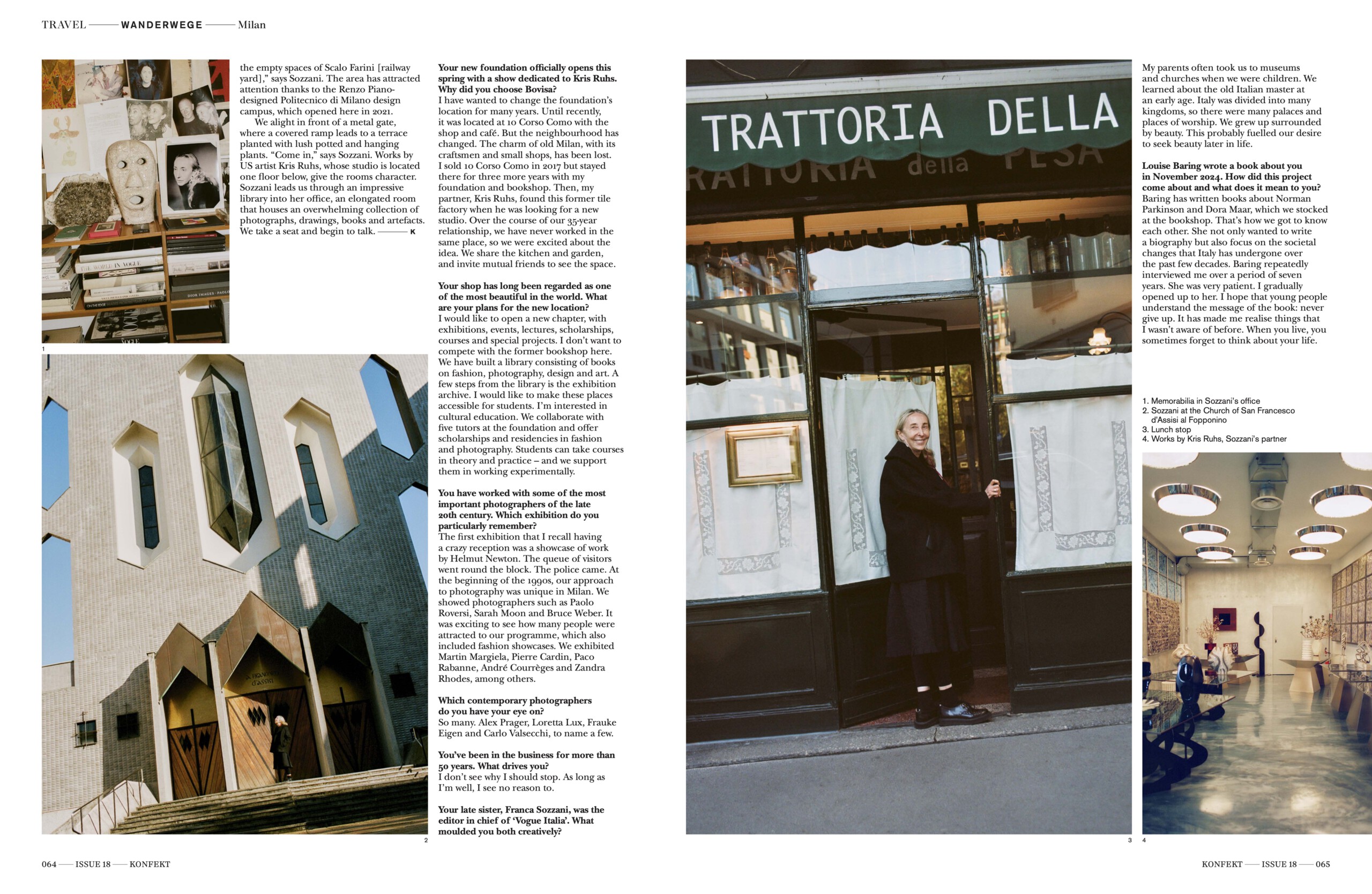
We alight in front of a metal gate, where a covered ramp leads to a terrace planted with lush potted and hanging plants. „Come in,“ says Sozzani. Works by US artist Kris Ruhs, whose studio is located one floor below, give the rooms character. Sozzani leads us through an impressive library into her office, an elongated room that houses an overwhelming collection of photographs, drawings, books and artefacts. We take a seat and begin to talk.
Your new foundation officially opens this spring with a show dedicated to Kris Ruhs. Why did you choose Bovisa?
I have wanted to change the foundation’s location for many years. Until recently,
it was located at 10 Corso Como with the shop and café. But the neighbourhood has changed. The charm of old Milan, with its craftsmen and small shops, has been lost. I sold 10 Corso Como in 2017 but stayed there for three more years with my foundation and bookshop. Then, my partner, Kris Ruhs, found this former tile factory when he was looking for a new studio. Over the course of our 35-year relationship, we have never worked in the same place, so we were excited about the idea. We share the kitchen and garden, and invite mutual friends to see the space.
Your shop has long been regarded as one of the most beautiful in the world. What are your plans for the new location?
I would like to open a new chapter, with exhibitions, events, lectures, scholarships, courses and special projects. I don’t want to compete with the former bookshop here. We have built a library consisting of books on fashion, photography, design and art. A few steps from the library is the exhibition archive. I would like to make these places accessible for students. I’m interested in cultural education. We collaborate with five tutors at the foundation and offer scholarships and residencies in fashion and photography. Students can take courses in theory and practice – and we support them in working experimentally.
You have worked with some of the most important photographers of the late 20th century. Which exhibition do you particularly remember?
The first exhibition that I recall having a crazy reception was a showcase of work by Helmut Newton. The queue of visitors went round the block. The police came. At the beginning of the 1990s, our approach to photography was unique in Milan. We showed photographers such as Paolo Roversi, Sarah Moon and Bruce Weber. It was exciting to see how many people were attracted to our programme, which also included fashion showcases. We exhibited Martin Margiela, Pierre Cardin, Paco Rabanne, André Courrèges and Zandra Rhodes, among others.
Which contemporary photographers do you have your eye on?
So many. Alex Prager, Loretta Lux, Frauke Eigen and Carlo Valsecchi, to name a few.
You’ve been in the business for more than 50 years. What drives you?
I don’t see why I should stop. As long as I’m well, I see no reason to.
Your late sister, Franca Sozzani, was the editor in chief of ‘Vogue Italia’. What moulded you both creatively?
My parents often took us to museums and churches when we were children. We learned about the old Italian master at an early age. Italy was divided into many kingdoms, so there were many palaces and places of worship. We grew up surrounded by beauty. This probably fuelled our desire to seek beauty later in life.
Louise Baring wrote a book about you in November 2024. How did this project come about and what does it mean to you?
Baring has written books about Norman Parkinson and Dora Maar, which we stocked at the bookshop. That’s how we got to know each other. She not only wanted to write a biography but also focus on the societal changes that Italy has undergone over the past few decades. Baring repeatedly interviewed me over a period of seven years. She was very patient. I gradually opened up to her. I hope that young people understand the message of the book: never give up. It has made me realise things that I wasn’t aware of before. When you live, you sometimes forget to think about your life.
Konfekt,
Spring 2025