Ilona Marx
Editorial work / Concepts / Texts
Treasure hunters
Fashion / Food / Interior Design / Travel
A meal at Sissi Pohle and Pat Scherzer’s home is always a sumptuous affair. The founders of vintage and antique shop Outofuseberlin and set-design label Tables and Food certainly know how to put on a good show.
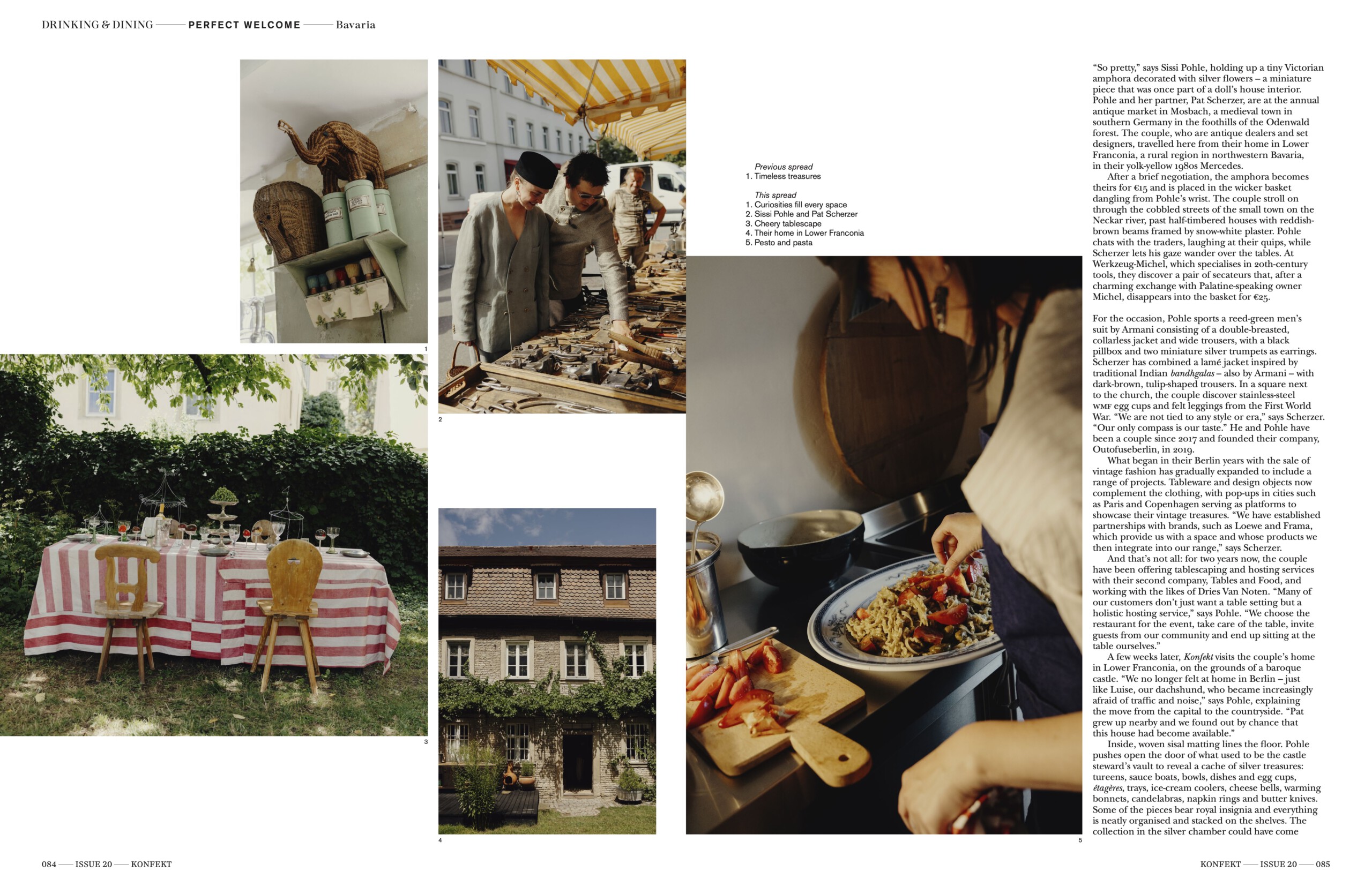
“So pretty,” says Sissi Pohle, holding up a tiny Victorian amphora decorated with silver flowers – a miniature piece that was once part of a doll’s house interior. Pohle and her partner, Pat Scherzer, are at the annual antique market in Mosbach, a medieval town in southern Germany in the foothills of the Odenwald forest. The couple, who are antique dealers and set designers, travelled here from their home in Lower Franconia, a rural region in northwestern Bavaria, in their yolk-yellow 1980s Mercedes.
After a brief negotiation, the amphora becomes theirs for €15 and is placed in the wicker basket dangling from Pohle’s wrist. The couple stroll on through the cobbled streets of the small town on the Neckar river, past half-timbered houses with reddish- brown beams framed by snow-white plaster. Pohle chats with the traders, laughing at their quips, while Scherzer lets his gaze wander over the tables. At Werkzeug-Michel, which specialises in 20th-century tools, they discover a pair of secateurs that, after a charming exchange with Palatine-speaking owner Michel, disappears into the basket for €25.
For the occasion, Pohle sports a reed-green men’s suit by Armani consisting of a double-breasted, collarless jacket and wide trousers, with a black pillbox and two miniature silver trumpets as earrings. Scherzer has combined a lamé jacket inspired by traditional Indian bandhgalas – also by Armani – with dark-brown, tulip-shaped trousers. In a square next to the church, the couple discover stainless-steel WMF egg cups and felt leggings from the First World War. “We are not tied to any style or era,” says Scherzer. “Our only compass is our taste.” He and Pohle have been a couple since 2017 and founded their company, Outofuseberlin, in 2019.
What began in their Berlin years with the sale of vintage fashion has gradually expanded to include a range of projects. Tableware and design objects now complement the clothing, with pop-ups in cities such as Paris and Copenhagen serving as platforms to showcase their vintage treasures. “We have established partnerships with brands, such as Loewe and Frama, which provide us with a space and whose products we then integrate into our range,” says Scherzer.
And that’s not all: for two years now, the couple have been offering tablescaping and hosting services with their second company, Tables and Food, and working with the likes of Dries Van Noten. “Many of our customers don’t just want a table setting but a holistic hosting service,” says Pohle. “We choose the restaurant for the event, take care of the table, invite guests from our community and end up sitting at the table ourselves.”
A few weeks later, Konfekt visits the couple’s home in Lower Franconia, on the grounds of a baroque castle. “We no longer felt at home in Berlin – just like Luise, our dachshund, who became increasingly afraid of traffic and noise,” says Pohle, explaining the move from the capital to the countryside. “Pat grew up nearby and we found out by chance that this house had become available.”
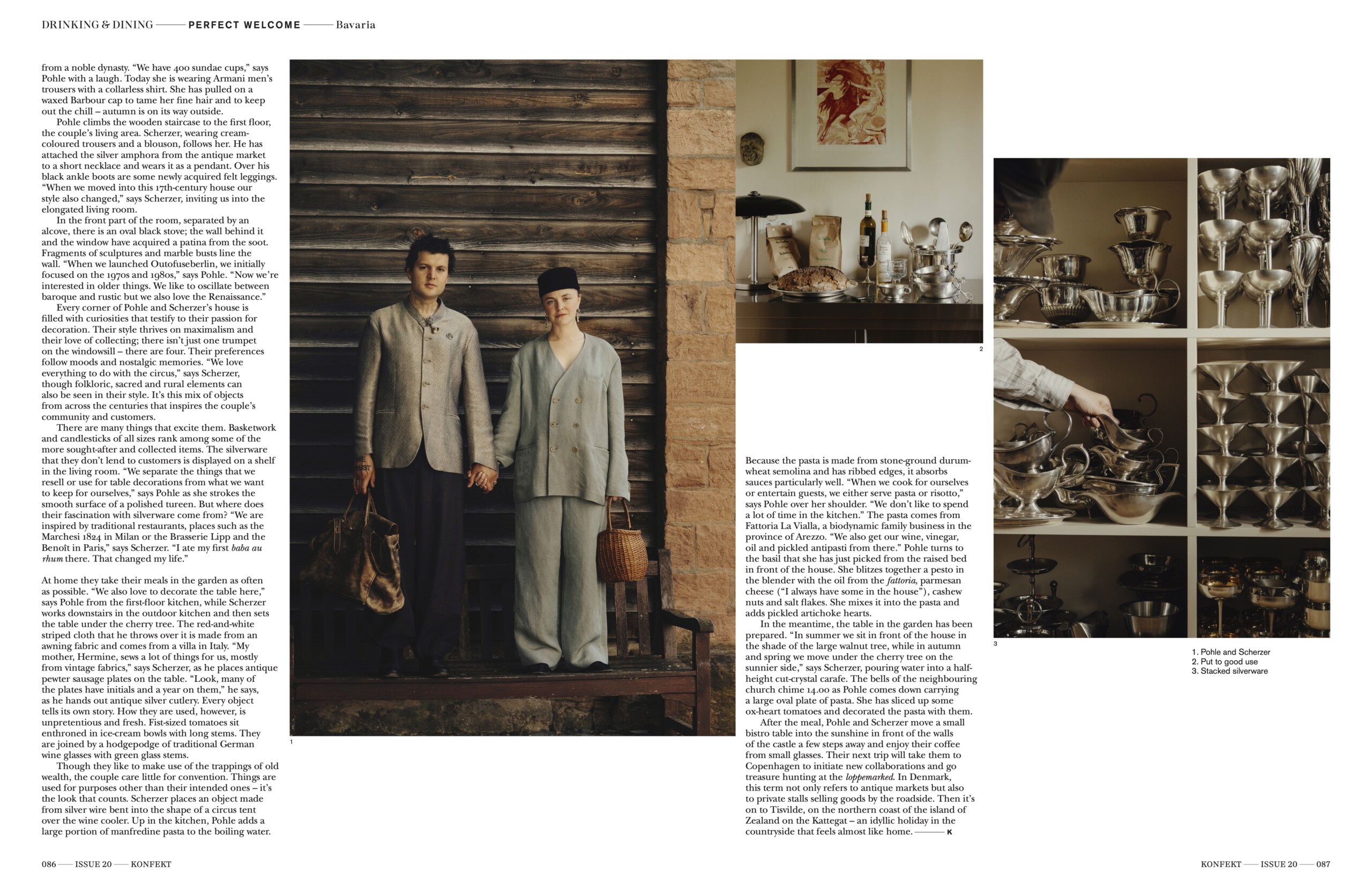
Inside, woven sisal matting lines the floor. Pohle pushes open the door of what used to be the castle steward’s vault to reveal a cache of silver treasures: tureens, sauce boats, bowls, dishes and egg cups, étagères, trays, ice-cream coolers, cheese bells, warming bonnets, candelabras, napkin rings and butter knives. Some of the pieces bear royal insignia and everything is neatly organised and stacked on the shelves. The collection in the silver chamber could have come from a noble dynasty. “We have 400 sundae cups,” says Pohle with a laugh. Today she is wearing Armani men’s trousers with a collarless shirt. She has pulled on a waxed Barbour cap to tame her fine hair and to keep out the chill – autumn is on its way outside.
Pohle climbs the wooden staircase to the first floor, the couple’s living area. Scherzer, wearing cream- coloured trousers and a blouson, follows her. He has attached the silver amphora from the antique market to a short necklace and wears it as a pendant. Over his black ankle boots are some newly acquired felt leggings. “When we moved into this 17th-century house our style also changed,” says Scherzer, inviting us into the elongated living room.
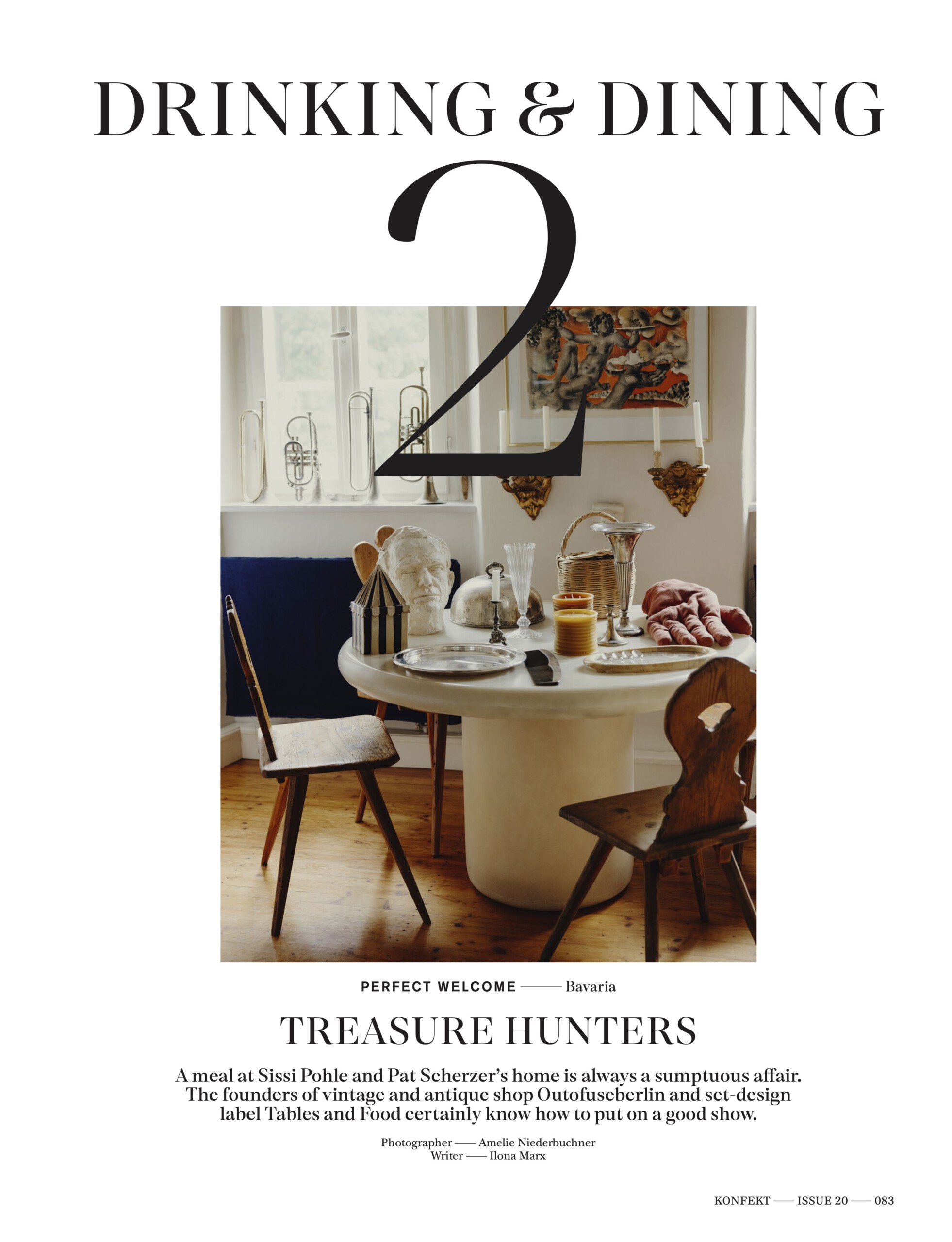
In the front part of the room, separated by an alcove, there is an oval black stove; the wall behind it and the window have acquired a patina from the soot. Fragments of sculptures and marble busts line the wall. “When we launched Outofuseberlin, we initially focused on the 1970s and 1980s,” says Pohle. “Now we’re interested in older things. We like to oscillate between baroque and rustic but we also love the Renaissance.”
Every corner of Pohle and Scherzer’s house is filled with curiosities that testify to their passion for decoration. Their style thrives on maximalism and their love of collecting; there isn’t just one trumpet on the windowsill – there are four. Their preferences follow moods and nostalgic memories. “We love everything to do with the circus,” says Scherzer, though folkloric, sacred and rural elements can also be seen in their style. It’s this mix of objects from across the centuries that inspires the couple’s community and customers.
There are many things that excite them. Basketwork and candlesticks of all sizes rank among some of the more sought-after and collected items. The silverware that they don’t lend to customers is displayed on a shelf in the living room. “We separate the things that we resell or use for table decorations from what we want to keep for ourselves,” says Pohle as she strokes the smooth surface of a polished tureen. But where does their fascination with silverware come from? “We are inspired by traditional restaurants, places such as the Marchesi 1824 in Milan or the Brasserie Lipp and the Benoît in Paris,” says Scherzer. “I ate my first baba au rhum there. That changed my life.”
At home they take their meals in the garden as often as possible. “We also love to decorate the table here,” says Pohle from the first-floor kitchen, while Scherzer works downstairs in the outdoor kitchen and then sets the table under the cherry tree. The red-and-white striped cloth that he throws over it is made from an awning fabric and comes from a villa in Italy. “My mother, Hermine, sews a lot of things for us, mostly from vintage fabrics,” says Scherzer, as he places antique pewter sausage plates on the table. “Look, many of the plates have initials and a year on them,” he says, as he hands out antique silver cutlery. Every object tells its own story. How they are used, however, is unpretentious and fresh. Fist-sized tomatoes sit enthroned in ice-cream bowls with long stems. They are joined by a hodgepodge of traditional German wine glasses with green glass stems.
Though they like to make use of the trappings of old wealth, the couple care little for convention. Things are used for purposes other than their intended ones – it’s the look that counts. Scherzer places an object made from silver wire bent into the shape of a circus tent over the wine cooler. Up in the kitchen, Pohle adds a large portion of manfredine pasta to the boiling water. Because the pasta is made from stone-ground durum- wheat semolina and has ribbed edges, it absorbs sauces particularly well. “When we cook for ourselves or entertain guests, we either serve pasta or risotto,” says Pohle over her shoulder. “We don’t like to spend a lot of time in the kitchen.” The pasta comes from Fattoria La Vialla, a biodynamic family business in the province of Arezzo. “We also get our wine, vinegar, oil and pickled antipasti from there.” Pohle turns to the basil that she has just picked from the raised bed in front of the house. She blitzes together a pesto in the blender with the oil from the fattoria, parmesan cheese (“I always have some in the house”), cashew nuts and salt flakes. She mixes it into the pasta and adds pickled artichoke hearts.
In the meantime, the table in the garden has been prepared. “In summer we sit in front of the house in the shade of the large walnut tree, while in autumn and spring we move under the cherry tree on the sunnier side,” says Scherzer, pouring water into a half- height cut-crystal carafe. The bells of the neighbouring church chime 14.00 as Pohle comes down carrying a large oval plate of pasta. She has sliced up some ox-heart tomatoes and decorated the pasta with them.
After the meal, Pohle and Scherzer move a small bistro table into the sunshine in front of the walls of the castle a few steps away and enjoy their coffee from small glasses. Their next trip will take them to Copenhagen to initiate new collaborations and go treasure hunting at the loppemarked. In Denmark, this term not only refers to antique markets but also to private stalls selling goods by the road–side. Then it’s on to Tisvilde, on the northern coast of the island of Zealand on the Kattegat – an idyllic holiday in the countryside that feels almost like home.
Konfekt,
Autumn 2025