Ilona Marx
Editorial work / Concepts / Texts
Blue dye thinking
Art & Culture / Fashion / Travel
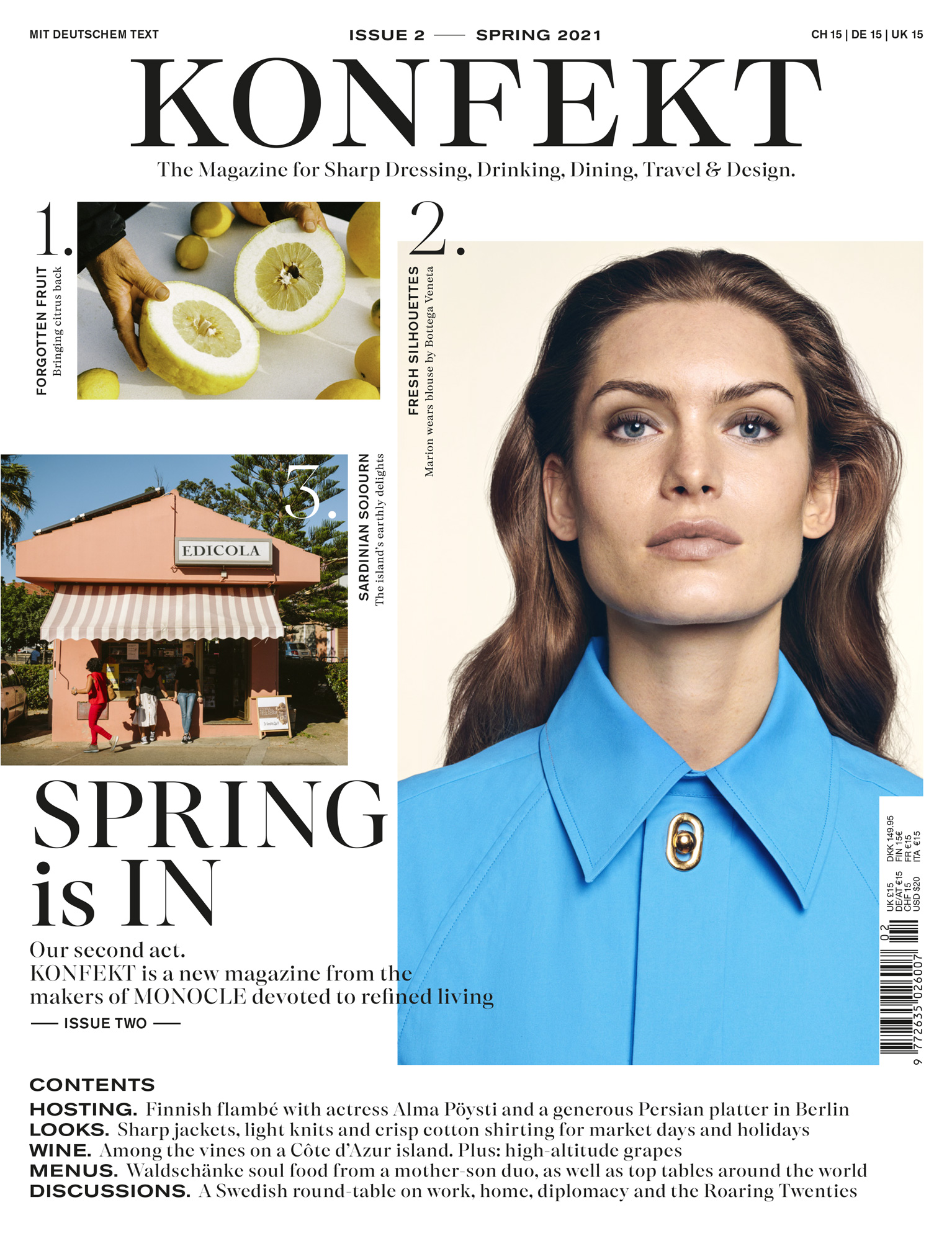
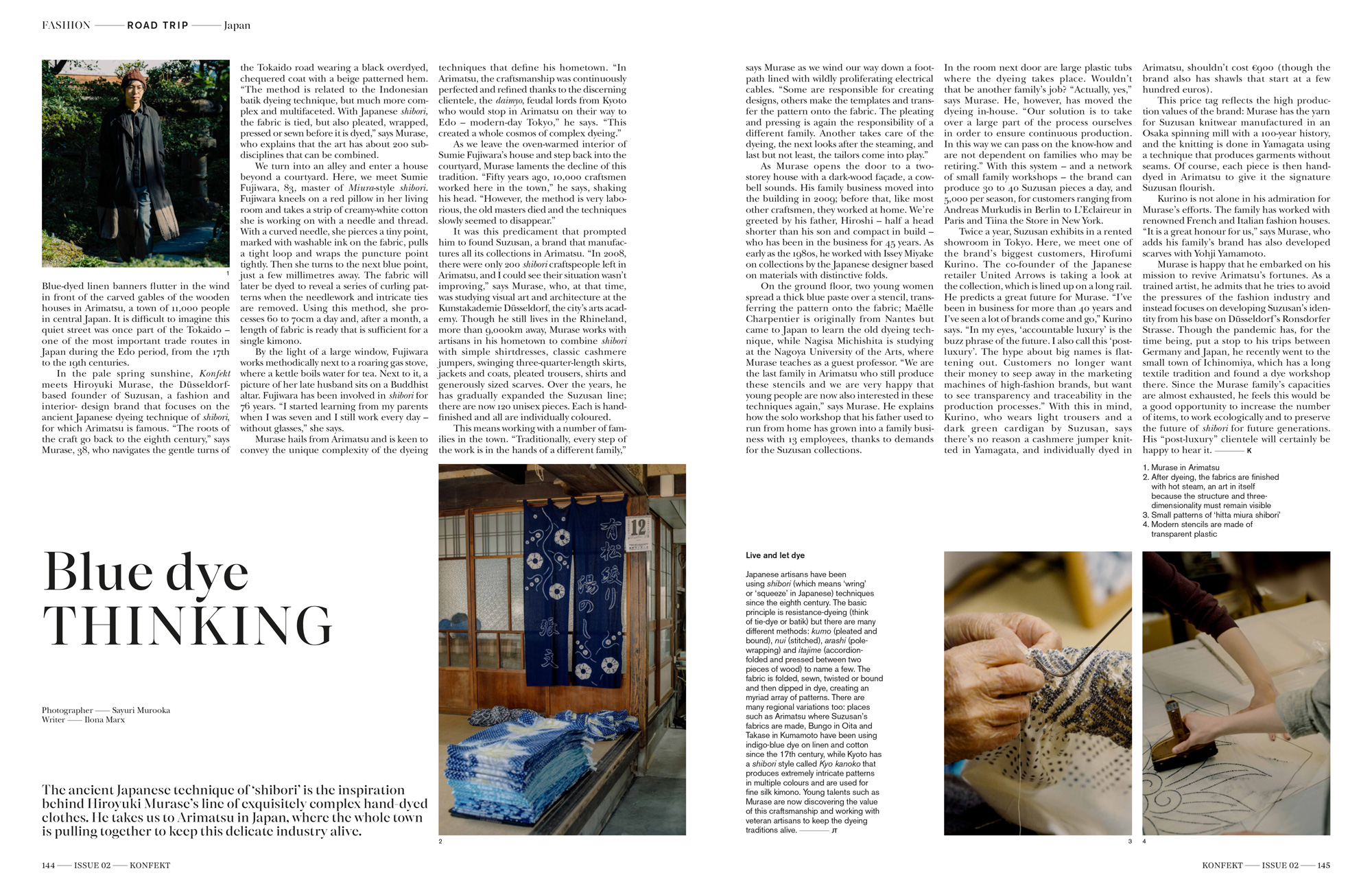
The ancient Japanese technique of ‘shibori’ is the inspiration behind Hiroyuki Murase’s line of exquisitely complex hand-dyed clothes. He takes us to Arimatsu in Japan, where the whole town is pulling together to keep this delicate industry alive.
Blue-dyed linen banners flutter in the wind in front of the carved gables of the wooden houses in Arimatsu, a town of 11,000 people in central Japan. It is difficult to imagine this quiet street was once part of the Tokaido – one of the most important trade routes in Japan during the Edo period, from the 17th to the 19th centuries.
In the pale spring sunshine, Konfekt meets Hiroyuki Murase, the Düsseldorf-based founder of Suzusan, a fashion and interior- design brand that focuses on the ancient Japanese dyeing technique of shibori, for which Arimatsu is famous. “The roots of the craft go back to the eighth century,” says Murase, 38, who navigates the gentle turns of the Tokaido road wearing a black overdyed, chequered coat with a beige patterned hem. “The method is related to the Indonesian batik dyeing technique, but much more complex and multifaceted. With Japanese shibori, the fabric is tied, but also pleated, wrapped, pressed or sewn before it is dyed,” says Murase, who explains that the art has about 200 subdisciplines that can be combined.
We turn into an alley and enter a house beyond a courtyard. Here, we meet Sumie Fujiwara, 83, master of Miurastyle shibori. Fujiwara kneels on a red pillow in her living room and takes a strip of creamy-white cotton she is working on with a needle and thread. With a curved needle, she pierces a tiny point, marked with washable ink on the fabric, pulls a tight loop and wraps the puncture point tightly. Then she turns to the next blue point, just a few millimetres away. The fabric will later be dyed to reveal a series of curling patterns when the needlework and intricate ties are removed. Using this method, she processes 60 to 70cm a day and, after a month, a length of fabric is ready that is sufficient for a single kimono.
By the light of a large window, Fujiwara works methodically next to a roaring gas stove, where a kettle boils water for tea. Next to it, a picture of her late husband sits on a Buddhist altar. Fujiwara has been involved in shibori for 76 years. “I started learning from my parents when I was seven and I still work every day – without glasses,” she says.
Murase hails from Arimatsu and is keen to convey the unique complexity of the dyeing techniques that define his hometown. “In Arimatsu, the craftsmanship was continuously perfected and refined thanks to the discerning clientele, the daimyo, feudal lords from Kyoto who would stop in Arimatsu on their way to Edo – modernday Tokyo,” he says. “This created a whole cosmos of complex dyeing.”
As we leave the oven-warmed interior of Sumie Fujiwara’s house and step back into the courtyard, Murase laments the decline of this tradition. “Fifty years ago, 10,000 craftsmen worked here in the town,” he says, shaking his head. “However, the method is very laborious, the old masters died and the techniques slowly seemed to disappear.”
It was this predicament that prompted him to found Suzusan, a brand that manufactures all its collections in Arimatsu. “In 2008, there were only 200 shibori craftspeople left in Arimatsu, and I could see their situation wasn’t improving,” says Murase, who, at that time, was studying visual art and architecture at the Kunstakademie Düsseldorf, the city’s arts academy. Though he still lives in the Rhineland, more than 9,000km away, Murase works with artisans in his hometown to combine shibori with simple shirtdresses, classic cashmere jumpers, swinging three-quarter-length skirts, jackets and coats, pleated trousers, shirts and generously sized scarves. Over the years, he has gradually expanded the Suzusan line; there are now 120 unisex pieces. Each is hand finished and all are individually coloured.
This means working with a number of families in the town. “Traditionally, every step of the work is in the hands of a different family,” says Murase as we wind our way down a footpath lined with wildly proliferating electrical cables. “Some are responsible for creating designs, others make the templates and transfer the pattern onto the fabric. The pleating and pressing is again the responsibility of a different family. Another takes care of the dyeing, the next looks after the steaming, and last but not least, the tailors come into play.”
As Murase opens the door to a two storey house with a darkwood façade, a cowbell sounds. His family business moved into the building in 2009; before that, like most other craftsmen, they worked at home. We’re greeted by his father, Hiroshi – half a head shorter than his son and compact in build – who has been in the business for 45 years. As early as the 1980s, he worked with Issey Miyake on collections by the Japanese designer based on materials with distinctive folds.
On the ground floor, two young women spread a thick blue paste over a stencil, transferring the pattern onto the fabric; Maëlle Charpentier is originally from Nantes but came to Japan to learn the old dyeing technique, while Nagisa Michishita is studying at the Nagoya University of the Arts, where Murase teaches as a guest professor. “We are the last family in Arimatsu who still produce these stencils and we are very happy that young people are now also interested in these techniques again,” says Murase. He explains how the solo workshop that his father used to run from home has grown into a family business with 13 employees, thanks to demands for the Suzusan collections.
In the room next door are large plastic tubs where the dyeing takes place. Wouldn’t that be another family’s job? “Actually, yes,” says Murase. He, however, has moved the dyeing inhouse. “Our solution is to take over a large part of the process ourselves in order to ensure continuous production. In this way we can pass on the knowhow and are not dependent on families who may be retiring.” With this system – and a network of small family workshops – the brand can produce 30 to 40 Suzusan pieces a day, and 5,000 per season, for customers ranging from Andreas Murkudis in Berlin to L’Eclaireur in Paris and Tiina the Store in New York.
Twice a year, Suzusan exhibits in a rented showroom in Tokyo. Here, we meet one of the brand’s biggest customers, Hirofumi Kurino. The co-founder of the Japanese retailer United Arrows is taking a look at the collection, which is lined up on a long rail. He predicts a great future for Murase. “I’ve been in business for more than 40 years and I’ve seen a lot of brands come and go,” Kurino says. “In my eyes, ‘accountable luxury’ is the buzz phrase of the future. I also call this ‘post- luxury’. The hype about big names is flattening out. Customers no longer want their money to seep away in the marketing machines of highfashion brands, but want to see transparency and traceability in the production processes.” With this in mind, Kurino, who wears light trousers and a dark green cardigan by Suzusan, says there’s no reason a cashmere jumper knitted in Yamagata, and individually dyed in Arimatsu, shouldn’t cost €900 (though the brand also has shawls that start at a few hundred euros).
This price tag reflects the high production values of the brand: Murase has the yarn for Suzusan knitwear manufactured in an Osaka spinning mill with a 100-year history, and the knitting is done in Yamagata using a technique that produces garments without seams. Of course, each piece is then hand-dyed in Arimatsu to give it the signature Suzusan flourish.
Kurino is not alone in his admiration for Murase’s efforts. The family has worked with renowned French and Italian fashion houses. “It is a great honour for us,” says Murase, who adds his family’s brand has also developed scarves with Yohji Yamamoto.
Murase is happy that he embarked on his mission to revive Arimatsu’s fortunes. As a trained artist, he admits that he tries to avoid the pressures of the fashion industry and instead focuses on developing Suzusan’s identity from his base on Düsseldorf’s Ronsdorfer Strasse. Though the pandemic has, for the time being, put a stop to his trips between Germany and Japan, he recently went to the small town of Ichinomiya, which has a long textile tradition and found a dye workshop there. Since the Murase family’s capacities are almost exhausted, he feels this would be a good opportunity to increase the number of items, to work ecologically and to preserve the future of shibori for future generations. His “post-luxury” clientele will certainly be happy to hear it.
Live and let dye
Japanese artisans have been using shibori (which means ‘wring’ or ‘squeeze’ in Japanese) techniques since the eighth century. The basic principle is resistance-dyeing (think of tie-dye or batik) but there are many different methods: kumo (pleated and bound), nui (stitched), arashi (pole wrapping) and itajime (accordion-folded and pressed between two pieces of wood) to name a few. The fabric is folded, sewn, twisted or bound and then dipped in dye, creating an myriad array of patterns. There are many regional variations too: places such as Arimatsu where Suzusan’s fabrics are made, Bungo in Oita and Takase in Kumamoto have been using indigo-blue dye on linen and cotton since the 17th century, while Kyoto has a shibori style called Kyo kanoko that produces extremely intricate patterns in multiple colours and are used for fine silk kimono. Young talents such as Murase are now discovering the value of this craftsmanship and working with veteran artisans to keep the dyeing traditions alive.
Konfekt,
February 2022