Ilona Marx
Editorial work / Concepts / Texts
Culinary portrait
Art & Culture / Food / Travel
Victoire de Taillac-Touhami’s Parisian apartment is the setting for her recreation of a childhood dish. And not even a visit from the Louvre can interrupt dinner.
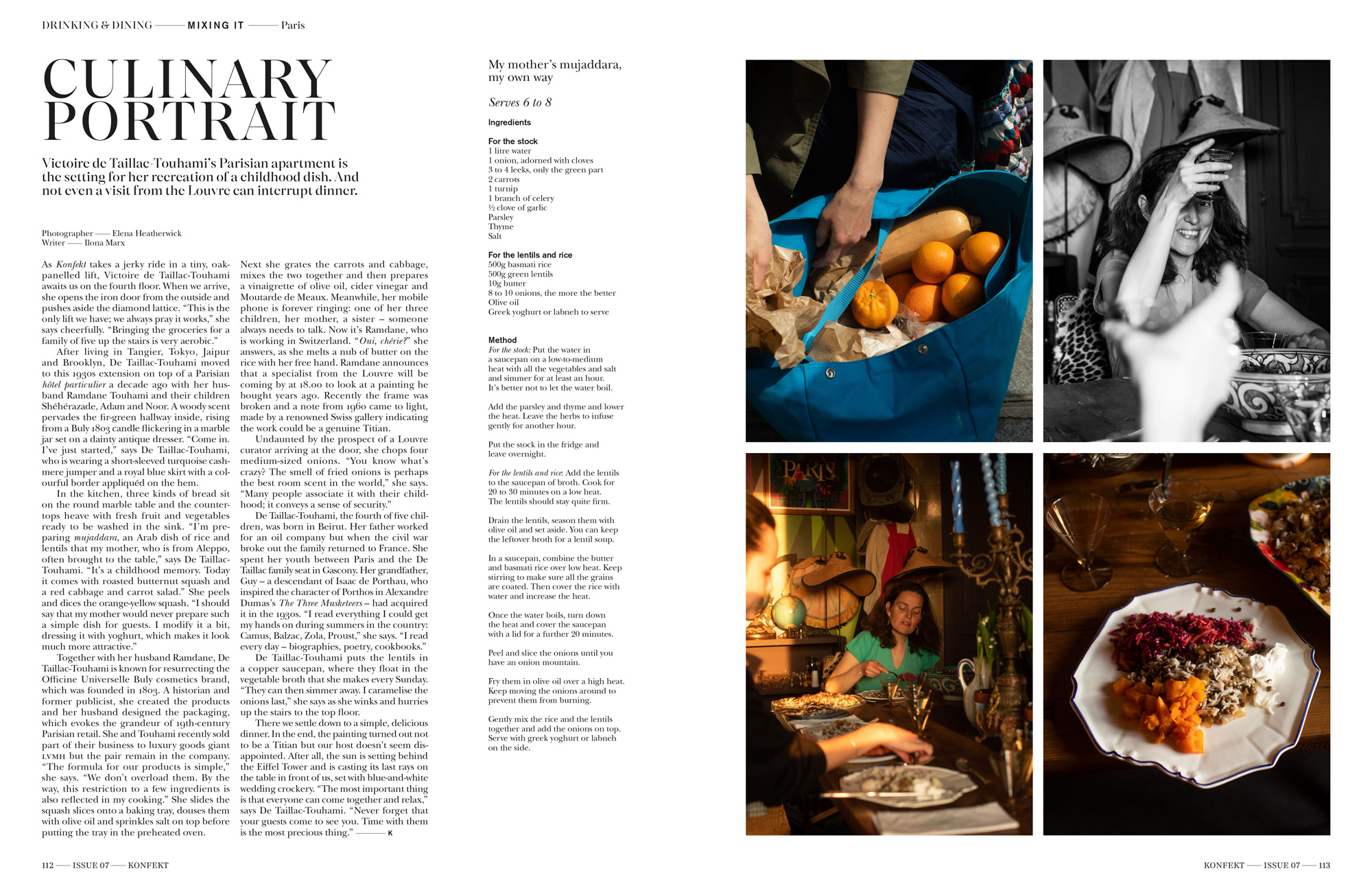
As Konfekt takes a jerky ride in a tiny, oak-panelled lift, Victoire de Taillac-Touhami awaits us on the fourth floor. When we arrive, she opens the iron door from the outside and pushes aside the diamond lattice. “This is the only lift we have; we always pray it works,” she says cheerfully. “Bringing the groceries for a family of five up the stairs is very aerobic.” After living in Tangier, Tokyo, Jaipur and Brooklyn, De Taillac-Touhami moved to this 1930s extension on top of a Parisian hôtel particulier a decade ago with her husband Ramdane Touhami and their children Shéhérazade, Adam and Noor. A woody scent pervades the fir-green hallway inside, rising from a Buly 1803 candle flickering in a marble jar set on a dainty antique dresser. “Come in. I’ve just started,” says De Taillac-Touhami, who is wearing a short-sleeved turquoise cashmere jumper and a royal blue skirt with a colourful border appliquéd on the hem.
In the kitchen, three kinds of bread sit on the round marble table and the countertops heave with fresh fruit and vegetables ready to be washed in the sink. “I’m preparing mujaddara, an Arab dish of rice and lentils that my mother, who is from Aleppo, often brought to the table,” says De Taillac-Touhami. “It’s a childhood memory. Today it comes with roasted butternut squash and a red cabbage and carrot salad.” She peels and dices the orange-yellow squash. “I should say that my mother would never prepare such a simple dish for guests. I modify it a bit, dressing it with yoghurt, which makes it look much more attractive.”
Together with her husband Ramdane, De Taillac-Touhami is known for resurrecting the Officine Universelle Buly cosmetics brand, which was founded in 1803. A historian and former publicist, she created the products and her husband designed the packaging, which evokes the grandeur of 19th-century Parisian retail. She and Touhami recently sold part of their business to luxury goods giant LVMH but the pair remain in the company. “The formula for our products is simple,” she says. “We don’t overload them. By the way, this restriction to a few ingredients is also reflected in my cooking.” She slides the squash slices onto a baking tray, douses them with olive oil and sprinkles salt on top before putting the tray in the preheated oven.
Next she grates the carrots and cabbage, mixes the two together and then prepares a vinaigrette of olive oil, cider vinegar and Moutarde de Meaux. Meanwhile, her mobile phone is forever ringing: one of her three children, her mother, a sister – someone always needs to talk. Now it’s Ramdane, who is working in Switzerland. “Oui, chérie?” she answers, as she melts a nub of butter on the rice with her free hand. Ramdane announces that a specialist from the Louvre will be coming by at 18.00 to look at a painting he bought years ago. Recently the frame was broken and a note from 1960 came to light, made by a renowned Swiss gallery indicating the work could be a genuine Titian.
Undaunted by the prospect of a Louvre curator arriving at the door, she chops four mediumsized onions. “You know what’s crazy? The smell of fried onions is perhaps the best room scent in the world,” she says. “Many people associate it with their childhood; it conveys a sense of security.”
De Taillac-Touhami, the fourth of five children, was born in Beirut. Her father worked for an oil company but when the civil war broke out the family returned to France. She spent her youth between Paris and the De Taillac family seat in Gascony. Her grandfather, Guy – a descendant of Isaac de Porthau, who inspired the character of Porthos in Alexandre Dumas’s The Three Musketeers – had acquired it in the 1930s. “I read everything I could get my hands on during summers in the country: Camus, Balzac, Zola, Proust,” she says. “I read every day – biographies, poetry, cookbooks.”
De Taillac-Touhami puts the lentils in a copper saucepan, where they float in the vegetable broth that she makes every Sunday. “They can then simmer away. I caramelise the onions last,” she says as she winks and hurries up the stairs to the top floor.
There we settle down to a simple, delicious dinner. In the end, the painting turned out not to be a Titian but our host doesn’t seem disappointed. After all, the sun is setting behind the Eiffel Tower and is casting its last rays on the table in front of us, set with blue-and-white wedding crockery. “The most important thing is that everyone can come together and relax,” says De Taillac-Touhami. “Never forget that your guests come to see you. Time with them is the most precious thing.”
Konfekt,
July 2022