Ilona Marx
Editorial work / Concepts / Texts

Feathering the best
Art & Culture / Fashion
Brazilian-born Parisian designer Janaïna Milheiro has reinvented the traditional French craft of feather work, taking it beyond fashion into art galleries and architecture. Dior and Cartier knock on her door and her down-based fabrics are very much in demand. This singular artist thrives on collaboration, cross-pollination and experimentation.
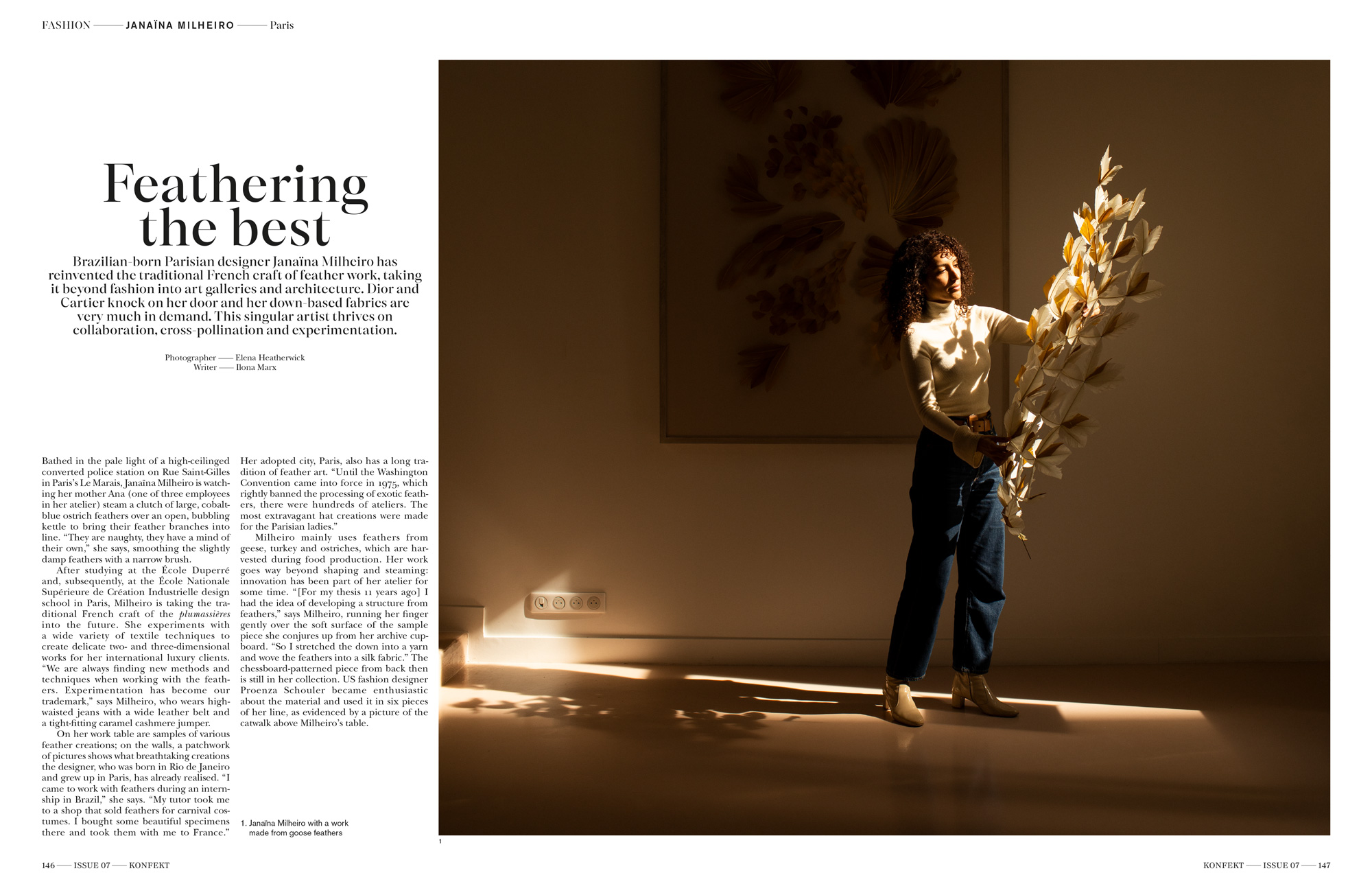
Bathed in the pale light of a high-ceilinged converted police station on Rue Saint-Gilles in Paris’s Le Marais, Janaïna Milheiro is watching her mother Ana (one of three employees in her atelier) steam a clutch of large, cobalt-blue ostrich feathers over an open, bubbling kettle to bring their feather branches into line. “They are naughty, they have a mind of their own,” she says, smoothing the slightly damp feathers with a narrow brush.
After studying at the École Duperré and, subsequently, at the École Nationale Supérieure de Création Industrielle design school in Paris, Milheiro is taking the traditional French craft of the plumassières into the future. She experiments with a wide variety of textile techniques to create delicate two- and three-dimensional works for her international luxury clients. “We are always finding new methods and techniques when working with the feathers. Experimentation has become our trademark,” says Milheiro, who wears high-waisted jeans with a wide leather belt and a tight-fitting caramel cashmere jumper.
On her work table are samples of various feather creations; on the walls, a patchwork of pictures shows what breathtaking creations the designer, who was born in Rio de Janeiro and grew up in Paris, has already realised. “I came to work with feathers during an internship in Brazil,” she says. “My tutor took me to a shop that sold feathers for carnival costumes. I bought some beautiful specimens there and took them with me to France.” Her adopted city, Paris, also has a long tradition of feather art. “Until the Washington Convention came into force in 1975, which rightly banned the processing of exotic feathers, there were hundreds of ateliers. The most extravagant hat creations were made for the Parisian ladies.”
Milheiro mainly uses feathers from geese, turkey and ostriches, which are harvested during food production. Her work goes way beyond shaping and steaming: innovation has been part of her atelier for some time. “[For my thesis 11 years ago] I had the idea of developing a structure from feathers,” says Milheiro, running her finger gently over the soft surface of the sample piece she conjures up from her archive cupboard. “So I stretched the down into a yarn and wove the feathers into a silk fabric.” The chessboard-patterned piece from back then is still in her collection. US fashion designer Proenza Schouler became enthusiastic about the material and used it in six pieces of her line, as evidenced by a picture of the catwalk above Milheiro’s table.
Visits from designers and the big fashion houses have not been a rarity for Milheiro since she was given a grant and a workspace by the municipal institution Les Ateliers de Paris in 2011 after graduating and was able to take part in the Première Vision fabric fair in Paris. “That was the kick-off,” says Milheiro as she sits down with her colleague Maïlys and begins to cut feathers into shape with a steady hand. “Everything happened within a few months. I transformed from a graduate into an entrepreneur,”she says. On the high white walls behind her, large-format graphic artworks with feathers are a reminder that Milheiro also exhibits in galleries. Her three-dimensional objects, which often use precious metals such as brass and copper or rhinestones in addition to bird feathers, have adorned the shop windows of exclusive clients such as Hermès, Cartier and Guerlain.
Even so, about 50 per cent of the atelier’s work goes into fashion. “Often we use the feathers like beads to create a ‘feather fabric’, as hap-pened with our most challenging commission to date, for Dior Homme,” says Milheiro. “We applied feathers to a white tulle shirt with feather embroidery, based on an iconic lace fabric, the toile de jouy. Two thousand hours went into this shirt. Every feather was cut into shape. It was crazy elaborate work.”
The lace fabrics and embroideries that inspired her during her studies are still her greatest source of inspiration. “Feathers have a magic for me, a beauty that I can’t escape,” she says, confiding that the Dior Homme commission was not the only challenge. Another recent hurdle was the collaboration with the German fashion designer duo Talbot Runhof, who asked her to realise a feather-mesh top with Mayer’sche Hofkunstanstalt, a Munich mosaic workshop. Her latest experiments also revolve around the medium. “I am working on integrating arrangements of feathers into glass panels – more precisely into windows, doors and room dividers,” says Milheiro.
The Parisian morning sun shines onto samples of her work that stand on a half-height archive shelf. Filigree translucent patterns cast ornamental shadows on the floor. “There are so many possibilities that this opens up,” adds Milheiro. “People in the fashion world might know my name but architecture is a new field for me.” She hopes to continue working across discplines, marrying modern technologies with ancient craftsmanship to once again reimagine this métier.
Konfekt,
July 2022