Ilona Marx
Editorial work / Concepts / Texts
Longtime companions
Interior Design / Travel
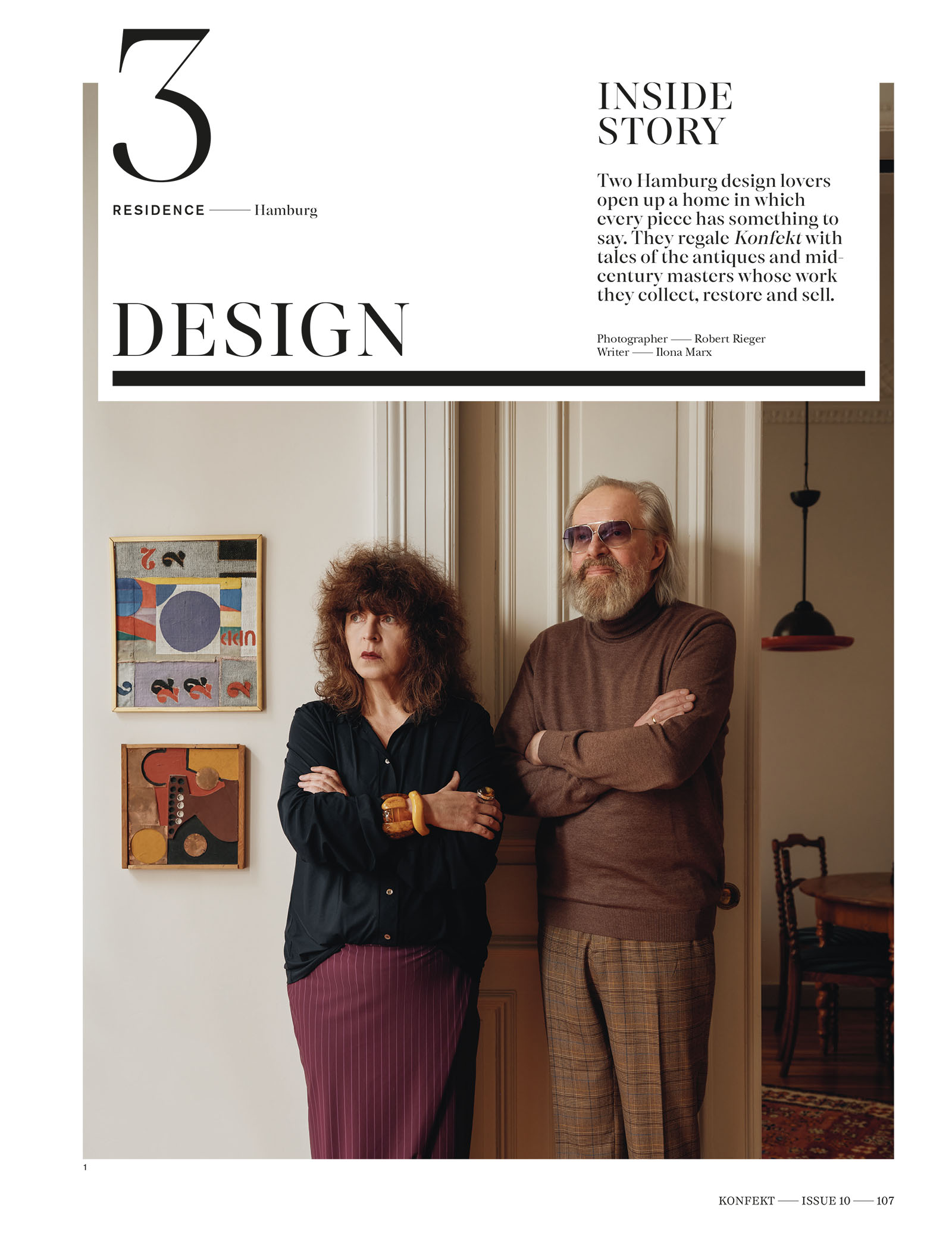
Two Hamburg design lovers open up a home in which every piece has something to say. They regale Konfekt with tales of the antiques and mid-century masters whose work they collect, restore and sell.
Martina Münch opens the door of her first-floor late 19th-century apartment in Hamburg’s Schanzenviertel and ushers Konfekt in. “Thomas Mann had a stuffed brown bear in the entrance area with a tray for business cards,” she says with a twinkle in her eye. “We gave that one a miss.”
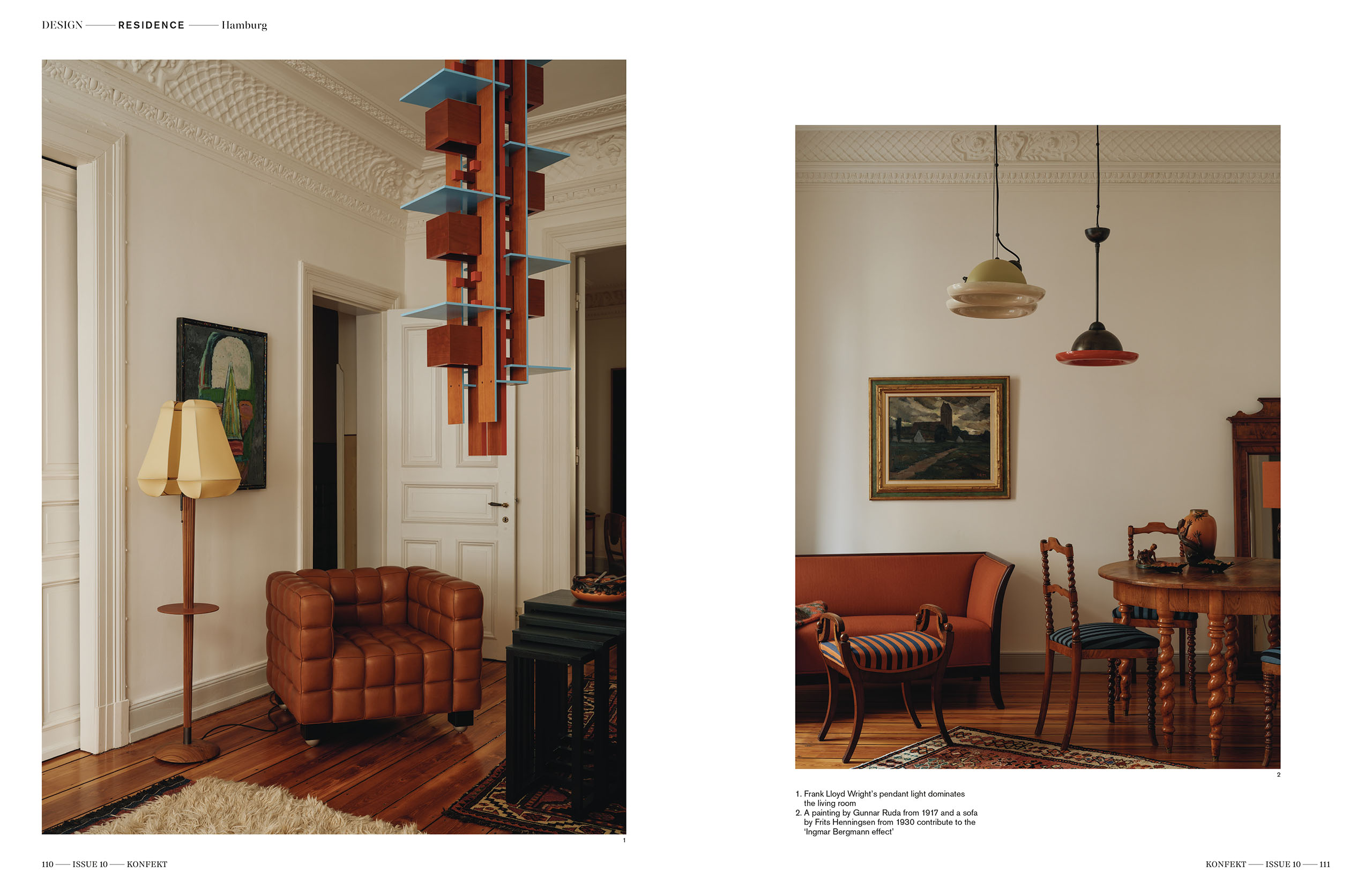
“Come in!” calls her husband, Manfred Werner, who beckons us into a large living room, where he stands with striking shoulderlength grey hair and tinted glasses. With large windows facing the cobblestoned Susannenstrasse, the apartment is diagonally opposite the Rote Flora building, a former theatre and concert hall that has been an autonomous cultural centre in Hamburg’s left-wing scene for more than 30 years. “The Schanzenviertel has developed visually into an ideal image of the bohemian quarter, with many secondhand shops, which makes us very happy,” says Werner of the area. “Back in the 1980s there were only two punk clubs and the Hells Angels. Now we not only have a cultural offering here but also a nice outdoor restaurant.” But the view is not the most striking feature here, by any means. As the owners of furniture store Wohnkultur 66, a Hamburg design institution founded in 1993, Münch and Werner are experts in furniture from the first half of the 20th century and moved into the house in Susannenstrasse last year with an illustrious group of great designers – or, more precisely, their work. Our gaze is soon drawn to a metre long Yamagiwa pendant lamp by Frank Lloyd Wright. The Japanese-looking geometric object made from cherry wood hangs from an opulent stucco rosette. It dominates the living room and perfectly complements the other furnishings: a sofa by Finn Juhl from 1957 with the backrest facing the window, a Japanese screen and two semi-circular tables by Bruno Mathsson, which host a pair of lamps with ceramic bases and bulbous vases with squirrel decorations by Ipsens Enke. “The chandelier is a bit too long even for our ceiling height – we always have to dance around it,” says Münch, who adds that the couple’s business also sells the Wright lights.
Opposite the Juhl sofa is a brown-leather cubic armchair and a set of black box tables, both designed by Austrian designer Josef Hoffmann. A floor lamp serves as a reading light next to the leather fauteuil. “We had the lamp, based on the original design by Ernst Schwadron from 1949, reconstructed three years ago in co-operation with Austrian artist Konrad Friedel,” says Werner. “Schwadron was an architect of the Vienna Werkbund [a modernist housing estate] and emigrated to the US in 1938. We were able to find his descendants there and acquire the rights to some of the designs. Since then we have been rebuilding them in small series.”
While walking around the apartment, it’s almost impossible not to quiz the knowledgeable owners on the provenance of every piece; from the wool flokati rug to the Swedish landscape paintings, all of the objects have a story. Not infrequently, as in the case of Schwadron, these deal with expulsion and emigration in the 1930s and 1940s – a period that is particularly dear to the couple. “I was born in Bielefeld [in North Rhine-Westphalia],” says Münch, while pouring a cup of herbal tea. “I spent a lot of time at my grandparents’ house when I was a child. Their interiors were made by a carpenter in the 1930s and 1940s, according to my grandfather’s wishes. His style had a big effect on me. I inherited my love for antique 19th-century objects from my mother. She was crazy about antiques and took me with her on her long forays through relevant London shops as a child.”
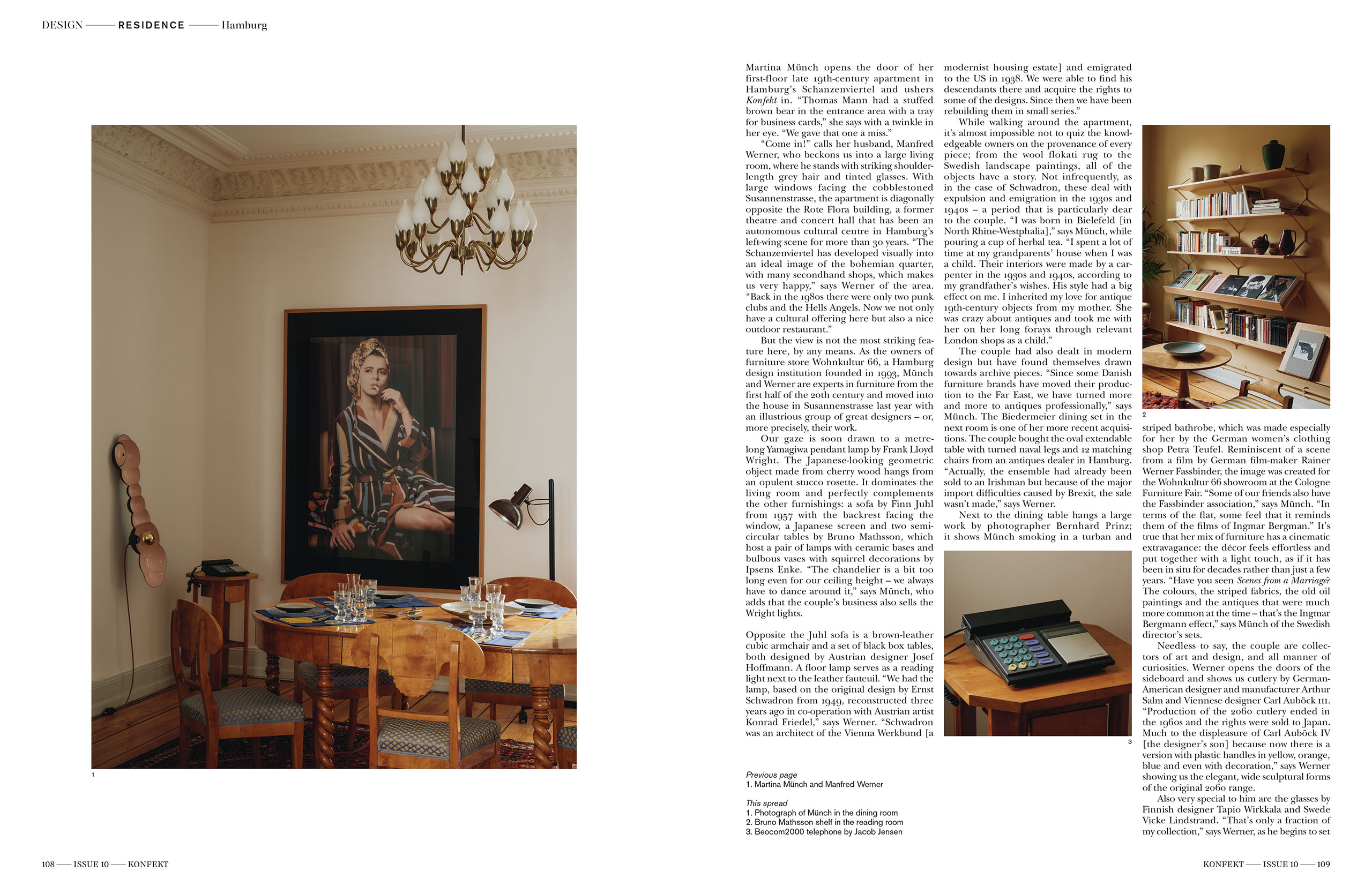
The couple had also dealt in modern design but have found themselves drawn towards archive pieces. “Since some Danish furniture brands have moved their produc-tion to the Far East, we have turned more and more to antiques professionally,” says Münch. The Biedermeier dining set in the next room is one of her more recent acquisitions. The couple bought the oval extendable table with turned naval legs and 12 matching chairs from an antiques dealer in Hamburg. “Actually, the ensemble had already been sold to an Irishman but because of the major import difficulties caused by Brexit, the sale wasn’t made,” says Werner.
Next to the dining table hangs a large work by photographer Bernhard Prinz; it shows Münch smoking in a turban and 2 striped bathrobe, which was made especially for her by the German women’s clothing shop Petra Teufel. Reminiscent of a scene from a film by German film-maker Rainer Werner Fassbinder, the image was created for the Wohnkultur 66 showroom at the Cologne Furniture Fair. “Some of our friends also have the Fassbinder association,” says Münch. “In terms of the flat, some feel that it reminds them of the films of Ingmar Bergman.” It’s true that her mix of furniture has a cinematic extravagance: the décor feels effortless and put together with a light touch, as if it has been in situ for decades rather than just a few years. “Have you seen Scenes from a Marriage? The colours, the striped fabrics, the old oil paintings and the antiques that were much more common at the time – that’s the Ingmar Bergmann effect,” says Münch of the Swedish director’s sets.
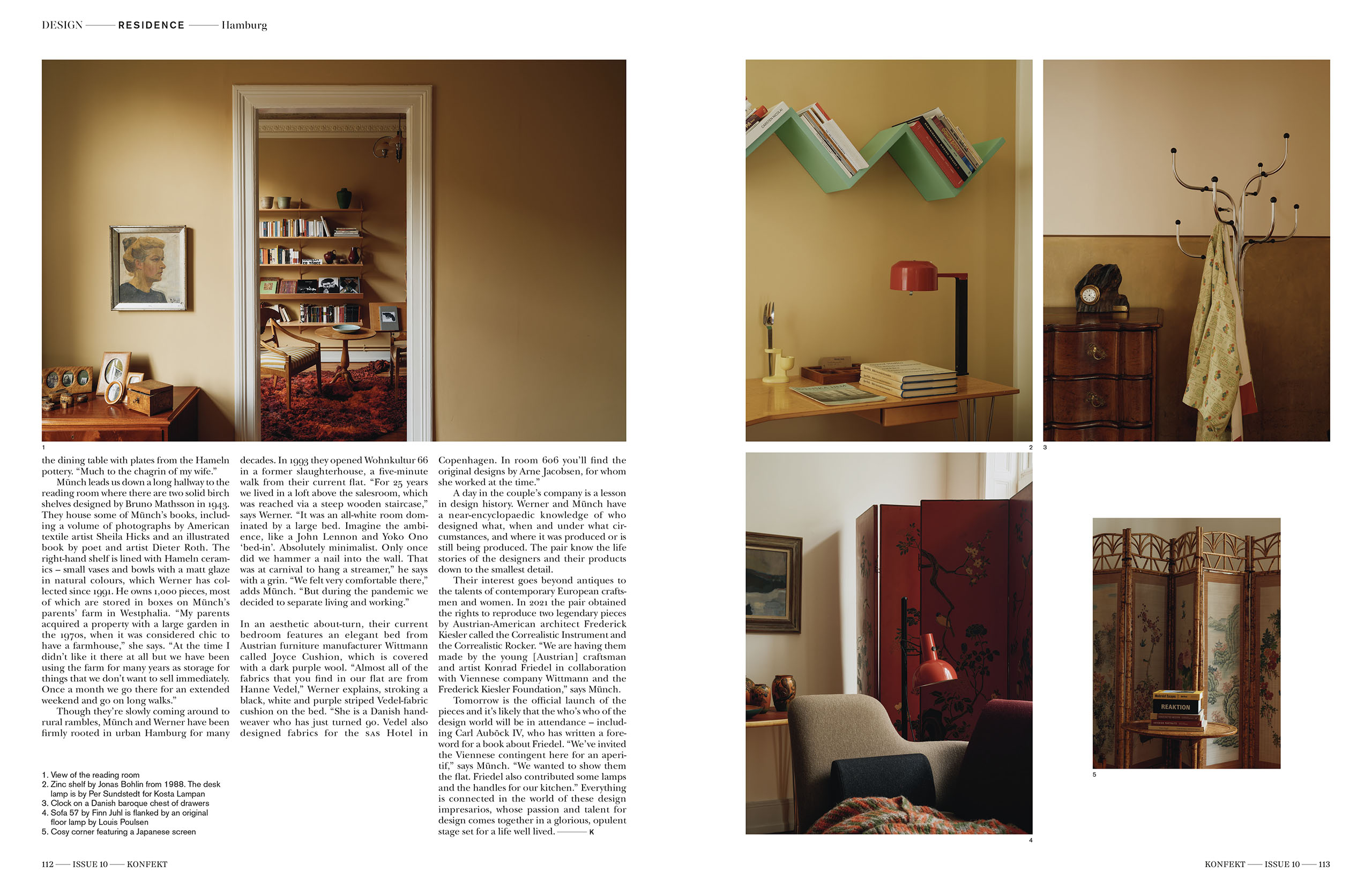
Needless to say, the couple are collectors of art and design, and all manner of curiosities. Werner opens the doors of the sideboard and shows us cutlery by German-American designer and manufacturer Arthur Salm and Viennese designer Carl Auböck III. “Production of the 2060 cutlery ended in the 1960s and the rights were sold to Japan. Much to the displeasure of Carl Auböck IV [the designer’s son] because now there is a version with plastic handles in yellow, orange, blue and even with decoration,” says Werner showing us the elegant, wide sculptural forms of the original 2060 range.
Also very special to him are the glasses by Finnish designer Tapio Wirkkala and Swede Vicke Lindstrand. “That’s only a fraction of my collection,” says Werner, as he begins to set 1 the dining table with plates from the Hameln pottery. “Much to the chagrin of my wife.”
Münch leads us down a long hallway to the reading room where there are two solid birch shelves designed by Bruno Mathsson in 1943. They house some of Münch’s books, including a volume of photographs by American textile artist Sheila Hicks and an illustrated book by poet and artist Dieter Roth. The right-hand shelf is lined with Hameln ceramics – small vases and bowls with a matt glaze in natural colours, which Werner has collected since 1991. He owns 1,000 pieces, most of which are stored in boxes on Münch’s parents’ farm in Westphalia. “My parents acquired a property with a large garden in the 1970s, when it was considered chic to have a farmhouse,” she says. “At the time I didn’t like it there at all but we have been using the farm for many years as storage for things that we don’t want to sell immediately. Once a month we go there for an extended weekend and go on long walks.”
Though they’re slowly coming around to rural rambles, Münch and Werner have been firmly rooted in urban Hamburg for many decades. In 1993 they opened Wohnkultur 66 in a former slaughterhouse, a five-minute walk from their current flat. “For 25 years we lived in a loft above the salesroom, which was reached via a steep wooden staircase,” says Werner. “It was an all-white room dominated by a large bed. Imagine the ambience, like a John Lennon and Yoko Ono ‘bed-in’. Absolutely minimalist. Only once did we hammer a nail into the wall. That was at carnival to hang a streamer,” he says with a grin. “We felt very comfortable there,” adds Münch. “But during the pandemic we decided to separate living and working.”
In an aesthetic about-turn, their current bedroom features an elegant bed from Austrian furniture manufacturer Wittmann called Joyce Cushion, which is covered with a dark purple wool. “Almost all of the fabrics that you find in our flat are from Hanne Vedel,” Werner explains, stroking a black, white and purple striped Vedel-fabric cushion on the bed. “She is a Danish handweaver who has just turned 90. Vedel also designed fabrics for the SAS Hotel in Copenhagen. In room 606 you’ll find the original designs by Arne Jacobsen, for whom she worked at the time.”
A day in the couple’s company is a lesson in design history. Werner and Münch have a near-encyclopaedic knowledge of who designed what, when and under what circumstances, and where it was produced or is still being produced. The pair know the life stories of the designers and their products down to the smallest detail. Their interest goes beyond antiques to the talents of contemporary European craftsmen and women. In 2021 the pair obtained the rights to reproduce two legendary pieces by Austrian-American architect Frederick Kiesler called the Correalistic Instrument and the Correalistic Rocker. “We are having them made by the young [Austrian] craftsman and artist Konrad Friedel in collaboration with Viennese company Wittmann and the Frederick Kiesler Foundation,” says Münch.
Tomorrow is the official launch of the pieces and it’s likely that the who’s who of the design world will be in attendance – including Carl Auböck IV, who has written a foreword for a book about Friedel. “We’ve invited the Viennese contingent here for an aperitif,” says Münch. “We wanted to show them the flat. Friedel also contributed some lamps and the handles for our kitchen.” Everything is connected in the world of these design impresarios, whose passion and talent for design comes together in a glorious, opulent stage set for a life well lived.
Konfekt,
Spring 2023