Ilona Marx
Editorial work / Concepts / Texts
Art of glass
Art & Culture
Five generations of the Mayer family have perfected the craft of translating artists’ work into glass panels. As Mayer’sche Hofkunstanstalt celebrates its 175th anniversary we take a tour of its workshops. Plus, we visit the creator of a Parisian antique homeware brand and the Italian sisters keeping lithography alive.
A faint breeze blows the malty smell of the brewery district across Stiglmaierplatz. Opposite the Löwenbräukeller, a wrought-iron gate leads into a courtyard. Here, the headquarters of Mayer’sche Hofkunstanstalt is as much a part of the city’s cultural identity as the breweries: this year, the Mayer family will celebrate 175 years of designing and creating mosaics and stained glass.
On the threshold of her third-floor office, Konfekt meets Petra Mayer, a trained architect. In a black pleated midi dress, her luxurious ash-blond hair piled up in a bun, we follow Petra down a corridor that opens up on to a gallery spanning a triangular atrium, a full three storeys high. “This is the heart of the building, the exhibition hall,” says Petra as the morning light floods through the room’s 15 metre-high window. “It was designed by architect Theodor Fischer in such a way that you can view the works from three different levels and from a wide variety of perspectives.”
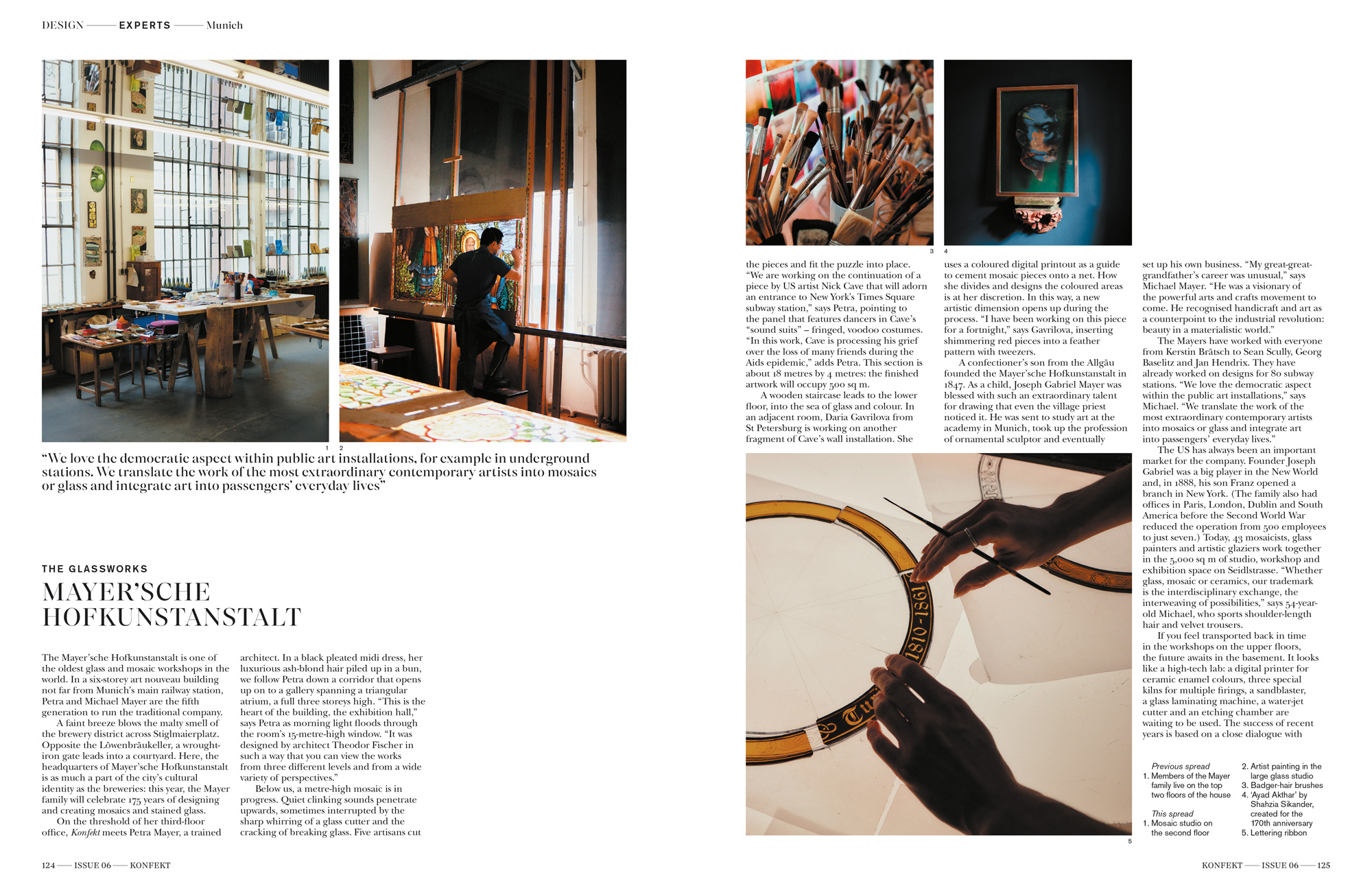
Below us, a metre-high mosaic is in progress. Quiet clinking sounds penetrate upwards, sometimes interrupted by the sharp whirring of a glass cutter and the cracking of breaking glass. Five artisans cut the pieces and fit the puzzle into place. “We are working on the continuation of a piece by US artist Nick Cave that will adorn an entrance to New York’s Times Square subway station,” says Petra, pointing to the panel that features dancers in Cave’s “sound suits” – fringed, voodoo costumes. “In this work, Cave is processing his grief over the loss of many friends during the Aids epidemic,” adds Petra. This section is about 18 metres by 4 metres: the finished artwork will occupy more than 500 sq m.
A wooden staircase leads to the lower floor, into the sea of glass and colour. In an adjacent room, Daria Gavrilova from St Petersburg is working on another fragment of Cave’s wall installation. She uses a coloured digital printout as a guide to cement mosaic pieces onto a net. How she divides and designs the coloured areas is at her discretion. In this way, a new artistic dimension opens up during the process. “I have been working on this piece for a fortnight,” says Gavrilova, inserting shimmering red pieces into a feather pattern with tweezers.
A confectioner’s son from the Allgäu region founded the Mayer’sche Hofkunstanstalt in 1847. As a child, Joseph Gabriel Mayer was blessed with such an extraordinary talent for drawing that even the village priest noticed it. He was sent to study art at the academy in Munich, took up the profession of ornamental sculptor and eventually set up his own business. “My great-great-grandfather’s career was unusual,” says Michael Mayer. “He was a visionary of the powerful arts and crafts movement to come. He recognised handicraft and art as a counterpoint to the industrial revolution: beauty in a materialistic world.”
The Mayers have worked with everyone from Kerstin Brätsch to Sean Scully, Georg Baselitz and Jan Hendrix. They have already worked on designs for 80 subway stations. “We love the democratic aspect within the public art installations,” says Michael. “We translate the work of the most extraordinary contemporary artists into mosaics or glass and integrate art into the everyday lives of passengers.”
The US has always been an important market for the company. Founder Joseph Gabriel was a big player in the New World and, in 1888, his son Franz opened a branch in New York. (The family also had offices in Paris, London, Dublin and South America before the Second World War reduced the operation from 500 employees to just seven.) Today, 43 mosaicists, glass painters and artistic glaziers work together in the 5,000 sq m of studio, workshop and exhibition space on Seidlstrasse. “Whether glass, mosaic or ceramics, our trademark is the interdisciplinary exchange, the interweaving of possibilities,” says 55-year-old Michael, who sports shoulder-length hair and velvet trousers.
If you feel transported back in time in the workshops on the upper floors, the future awaits in the basement. It looks like a high-tech lab: a digital printer for ceramic enamel colours, three special kilns for multiple firings, a sandblaster, a glass laminating machine, a water-jet cutter and an etching chamber are waiting to be used. The success of recent years is based on a close dialogue with artists. “We have three flats in the house,” says Petra as we continue on our tour through the studios. “Many of the artists stay with us, sometimes for weeks. These residencies are important to gain an understanding of artistic expression. After all, the works are translated by us into another medium. This requires a relationship of trust, a partnership, a ‘letting go’ on the part of the artists. Through time together, we sense whether we speak the same language, our possibilities converge. We can set off fireworks if they trust us.”
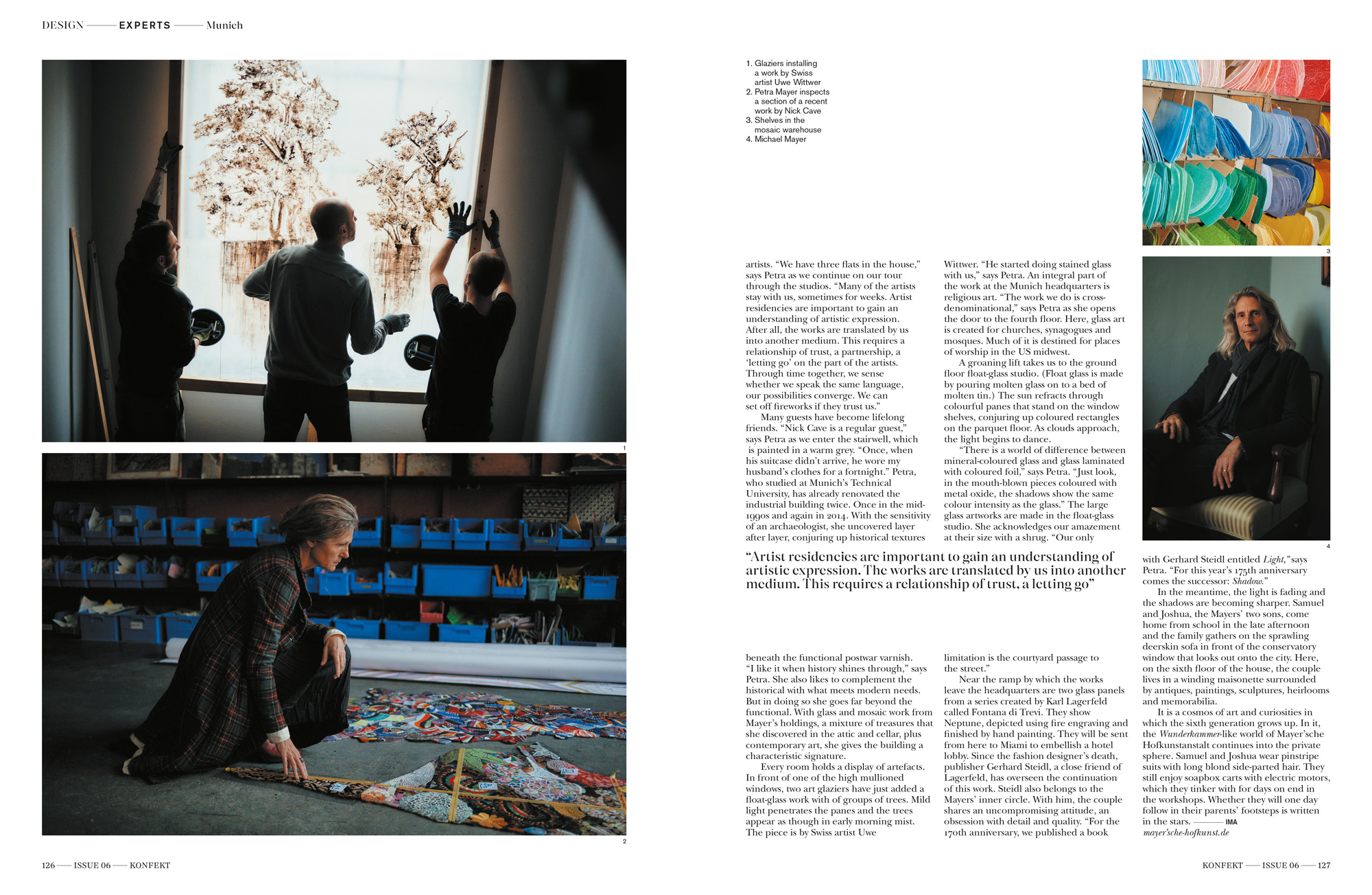
Many guests have become lifelong friends. “Nick Cave is a regular guest,” says Petra as we enter the stairwell, which is painted in a warm grey. “Once, when his suitcase didn’t arrive, he wore my husband’s clothes for a fortnight.” Petra, who studied at Munich’s Technical University, has already renovated the industrial building twice: once in the mid-1990s and again in 2014. With the sensitivity of an archaeologist, she uncovered layer after layer, conjuring up historical textures beneath the postwar varnish. “I like it when history shines through,” says Petra. She also likes to complement the historical with what meets modern needs. But in doing so she goes far beyond the merely practical. With glass and mosaic work from Mayer’s holdings, a mixture of treasures that she discovered in the attic and cellar, plus contemporary art, she has given the building a characteristic signature. Every room holds a display of artefacts. In front of one of the high mullioned windows, two art glaziers have just added a float-glass work of two groups of trees. Mild light penetrates the panes and the trees appear as though in early morning mist. The piece is by Swiss artist Uwe Wittwer. “He started doing stained glass with us,” says Petra. An integral part of the work at the Munich headquarters is religious art. “The work we do is cross-denominational,” says Petra as she opens the door to the fourth floor. Here, glass art is created for churches, synagogues and mosques. Much of it is destined for places of worship in the US midwest.
A groaning lift takes us to the ground floor float-glass studio. (Float glass is made by pouring molten glass onto a bed of molten tin.) The sun refracts through colourful panes that stand on the window shelves, conjuring up coloured rectangles on the parquet floor. As clouds approach, the light begins to dance.
“There is a world of difference between mineral-coloured glass and glass laminated with coloured foil,” says Petra. “Just look, in the mouth-blown pieces coloured with metal oxide, the shadows show the same colour intensity as the glass.” Larger artworks are made in the float-glass studio. She acknowledges our amazement at their size with a shrug. “Our only limitation is the courtyard passage to the street.”
Near the ramp by which the works leave the headquarters are two panels from a series created by Karl Lagerfeld called Fontana di Trevi. They show Neptune, depicted using fire engraving and finished by hand painting. They will be sent from here to Miami to embellish a hotel lobby. Since the fashion designer’s death, publisher Gerhard Steidl, a close friend of Lagerfeld, has overseen the continuation of this work. Steidl also belongs to the Mayers’ inner circle. With him, the couple shares an uncompromising attitude, an obsession with detail and quality. “For the 170th anniversary, we published a book with him entitled Light,” says Petra. “For this year’s 175th anniversary comes the successor: Shadow.”
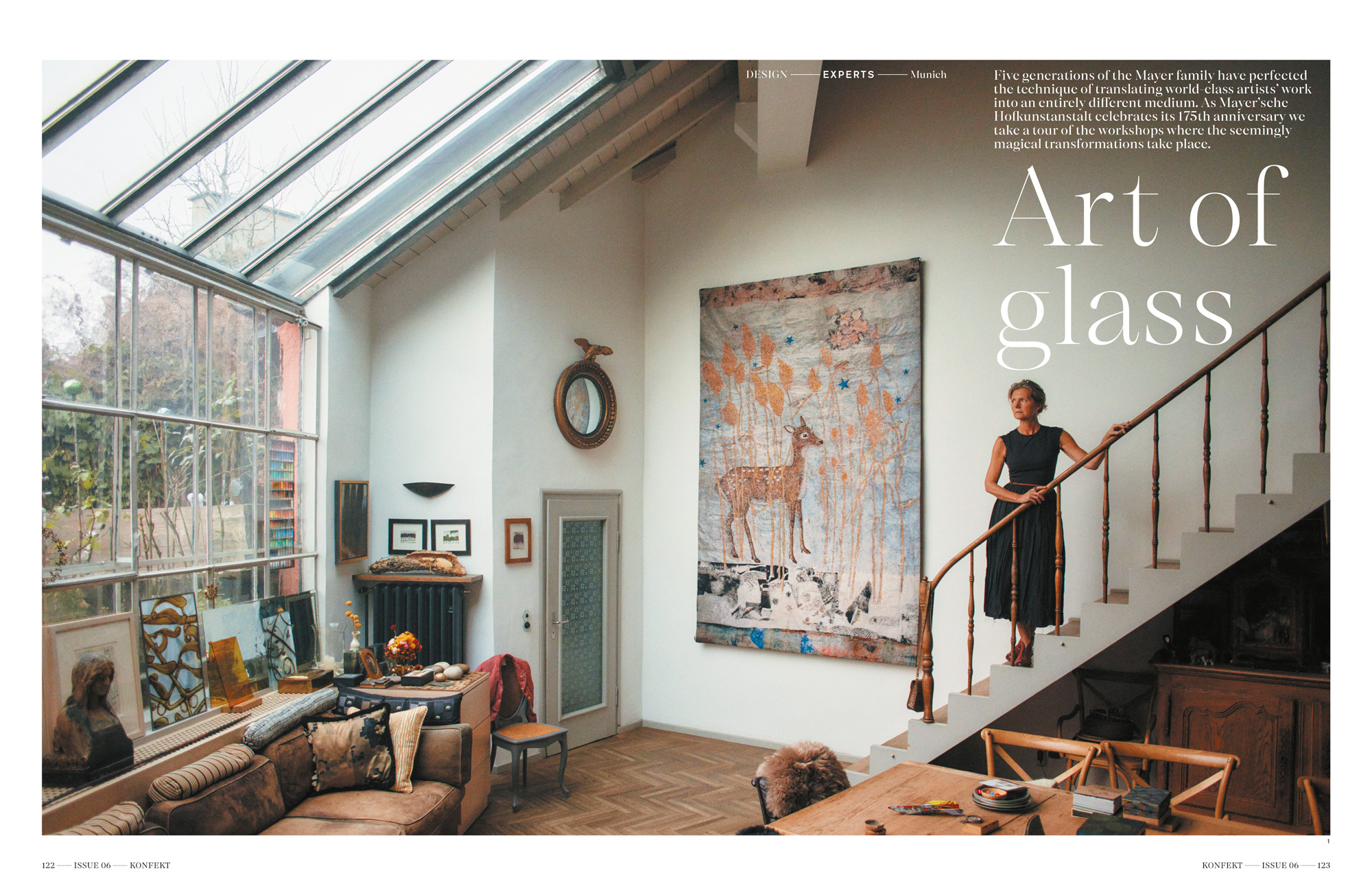
In the meantime, the light is fading and the shadows are becoming sharper. Samuel and Joshua, the Mayers’ two sons, come home from school in the late afternoon and the family gathers on the sprawling deerskin sofa in front of the conservatory window that looks out onto the city. Here, on the sixth floor of the house, the couple lives in a winding maisonette surrounded by antiques, paintings, sculptures, heirlooms and memorabilia.
It is a cosmos of art and curiosities in which the sixth generation grows up. In it, the Wunderkammer-like world of Mayer’sche Hofkunstanstalt continues into the private sphere. Samuel and Joshua wear pinstripe suits with long blond side-parted hair. They still enjoy soapbox carts with electric motors, which they tinker with for days on end in the workshops. Whether they will one day follow in their parents’ footsteps is written in the stars.
Konfekt,
June 2022