Ilona Marx
Editorial work / Concepts / Texts
Sparkling waters
Art & Culture / Interview
On a walk along the Isar River to a beer garden, jewellery designer Saskia Diez explains how anthropology influences her work, and why designing is such an intimate process.
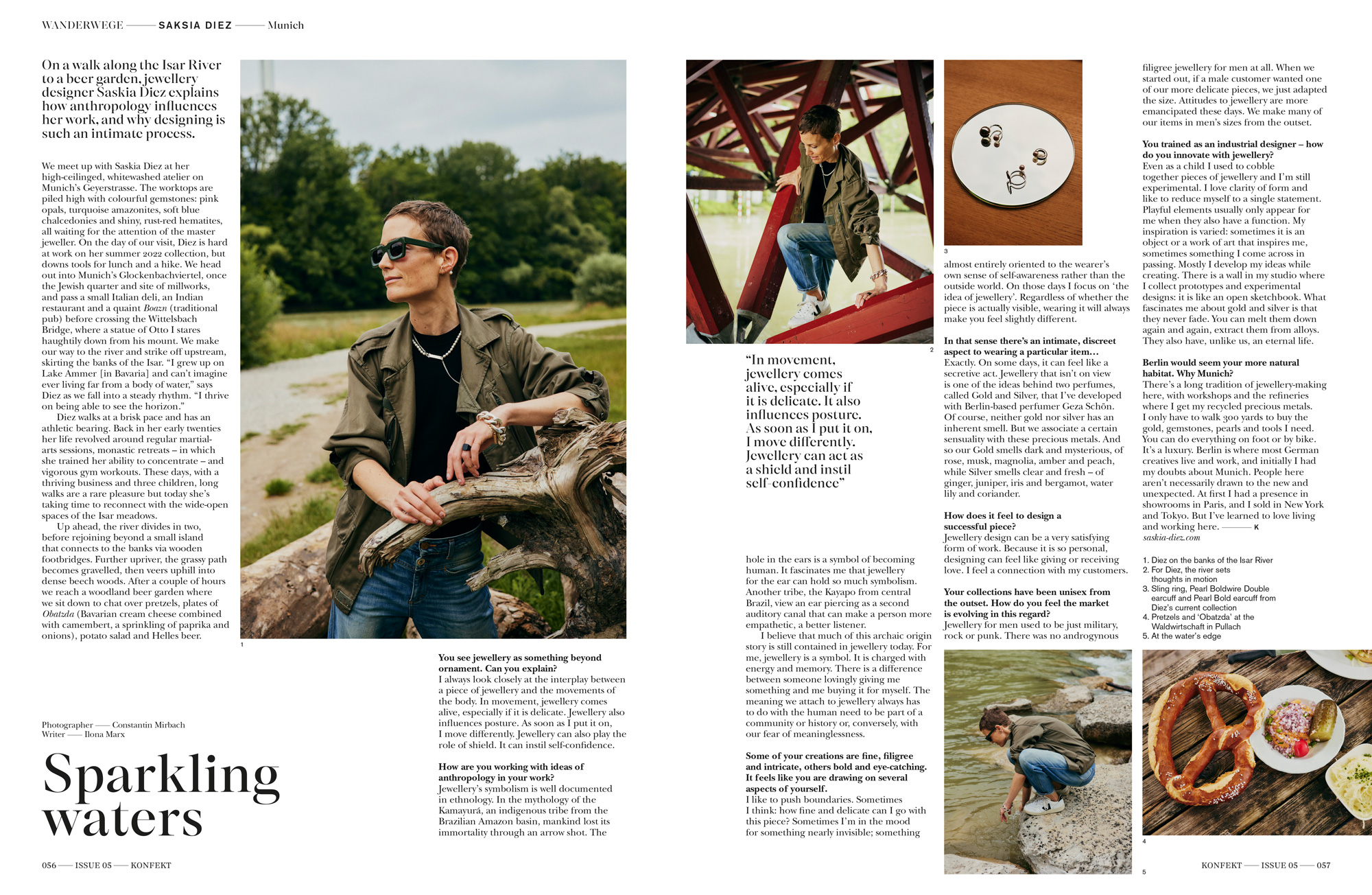
We meet up with Saskia Diez at her high-ceilinged, whitewashed atelier on Munich’s Geyerstrasse. The worktops are piled high with colourful gemstones: pink opals, turquoise amazonites, soft blue chalcedonies and shiny, rust-red hematites, all waiting for the attention of the master jeweller. On the day of our visit, Diez is hard at work on her summer 2022 collection, but downs tools for lunch and a hike. We head out into Munich’s Glockenbachviertel, once the Jewish quarter and site of millworks, and pass a small Italian deli, an Indian restaurant and a quaint Boazn (traditional pub) before crossing the Wittelsbach Bridge, where a statue of Otto I stares haughtily down from his mount. We make our way to the river and strike off upstream, skirting the banks of the Isar. “I grew up on Lake Ammer [in Bavaria] and can’t imagine ever living far from a body of water,” says Diez as we fall into a steady rhythm. “I thrive on being able to see the horizon.”
Diez walks at a brisk pace and has an athletic bearing. Back in her early twenties her life revolved around regular martial-arts sessions, monastic retreats – in which she trained her ability to concentrate – and vigorous gym workouts. These days, with a thriving business and three children, long walks are a rare pleasure but today she’s taking time to reconnect with the wide-open spaces of the Isar meadows.
Up ahead, the river divides in two, before rejoining beyond a small island that connects to the banks via wooden footbridges. Further upriver, the grassy path becomes gravelled, then veers uphill into dense beech woods. After a couple of hours we reach a woodland beer garden where we sit down to chat over pretzels, plates of Obatzda (Bavarian cream cheese combined with camembert, a sprinkling of paprika and onions), potato salad and Helles beer.
You see jewellery as something beyond ornament. Can you explain?
I always look closely at the interplay between a piece of jewellery and the movements of the body. In movement, jewellery comes alive, especially if it is delicate. Jewellery also influences posture. As soon as I put it on, I move differently. Jewellery can also play the role of shield. It can instil self-confidence.
How are you working with ideas of anthropology in your work?
Jewellery’s symbolism is well documented in ethnology. In the mythology of the Kamayurá, an indigenous tribe from the Brazilian Amazon basin, mankind lost its immortality through an arrow shot. The hole in the ears is a symbol of becoming human. It fascinates me that jewellery for the ear can hold so much symbolism. Another tribe, the Kayapo from central Brazil, view an ear piercing as a second auditory canal that can make a person more empathetic, a better listener. I believe that much of this archaic origin story is still contained in jewellery today. For me, jewellery is a symbol. It is charged with energy and memory. There is a difference between someone lovingly giving me something and me buying it for myself. The meaning we attach to jewellery always has to do with the human need to be part of a community or history or, conversely, with our fear of meaninglessness.
Some of your creations are fine, filigree and intricate, others bold and eye-catching. It feels like you are drawing on several aspects of yourself.
I like to push boundaries. Sometimes I think: how fine and delicate can I go with this piece? Sometimes I’m in the mood for something nearly invisible; something almost entirely oriented to the wearer’s own sense of self-awareness rather than the outside world. On those days I focus on ‘the idea of jewellery’. Regardless of whether the piece is actually visible, wearing it will always make you feel slightly different.
In that sense there’s an intimate, discreet aspect to wearing a particular item…
Exactly. On some days, it can feel like a secretive act. Jewellery that isn’t on view is one of the ideas behind two perfumes, called Gold and Silver, that I’ve developed with Berlin-based perfumer Geza Schön. Of course, neither gold nor silver has an inherent smell. But we associate a certain sensuality with these precious metals. And so our Gold smells dark and mysterious, of rose, musk, magnolia, amber and peach, while Silver smells clear and fresh – of ginger, juniper, iris and bergamot, waterlily and coriander.
How does it feel to design a successful piece?
Jewellery design can be a very satisfying form of work. Because it is so personal, designing can feel like giving or receiving love. I feel a connection with my customers.
Your collections have been unisex from the outset. How do you feel the marketis evolving in this regard?
Jewellery for men used to be just military, rock or punk. There was no androgynous filigree jewellery for men at all. When we started out, if a male customer wanted one of our more delicate pieces, we just adapted the size. Attitudes to jewellery are more emancipated these days. We make many of our items in men’s sizes from the outset.
You trained as an industrial designer – how do you innovate with jewellery?
Even as a child I used to cobble together pieces of jewellery and I’m still experimental. I love clarity of form and like to reduce myself to a single statement. Playful elements usually only appear for me when they also have a function. My inspiration is varied: sometimes it is an object or a work of art that inspires me, sometimes something I come across in passing. Mostly I develop my ideas while creating. There is a wall in my studio where I collect prototypes and experimental designs: it is like an open sketchbook. What fascinates me about gold and silver is that they never fade. You can melt them down again and again, extract them from alloys. They also have, unlike us, an eternal life.
Berlin would seem your more natural habitat. Why Munich?
There’s a long tradition of jewellery‑making here, with workshops and the refineries where I get my recycled precious metals. I only have to walk 300 yards to buy the gold, gemstones, pearls and tools I need. You can do everything on foot or by bike. It’s a luxury. Berlin is where most German creatives live and work, and initially I had my doubts about Munich. People here aren’t necessarily drawn to the new and unexpected. At first I had a presence in showrooms in Paris, and I sold in New York and Tokyo. But I’ve learned to love living and working here.
Konfekt,
May 2022