Ilona Marx
Editorial work / Concepts / Texts
Sound ideas
Art & Culture / Interior Design
Admiration for Rudolf Diesel’s inventive spirit led architect and product designer Marie Aigner to move into his former house on Munich’s Höchlstrasse. This is not only Aigner’s center of life, but also a generous stage for her sound-absorbing furniture and sculptures made from recycled materials.
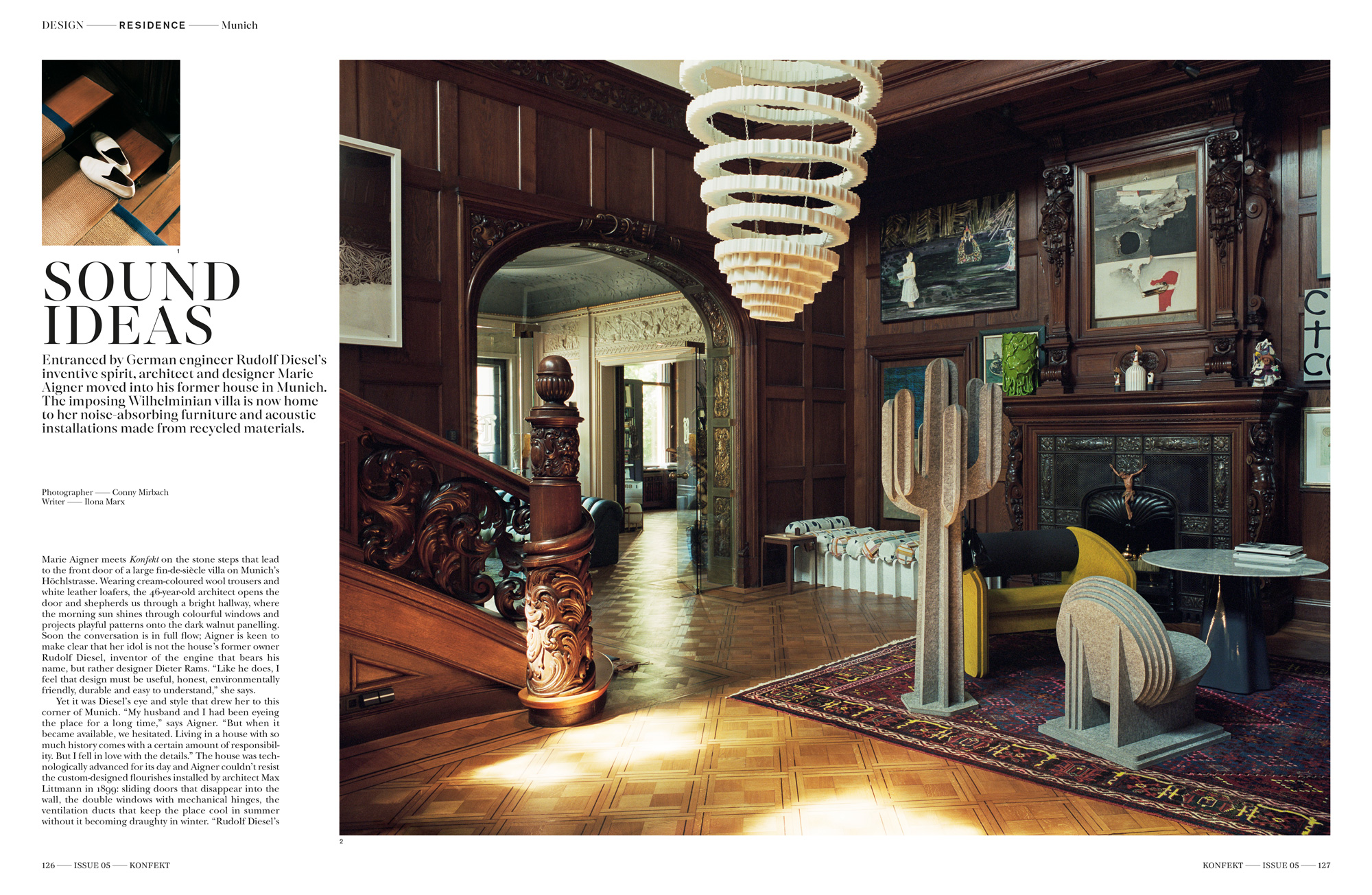
„Design must benefit people, must be honest, environmentally friendly, durable and understandable.“ Marie Aigner has internalized the spirit of industrial design legend Dieter Rams‘ Ten Theses for Good Design. And she lives this philosophy in a residence once built for German engineer Rudolf Diesel. „My husband and I had been eyeing the house for some time,“ she explains as we walk together up the stone steps of the neo-baroque villa from 1899 and enter the bright entrance hall. The morning sun refracts in the colorful windows on the wide wooden staircase that leads to the surrounding gallery and the upper floor, conjuring up reflections of color on the dark walnut paneling.
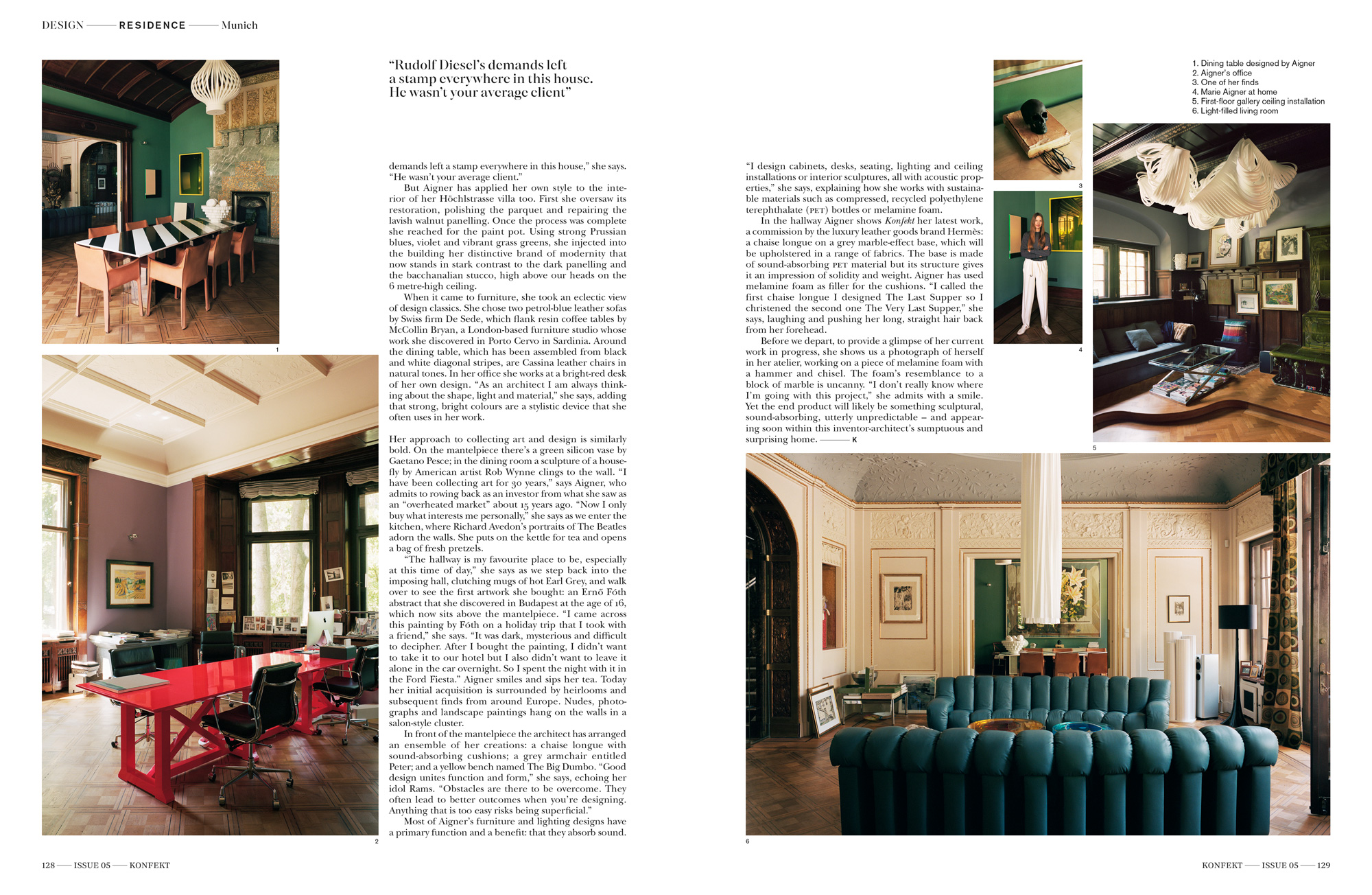
„At first we were hesitant, because such a house steeped in history also brings responsibility. But then I got excited about the details: sliding doors that disappear into the walls, double windows with mechanical coupling hinges, air ducts that provide ventilation in the summer but don’t create drafts in the winter. Rudolf Diesel got involved in every angle; he was by no means just the builder.“ The 46-year-old also got personally involved, overseeing the extensive renovation of the landmarked building, which is based on a design by architect Max Littmann – though the initial aim was to reconstruct it to its original state. „However, it was important to me to take away some of the seriousness, the gravity of the building.“ With nonchalance and courage, she breathed modernity into the dignified walls. Helpful in this was a deep reach into the color pot: The walls in the house were dipped in strong Prussian blue, in violet and grass green, a refreshing contrast to the dark wood and the bacchanalian stucco scenes that adorn the six-meter-high ceilings.
On this spacious stage, Aigner mindlessly combines classics of furniture history. For example, in the living room, where the petrol-colored De Sede leather sofa ‚Tatzelwurm‘ finds itself flanked by the synthetic resin tables by McCollin Bryan, which Aigner discovered in Porto Cervo, Sardinia. She has grouped natural-colored leather chairs by Cassina around the dining table with black and white diagonal stripes, and her self-designed desk in the study has a bright red, glossy surface. „Architecture is always about the details, the colors, the shapes, the light, the materials,“ says Marie Aigner, and looking around the house on Höchlstrasse, this statement is immediately brought to life: The grass-green silicone vase by Gaetano Pesce on the mantelpiece, the fly sculpture by Rob Wynne on the dining room wall, the Beatles portraits by Richard Avedon in the kitchen – everything appears casual, designed with spontaneity and ease.
The central space of the Beletage, which houses the kitchen, living room, dining room and Aigner’s office plus a large terrace, is the entry hall. „The hall is my favorite place, especially at this time of day.“ Her first piece of art, an abstract Ernö Fóth bought in Budapest when she was 17, has been given a prominent place above the fireplace and is surrounded by follow-up acquisitions: Nudes, photographs, landscape paintings, in bold Petersburg hangings. In front, an ensemble of her own creations: the chaise longue ‚The Last Supper‘ with sound-absorbing overlay, the gray armchair ‚Peter,‘ the yellow bench ‚Big Dumbo‘ and ‚Carlchen,‘ the man-sized cactus. „A design is perfect when nothing superfluous clutters it. Good design bundles function and form design and rises from arbitrariness.“ Indeed, Aigner’s designs never seem arbitrary, but rather individualistic, at times postmodern, always unseen. Her influences range from Max Bill to Art Deco.
„Obstacles want to be overcome and often lead to a better result in design. The things that fall too easily often remain on the surface.“ The path of least resistance is not for Marie Aigner, she likes to limit herself once in a while. At the same time, she burns for multifunctional: her furniture pieces and light sources often have another talent in addition to their actual function: they absorb sound. Aigner studied architecture, interior design and product design. Her interdisciplinary work aims to make spaces usable and design them despite difficult acoustics.
I design acoustically effective furniture and room sculptures,“ she says, describing her specialty. On the one hand, she uses a material made from pressed, recycled PET bottles, and on the other, melamine resin foam, both from sustainable production. She uses them to build cabinets, desks, seating, lighting and ceiling installations.
In 2006, while working on a large contract for the company Pinta Acoustic, which also deals with sound absorption, Aigner met her current husband, the entrepreneur and sailing athlete Michael Illbruck. She now lives with him and their 13-year-old son Oscar, an avid skater, in the Rudolf Diesel Villa. Marie Aigner’s father died at an early age as a result of a car accident, and the daughter spent her youth at a boarding school in Landshut, housed in a former Cistercian monastery. After studying architecture at the Technical University of Munich, she worked for New York architect Richard Meier, among others. Since returning to Munich in 2007, she has been self-employed.
And the business is up and running. Aigner builds company buildings, furnishes private homes, develops installations at the interface between art and design. Most recently, one of her ceiling sculptures traveled to Hong Kong with Milan gallery owner and interior design expert Rossana Orlandi to be shown as part of the ‚Wasteless Value‘ exhibition. The result of her latest commission is currently waiting in the entrance hall to be inspected by client Hermès: a chaise longue with a light gray marbled base on which rest rolls of upholstery covered with various fabrics. The base is an architectural-looking, material-saving post-and-beam construction made of sound-absorbing PET material. The cushions on top are filled with melamine foam. „I’ve christened the new chaise longue ‚The Very Last Supper.‘ Let’s see what comes next,“ Aigner laughs, brushing her long straight hair out of her forehead.
Before we say goodbye, she lets us in on her current project and shows us photos from her studio. This time, she approached her preferred material, melamine resin foam, like a sculptor, with hammer and chisel. In fact, in the photos, the whole thing bears a resemblance to a block of marble. „I don’t yet know what will emerge,“ says Marie Aigner. Whatever it will be. It will be sculptural, sound-absorbing – and not seen like this before. Another balancing act between art and practicality.
Konfekt,
May 2022